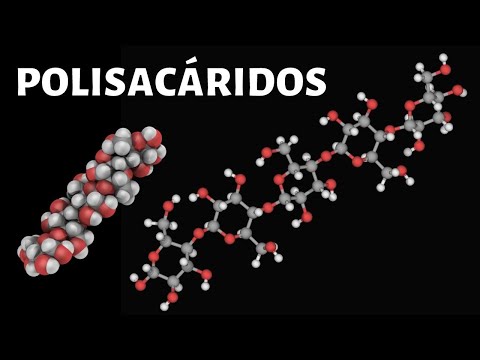
Los POLISACÁRIDOS explicados: estructura, clasificación, ejemplos, características
Polysaccharides: Structure and Function
Overview of Polysaccharides
- Polysaccharides, or glycans, are high molecular weight compounds made of over 10 monosaccharide units linked by glycosidic bonds. They are abundant in nature and serve various functions.
- Found in all living organisms, polysaccharides are crucial for energy storage, cell communication, and structural support.
Characteristics of Polysaccharides
- Composed mainly of carbon, hydrogen, and oxygen; they exhibit high molecular weight and structural diversity.
- Solubility varies among polysaccharides; some dissolve in water while others do not based on their structure.
- Hydrolysis releases individual monosaccharide residues from polysaccharide chains.
Structural Diversity
- Commonly composed of pentose (5-carbon) and hexose (6-carbon) sugars; each sugar can exist in furanose or pyranose forms.
- Glycosidic linkages can be α or β-configured, with potential substitutions on hydroxyl groups affecting structure.
Classification of Polysaccharides
Homopolysaccharides
- Made up of identical sugar units; examples include cellulose (β(1→4)-linked glucose), glycogen, starch, and chitin.
Heteropolysaccharides
- Composed of two or more different types of sugars; examples include hyaluronic acid (glucuronic acid + N-acetyl-D-glucosamine).
Examples and Applications
Cellulose and Chitin
Polysaccharides: Structure and Function
Overview of Invertebrate Animals and Polysaccharides
- The discussion begins with the importance of invertebrate animals, including insects and crustaceans, highlighting their role in ecosystems.
- Homopolysaccharides like glycogen and starch are crucial for both humans and ecosystems as they form structural components at the base of the food chain.
- These polysaccharides serve multiple functions, primarily acting as energy reserves.
Starch vs. Glycogen
- Starch is synthesized in plants while glycogen is produced in animals; both are homopolysaccharides made up of glucose residues linked by different glycosidic bonds.
- The complexity of these molecules arises from their branched structures, which can form compact granules with the assistance of proteins.
- Starch consists of two types of glucose polymers: amylose (linear structure) and amylopectin (branched structure).
Structural Characteristics
- Amylose features α(1→4) bonds linking glucose residues linearly, whereas amylopectin has a branched structure connected to amylose via α(1→6) bonds.
- Glycogen also comprises glucose units linked by α(1→4) bonds but possesses a higher branching frequency compared to starch.
Heparin: A Unique Heteropolysaccharide
- Heparin is introduced as a glycosaminoglycan that contains sulfate groups; it is classified as a heteropolysaccharide composed mainly of glucuronic acid units.
- This compound includes N-glucosamine sulfate units with an additional sulfate group on carbon 6, linked through α(1→4) bonds.