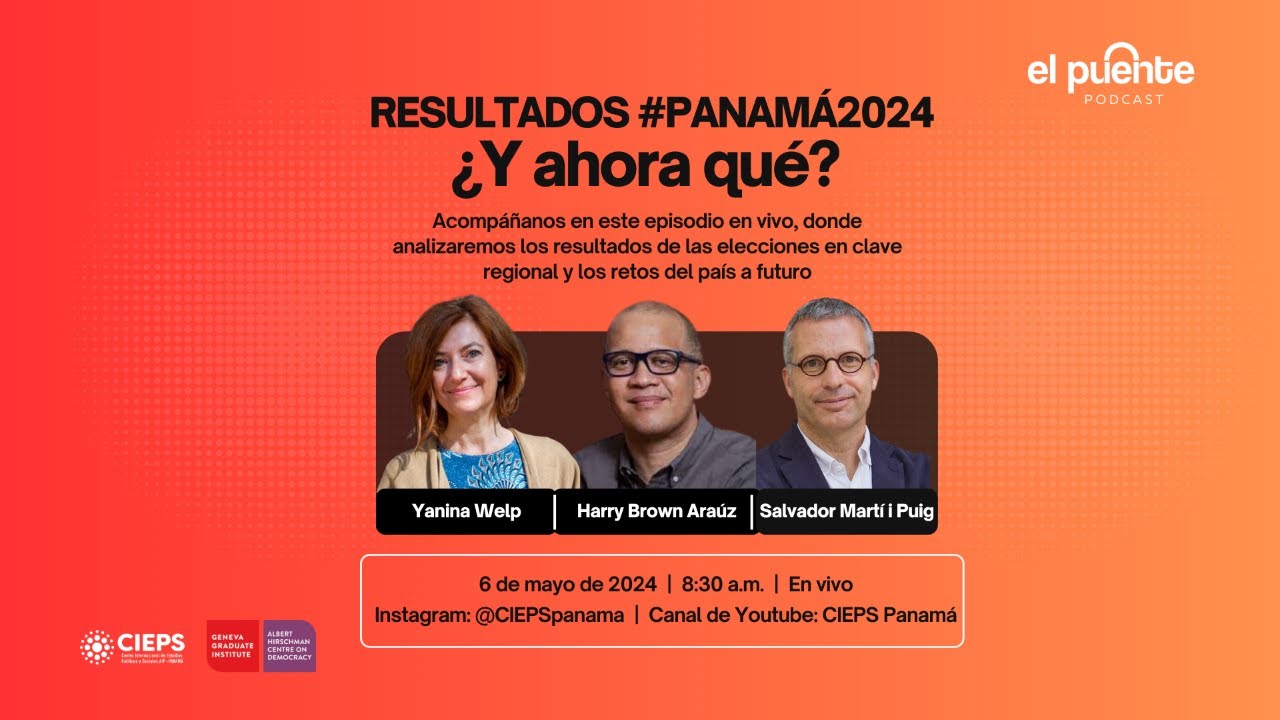
13 | Resultados #Panamá2024, ¿y ahora qué? | El Puente Podcast
Context of Recent Elections in Panama
Overview of the Election Situation
- The recent elections in Panama were marked by unusual events, including the disqualification of the leading candidate and subsequent changes in candidacy.
- A significant wave of protests occurred last year, indicating ongoing civic mobilization and dissatisfaction with governance.
- Despite initial concerns about potential electoral fraud, the elections proceeded without major incidents.
Key Insights from the Election
- Harry Brown emphasizes that elections are a triumph for democracy, especially in countries like Panama where democratic processes are still maturing.
- The election was characterized as free, clean, and competitive despite its atypical nature due to prior disqualifications.
- The high voter turnout (77.63%) is noted as historically significant for Panama and indicative of strong public engagement.
Regional Implications and Future Considerations
Reflections on Central American Democracy
- Salvador Martí discusses the importance of competitive elections in Central America, contrasting them with non-competitive scenarios seen in Nicaragua and El Salvador.
- He highlights that maintaining freedoms such as expression and assembly is crucial for future electoral integrity.
- The need for vigilance against monopolistic tendencies within political regimes is emphasized to ensure continued democratic practices.
Conclusion on Democratic Progress
The Current State of Democracy in Panama
Electoral Process and Governance Challenges
- Discussion on the importance of electoral processes, emphasizing the need for competition and fairness to select effective governments that can implement public policies improving citizens' quality of life.
- Highlighting the connection between governance and public service demands, particularly in health and education, amidst a backdrop of protests in Panama.
Context of Protests and Political Landscape
- Overview of recent protests in Panama, focusing on public demand for better services while noting the election results where a clear winner lacks majority support.
- Reflection on historical protests leading to elections, with emphasis on environmental sustainability as a significant theme during these events.
- Mention of complex issues facing the new government, including pension program challenges that were previously avoided by past administrations due to political capital concerns.
Economic Concerns and Public Sentiment
- Analysis of various intersecting issues such as economic stagnation, job loss from the pandemic, and corruption affecting governance agendas post-protests.
- Insight into José Raúl Mulino's campaign slogan "chenchén para tu bolsillo," which resonates with voters struggling financially; 53% report insufficient funds for daily meals.
Youth Engagement and Legislative Changes
- Noting how Mulino's victory reflects urgent material needs among citizens; critiques regarding his endorsement by former president Martinelli amid corruption allegations.
- Emphasis on youth involvement in politics following protests; many young leaders are now part of legislative assemblies reflecting a shift towards younger representation.
Corruption Allegations Impacting Elections
- Discussion about Martinelli’s disqualification due to money laundering accusations; parallels drawn with other Central American countries experiencing similar electoral fragmentation issues.
Electoral Dynamics in Panama
The Role of the President in Democracy
- Discussion on how the presence of a president can influence democratization or de-democratization processes.
- Examination of the unique political landscape in El Salvador, where a president operates without legislative support and faces judicial vetoes.
Challenges Faced by New Leadership
- Analysis of the current situation in El Salvador, highlighting President Bukele's ability to neutralize opposing powers despite lacking local support.
- Consideration of whether the winning candidate, Simulino, has a clear agenda and if it can be negotiated with existing power structures.
Political Landscape and Citizen Engagement
- Exploration of Panama's party system as crucial for establishing checks and balances within governance.
- Inquiry into how citizen agendas align with executive priorities beyond financial incentives, emphasizing social policy implications.
Key Questions for Future Governance
- A pivotal question regarding the elected president's capacity to manage former President Martinelli’s influence and its implications for governance.
Historical Context and Citizen Mobilization
- Reference to significant mobilizations in Guatemala (2015), leading to elections that did not reflect public sentiment until recently with Bernardo Arévalo's election.
- Emphasis on the slow evolution of electoral offerings in Panama post-mobilizations, indicating potential disconnect between public demands and political representation.
Divergent Citizen Agendas
- Recognition that various citizen agendas exist within Panama’s socio-economic context, often conflicting yet needing articulation within political systems.
Electoral System Limitations
- Insight into how Panama’s electoral system favors major parties while independent candidates struggle against systemic disadvantages.
The Collapse of the Panamanian Party System
Overview of Political Dynamics
- The speaker discusses the significant collapse of the Panamanian party system, which has been in place for 35 years. This collapse is not sudden but creates new dynamics and challenges for Panamanian politics.
Relationship Between Leaders
- A key question arises regarding the relationship between former President Martinelli and newly elected President José Raúl Mulino, particularly concerning how Martinelli's social base will influence Mulino's presidency.
Historical Context from Latin America
- The speaker references historical precedents in Latin America (e.g., Bolivia, Colombia, Ecuador, Honduras) to illustrate potential outcomes of political tutelage where former leaders maintain influence over their successors.
Institutional Challenges
- There is a discussion about the timing of democratic deepening versus privatization in Panama, raising concerns about institutional integrity and potential risks to democracy.
Electoral Rules Discussion
- The conversation shifts to electoral rules, specifically the implications of electing a president with a simple majority in one round. This raises questions about legitimacy and representation when candidates win by large margins yet face significant opposition.
Reflections on Mulino's Victory Speech
Mixed Signals from Leadership
- In his victory speech, Mulino emphasizes human rights and freedom of expression while simultaneously attacking journalists who questioned him. This duality reflects both optimism and skepticism regarding his leadership style.
Familial Influence in Politics
- Observations are made about Mulino’s family presence during his speech, likening it to a monarchy rather than a democratic process. This raises concerns about dynastic politics overshadowing party systems.
Cultural and Elite Influences on Governance
Political Culture Variances
- The speaker highlights differences in political culture across Central America compared to Panama. These cultural distinctions affect how societies interpret politics and engage with governance.
Elite Power Structures
Understanding Panama's Political Landscape
The Complexity of Panama's Elite and Governance
- The speaker discusses the unique challenges faced by Panama in executing national projects, emphasizing that its elite operates on an international level, which should be seen as an asset despite historical complexities.
- There is a belief that social investment and education are crucial for progress, but this requires credible interlocutors and a society with specific demands to facilitate understanding.
Institutional Challenges and Electoral Dynamics
- The discussion highlights the institutional turmoil surrounding recent electoral processes, including disqualifications and pressures on the judiciary, leading to significant political disorder.
- A critical observation is made about the exhaustion of Panama's political system, indicating a need for institutional discussions, particularly regarding electoral reforms like implementing a second round of voting.
- Concerns are raised that the current ruling party may resist discussing electoral reforms due to fears of losing power in a more competitive election scenario.
Social Movements and Political Engagement
- The speaker notes that there is a pressing need for inclusivity in the electoral system to address past issues where participation was forced rather than welcomed.
- Emphasizing transparency, it is noted that the new president must build his own social base while navigating existing tensions within Panamanian society.
Environmental Issues and Elite Responses
- The conversation touches on how different segments of Panama’s elite reacted to environmental protests during elections; some chose silence while others were prepared for repression.
- It is highlighted that Panamanian elites operate differently from their Central American counterparts, with varying levels of awareness regarding socio-political issues affecting governance.
Historical Context and Future Implications
- A warning is issued about potential crises when political systems resist necessary changes. Historical examples from Latin America illustrate how delayed reforms can lead to severe consequences.
Political and Economic Elites: The Need for Transformation
The Role of Political and Economic Elites
- Discussion on the necessity for political and economic elites to adapt to changes that they have previously struggled to address, emphasizing the benefits of embracing a transformative agenda.
Independent Candidates in Electoral Reforms
- Inquiry about the capacity of independent candidates, who acted as a proto-party during the campaign, to influence upcoming electoral reforms.
- Reference to Juan Diego Alvarado's comments regarding how Panamanian parties are perceived as being in crisis while independents attempt to capitalize on opportunities.
Coalition Dynamics Among Independents
- Explanation of "Coalición Vamos," highlighting its function similar to a party despite not being one, raising questions about its potential impact on reforms.
- Emphasis on the ideological landscape in Panama, noting that while independents may lack traditional party structures, they possess strong ideas that could enhance their presence in future electoral processes.
Challenges Facing Independent Candidates
- Analysis of how independent candidates might struggle with forming long-term collective projects akin to traditional parties, potentially limiting their effectiveness in proposing necessary reforms.
- Speculation on whether independents will advocate for transparency and equitable competition but may fall short of establishing sustainable party frameworks.
Potential Transformative Impact vs. Limitations
- Salvador's perspective on whether independent candidacies can be transformative or if their reluctance to form parties could hinder their future actions.
- Acknowledgment that while independents can introduce fresh perspectives, they may also represent specific lobbies rather than broader citizen demands.
The Importance of Political Parties
- Commentary on the operational challenges faced by independent candidates due to a lack of cohesion and loyalty within their ranks, referencing Chile's constitutional assembly as an example.
- Reflection on societal trends favoring immediacy over institutional stability, stressing the need for educational efforts promoting the value of organized political structures like parties.
Conclusion: Navigating Political Complexity
- Final thoughts emphasize that effective governance requires negotiation and compromise—skills often lacking among independent candidates focused solely on individual agendas.
Political Dynamics and Independent Candidates in Central America
The Role of Culture in Politics
- The importance of having a cultural space within political candidacies is emphasized, suggesting that it shapes perspectives on the world.
- A warning is issued against equating politics with media noise, as this could lead to manipulation by external interests.
Limitations of Independent Candidates
- While independent candidates are welcomed, they often have specific limitations based on their interests or ideologies.
- The U.S. administration's support for democratic principles in Central America is highlighted, particularly regarding its influence on local governance.
Impact of U.S. Leadership on Central American Politics
- Speculation arises about how different U.S. administrations (e.g., Trump vs. Biden) will affect the behavior of Central American governments.
- Questions remain about the future political landscape and responses from leaders like Bukele under varying U.S. presidencies.
Security Agenda in Political Discourse
- There’s a noted absence of security issues in recent electoral discussions despite their significance in regional politics.
- Analysts reflect on how past mobilizations have altered Panamanian politics but acknowledge that key issues like inequality and border security were overlooked during campaigns.
Public Perception and Media Influence
- The perception of immigration issues is discussed; many citizens view them as distant problems due to media framing rather than direct experience.
- President-elect José Raúl Mulino's hard stance on border security reflects a broader trend towards addressing safety concerns superficially during elections.
Migration and Security as Political Tools
- Migration and security are identified as pivotal themes used by populist movements across Latin America and Europe, raising concerns about their implications for policy direction.
Fragmentation in Political Representation
Independent Candidates in Panama: A Unique Political Phenomenon
Overview of Independent Candidates
- Lombana is highlighted as the most successful independent candidate in Latin America, indicating a significant trend towards independent political movements in Panama.
- The strength of the independent phenomenon appears to be more pronounced in Panama compared to other countries in the region, suggesting unique socio-political dynamics at play.
Importance of Studying Panama's Political Landscape
- There is a call for academic exploration into Panama's political situation, emphasizing its distinct characteristics and the success of independent candidacies which pose new challenges for traditional politics.
- Research indicates that no candidate is entirely independent; this raises questions about accountability and individualization within Panamanian politics.
Challenges and Opportunities
- The entrenched majoritarian system in Panama has prompted society to seek alternatives through free nominations, particularly among youth who feel marginalized by existing political parties.
- Emphasizing dialogue as essential for revitalizing the social pact established during the canal recovery period, which remains unfulfilled despite its potential for wealth generation.
Governance and Electoral System Issues
- Attention is drawn to the need for political dialogue to address governance weaknesses and enhance participation through independent candidates or free nominations.
- Institutions may have limitations but can also present opportunities; understanding how these can be leveraged is crucial as political systems evolve over time.
Reflections on Recent Political Developments
- The recent peaceful transition amidst uncertainty reflects positively on Panamanian society, though concerns remain regarding future agendas like mining policies and electoral rules that are perceived as outdated.
- Observations from external electoral monitors were generally positive, contrasting with criticisms faced by similar initiatives in other countries. This suggests a learning opportunity for regional practices.
Educational Perspectives on Governance
- There’s an emphasis on improving public investment rather than dismantling existing structures; recognizing functional aspects within health and education sectors is vital.
Panama's Political Landscape and Economic Outlook
Uncertainty in Local Governance
- The political climate remains uncertain as local independent governments may act unpredictably, leading to a chaotic environment.
- Despite recent elections being clean and competitive, the future governance structure is unclear, raising concerns about stability.
Economic Resilience Amidst Challenges
- Panama's economy, while not growing as rapidly as it did a decade ago, remains active and poised to play a significant role in a tense geopolitical landscape.
- Current global conflicts highlight Panama's strategic importance; its ability to form beneficial agreements among elites could be crucial for future stability.
Importance of Democratic Processes
- The successful conduct of free and monitored elections should be celebrated; there is a need for public education on these positive developments.
- Acknowledgment of the work done by organizations like CIEPS (Centro de Estudios Internacionales y Políticos de Panamá), which can help keep key issues on the public agenda.
Reflections on Collaboration and Future Work
- Closing remarks express gratitude for engaging discussions about Panama’s situation, emphasizing the need for continued research and dialogue.
- Announcement of a second season indicates ongoing commitment to exploring Panamanian topics; appreciation is shown towards co-host Yanina Welp for her contributions.
Looking Ahead
Turn any video into a summary like this
YouTube links, meetings, lectures — with transcripts, search, and chat.