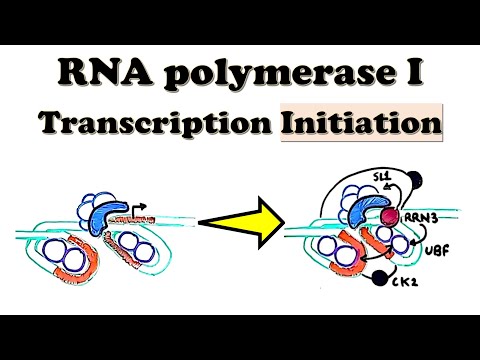
RNA polymerase I Transcription INITIATION - UBF and SL1 function in rRNA transcription
RNA Polymerase I Transcription: Initiation and Key Components
Overview of RNA Polymerase I Transcription
- The focus is on the initiation step of RNA polymerase I transcription, discussing promoters and transcription factors involved in this process.
- RNA polymerase I uniquely transcribes only one gene, the ribosomal RNA gene, which exists in multiple copies across chromosomes; humans have about 400 copies with varying activity levels.
Promoter Structure and Function
- The promoter for RNA polymerase I contains two key elements: the upstream promoter element (UPE) located between positions -100 to -150, and the core promoter from -45 to +20.
- The core promoter overlaps with the transcriptional start site (+1 position), allowing for polycistronic RNA production despite having a single promoter.
Role of Upstream Binding Factor (UBF)
- UBF binds to both UPE and core promoter regions; it enhances transcription rates but is not always essential for all ribosomal RNA genes.
- UBF is a dimeric protein containing HMG box domains that bind DNA and modulate its structure, facilitating chromatin de-condensation around the promoter.
Interaction Between UBF and SL1
- Upon binding, UBF induces topological changes in DNA that allow recruitment of SL1 protein through its binding domain.
- SL1 consists of TBP (TATA-binding protein) and TAFs (TBP-associated factors), which together enhance DNA binding at the A:T rich region near the transcription start site.
Recruitment of RNA Polymerase I
- The complex formed by TBP, UBF, and SL1 enables recruitment of active form RNA polymerase I beta (I β), primarily dependent on RRN3 protein's interaction with UBF and SL1.