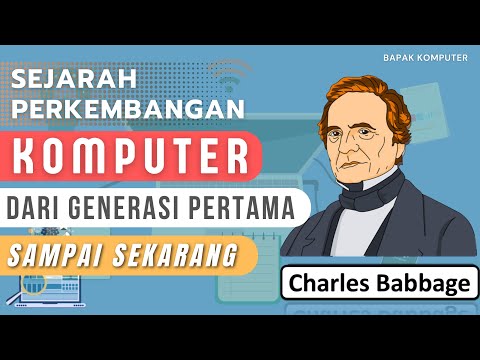
Sejarah Perkembangan Komputer
History of Computers
Introduction to Computer History
- The modern era heavily relies on computers, which have evolved from mere tools to essential societal needs.
- The video aims to provide a brief overview of the history and development of computers.
Early Innovations in Computing
- Charles Babbage created the first computing device in 1822, known as the "analytical machine," which was designed for mathematical calculations.
- Babbage is recognized as the "Father of Computers" due to his contributions that significantly aided computational tasks.
Generations of Computers
First Generation (1937 - 1946)
- The first generation began with computers used in academia and military applications, such as the ENIAC, which was the first general-purpose computer.
- Early computers utilized vacuum tubes for data storage and were large enough to occupy entire rooms.
Second Generation (1951 - 1964)
- Transistors replaced vacuum tubes during this generation; UNIVAC was introduced for commercial use in 1951.
- IBM launched its computer business with models like IBM 650 and IBM 700, leading to advancements in programming languages and operating systems.
Third Generation (1964 - 1971)
- This era saw improvements in transistor technology leading to integrated circuits; mini-computers emerged significantly impacting future generations.
- NASA utilized third-generation computers for its Apollo program, showcasing their advanced capabilities.
Fourth Generation (1970 - Present)
- The discovery of MOSFET technology led to microprocessor development; personal computers became smaller and more accessible.
- Mobile technologies like laptops and smartphones emerged, sparking intense competition among tech companies over patents.
Fifth Generation (Present and Beyond)
- Continuous advancements are noted with touch screen technology becoming prevalent on devices including smartphones and smartwatches.