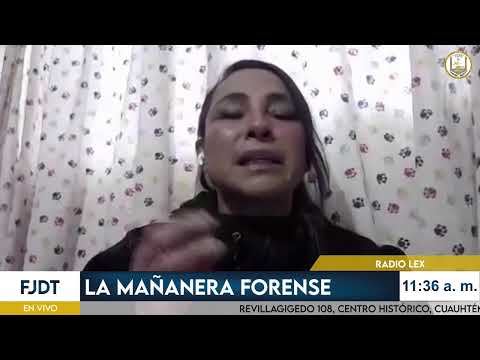
La mañanera forense| " Los criminales nacen o se hacen"| 20 de marzo del 2026
Introduction to the Program
Overview of Responsibility
- The program is produced by the Faculty of Judicial Tax Law, AFJDT Radio Lex, and they do not take responsibility for the content shared during broadcasts. Each guest and host is accountable for their statements.
Forensic Morning Report Launch
Program Initiation
- The hosts activate the investigative protocol, introducing "Forensic Morning," a report where law and science intersect without filters or assumptions, focusing solely on evidence. They greet listeners in Mexico City.
Guest Introduction
Welcoming Esmeralda Rodríguez Aparicio
- The hosts express gratitude towards the faculty and technical team while welcoming their guest, Maestra Esmeralda Rodríguez Aparicio, who will discuss whether criminals are born or made. They invite her to share her background.
Guest's Background
Educational Credentials
- Maestra Esmeralda Rodríguez introduces herself as a licensed criminalist with degrees in law and forensic sciences, along with specializations in criminal investigation and various diplomas related to forensic fields such as ballistics and lie detection.
Social Media Presence
Engagement on TikTok
- She mentions her presence on TikTok under "descodificación forense," aiming to provide scientific data to combat misinformation about forensic topics. A YouTube channel is planned but currently on hold due to work commitments.
Discussion Topic: Nature vs Nurture in Criminality
Exploring Criminal Behavior Origins
- The discussion begins with the question of whether criminals are born or made, highlighting that genetic information plays a role but emphasizes that criminality is multifactorial rather than determined by a single factor. Studies indicate this complexity exists within societal contexts influenced by social media dynamics.
Impact of Social Media on Perceptions of Violence
Memetics and Behavioral Influence
- Maestra Esmeralda discusses how social media has normalized violence and romanticized it while also leading to victim-blaming behaviors; these trends have significant social consequences that affect public opinion regarding crime origins. She plans to address memetics as part of this discourse.
Scientific vs Social Opinions
Differentiating Perspectives
- There’s a divide between scientifically grounded opinions about criminal behavior versus socially driven narratives often lacking academic rigor; she critiques discussions that lack scientific foundation while emphasizing the need for informed debate based on criminological principles rather than anecdotal evidence from influencers or popular figures online.
Understanding the Influence of Memetics on Criminal Behavior
The Role of Childhood Trauma in Criminality
- Discussion begins on how childhood experiences, such as lack of parental support or homelessness, influence violent behavior.
- Questions raised about motivations behind violent acts, including murder and kidnapping, emphasizing the need to understand these actions beyond mere sympathy for past suffering.
Evolution of Criminological Theories
- Reference to Cesare Lombroso's theory that criminals are born with certain physical traits; this view is now considered outdated.
- Introduction of Enrico Ferri’s perspective that socio-economic factors contribute significantly to criminal behavior, challenging the notion that individuals are inherently criminal.
Socioeconomic Factors and Crime
- Debate arises regarding whether wealth and political status exempt individuals from being labeled as criminals; acknowledgment of white-collar crime.
- Mention of labeling theory in criminology, which examines how societal labels can affect an individual's identity and behavior.
Transition to Synthetic Criminology
- Introduction to modern criminologists like Luis Rodríguez Manzanera and Alfredo Velasco who advocate for a multifactorial approach to understanding crime.
- Emphasis on human capacity for moral discernment despite adverse circumstances; discussion on empathy towards those with traumatic backgrounds.
Memetics: A New Perspective on Behavioral Patterns
- Explanation of Richard Dawkins' concept of memetics introduced in 1970, focusing on how behaviors can be learned and altered through social interactions.
- Example provided illustrating how recipes (or behaviors) evolve as they are shared among people, highlighting the dynamic nature of cultural transmission.
Memetics and Criminal Behavior
Understanding Memetics in Social Context
- The concept of memetics is introduced as a learned behavior that evolves over time, particularly in social networks.
- Memes can influence individuals' perceptions of status and power, leading them to replicate behaviors associated with criminality if they perceive benefits such as economic gain.
- Everyday memes on social media often reflect emotional states, which can be humorous or relatable, demonstrating how these ideas spread within communities.
Family Influence on Criminal Behavior
- The Differential Association Theory by Sutherland emphasizes the role of intimate environments like family in shaping behavior.
- A family's normalization of criminal acts (e.g., theft or intimidation) can predispose children to adopt similar behaviors, illustrating the concept of criminogenesis.
- The idea of the "selfish gene," as proposed by Dawkins, relates to social behaviors being replicated within familial contexts.
Genetic Predisposition and Environmental Factors
- Discussion shifts to the MAOA gene theory, linking genetic predispositions with environmental influences such as childhood abuse or neglect.
- Ethical considerations arise when discussing moral development; understanding one's family background is crucial for addressing potential antisocial tendencies.
Impact of Childhood Trauma on Behavior
- Children exposed to maltreatment may carry genetic markers that increase their likelihood of developing antisocial behavior later in life due to biochemical changes in brain function.
- Notable cases illustrate how damage to areas like the prefrontal cortex correlates with violent behavior patterns seen in serial offenders.
Misconceptions about Genetic Determinism
- While genetic predisposition exists, it does not equate to a predetermined fate; environmental factors play a significant role in behavioral outcomes.
- Emphasis is placed on understanding predispositions rather than labeling individuals based solely on genetics; this perspective encourages nuanced discussions around responsibility and rehabilitation.
Understanding Genetic Predisposition and Resilience
The Role of Genetics and Environment in Behavior
- The discussion begins with the acknowledgment of genetic predisposition influencing behavior, but emphasizes that other factors contribute to resilience, which helps individuals choose between good and bad paths.
- It is noted that humans possess an innate ability to discern right from wrong, illustrated by a baby's reaction to different emotional cues—recognizing anger versus kindness without formal teaching.
- The conversation shifts to the impact of genetics on brain function, particularly mentioning damage in areas like the amygdala that regulate emotions, highlighting how substances like alcohol can exacerbate these issues.
Multifactorial Influences on Criminal Behavior
- The speaker discusses the complexity of criminogenesis, referencing the MAOA gene as a biological factor contributing to predispositions for certain behaviors due to imbalances in neurotransmitters like serotonin and dopamine.
- While acknowledging triggers (or "detonantes") are necessary for behavioral outcomes, it is stressed that experiencing childhood trauma does not automatically label someone as a criminal; context matters significantly.
Parenting Styles and Their Impact on Development
- A critical perspective is offered regarding parenting styles that excessively shield children from frustration. This lack of exposure may lead to difficulties in coping with life's challenges later on.
- The importance of teaching children about effort and tolerance for frustration is emphasized. Without these lessons, children may develop maladaptive behaviors or criminal tendencies due to an inability to navigate societal expectations effectively.
Neurodevelopmental Considerations
- There’s a focus on neurostimulation's role in development. Insufficient stimulation can hinder children's ability to manage frustration and make rational choices, potentially leading them down problematic paths.
- The discussion touches upon memetics—the idea that behaviors can become repetitive patterns influenced by both genetic predispositions and learned experiences over time.
Modern Parenting Challenges
- A participant raises concerns about modern parenting trends where parents compensate for their own childhood lacks by overindulging their children. This could lead to entitlement rather than resilience.
- Observations are made about contemporary children's access to excessive material goods, questioning whether this abundance fosters healthy development or contributes negatively by failing to teach appreciation or effort.
Understanding Antisocial Behavior and Its Implications
The Importance of Teaching Values
- Discusses the lack of parental guidance in teaching children to return items that do not belong to them, highlighting a missed opportunity for instilling values.
- Emphasizes the need for setting boundaries with children to prevent normalizing antisocial behaviors, which can lead to larger issues.
Distinguishing Between Types of Antisocial Conduct
- Defines antisocial conduct as actions that violate social norms, using the example of taking someone else's eraser.
- Clarifies the difference between antisocial behavior (actions) and asocial traits (lack of desire to socialize), correcting common misconceptions about these terms.
Understanding Antisocial Traits and Disorders
- Describes antisocial traits as behaviors that consistently break societal rules, indicating a failure to adapt socially.
- Explains that when discussing disorders, it refers to severe actions causing sociological damage, such as criminal activities affecting families and communities.
Misconceptions About Psychopathy
- Addresses public misunderstanding regarding psychopathy, noting it is not classified separately in DSM5 but rather under antisocial personality disorder.
- Critiques the casual use of "psychopath" in society without understanding its clinical implications.
Reintegration into Society: A Complex Issue
- Supports the idea of social reintegration for offenders while stressing the importance of understanding criminological foundations behind their behavior.
- Introduces PCLR (Psychopathy Checklist-Revised), explaining how it assesses an individual's potential for reintegration based on adaptive versus maladaptive traits.
The Role of Social Media in Shaping Perceptions
- Highlights how individuals may feign remorse or manipulate public perception through media interactions, particularly those with dark triad traits like narcissism and psychopathy.
- Questions the impact of misinformation spread via social media on public understanding of psychological concepts related to crime and behavior.
Understanding the Impact of Misinformation in Social Media
The Tradition of Easy Information Access
- People have learned to seek easy answers, often relying on social media for information rather than conducting thorough research.
- This reliance on convenience has become a tradition passed down through generations, leading to a lack of critical thinking about the information consumed.
Consequences of Believing Misinformation
- There is a growing concern that individuals are accepting false information from social media without verification, which can lead to widespread misconceptions.
- The tendency to believe everything seen online is alarming and reflects a deeper issue within educational environments where critical analysis is lacking.
The Role of Memetics in Information Spread
- Misinformation spreads like a meme; as people share incorrect content (like memes with spelling errors), it mutates and becomes more distorted over time.
- This phenomenon can be observed in various contexts, including academic discussions where misinformation about criminology and criminalistics proliferates through viral videos.
The Dangers of Influencer Culture
- Some influencers provide misleading information regarding serious topics such as criminology, which can misinform their audience significantly.
- Misleading statements about crime and criminal behavior contribute to societal misunderstandings and perpetuate harmful stereotypes.
Accessibility vs. Practicality in Information Seeking
- While access to legal texts and resources has improved dramatically (e.g., downloadable codes), many still prefer quick fixes via social media instead of engaging with substantive material.
- People often choose attractive or entertaining sources over credible ones, reinforcing their biases rather than seeking factual knowledge.
Cultural Commentary on Knowledge Sharing
- Comedian Franco Escamilla highlights how everyone feels entitled to express opinions on complex subjects like law or medicine without proper understanding, contributing to misinformation spread.
- This cultural shift towards uninformed opinion-sharing exemplifies the challenges faced in combating misinformation today, particularly regarding sensitive topics like narcocorridos and their implications in society.
Memetics and the Influence of Music on Behavior
The Role of Music in Shaping Lifestyle Perceptions
- The lyrics of certain songs glorify figures from organized crime, leading to their replication in popular culture as people begin to sing, listen, and share these songs.
- This phenomenon can influence young individuals who may have never encountered violence or weapons, causing them to adopt behaviors and styles depicted in the music.
Understanding Criminal Behavior
- Listening to narco-corridos does not automatically make someone a criminal; it may lead to learned behaviors but does not guarantee criminality.
- Multiple social, familial, and environmental factors contribute to an individual's likelihood of engaging in criminal behavior.
Multifactorial Nature of Crime
- The speaker emphasizes that individuals do not simply "born" or "made" into criminals; rather, there are multifactorial influences at play.
- Different types of criminals exist (e.g., serial killers vs. those acting in self-defense), highlighting the complexity behind motivations for crime.
Genetic and Psychological Predispositions
- Criminology recognizes genetic predispositions alongside psychological factors such as childhood trauma that can influence behavior.
- Environmental contexts like family dynamics and neighborhood influences also play significant roles in shaping an individual’s path toward crime.
Individual Outcomes Despite Similar Backgrounds
- Not all individuals exposed to violence or negative environments become criminals; personal choices and rationality can lead different siblings raised under similar conditions down divergent paths (e.g., one becoming a police officer while another becomes a criminal).
- The discussion highlights how two siblings from the same background can end up with vastly different life outcomes based on various internal and external factors.
Understanding Criminal Behavior and Its Psychological Roots
The Role of Forensic Sciences in Understanding Criminal Behavior
- The discussion begins with the importance of forensic sciences in analyzing criminal behavior, highlighting its relevance to understanding underlying psychological factors.
- Reference is made to Sigmund Freud's psychosexual stages, emphasizing how improper development during these stages can lead to problematic adult behaviors.
Impact of Psychosexual Stages on Personality Development
- The conversation explores how negative experiences during the anal stage can instill harmful behavioral patterns that manifest later in life.
- The oral stage is identified as crucial for establishing human connections; neglecting this stage may hinder emotional bonding and social interactions.
Consequences of Romanticizing Criminal Figures
- A critical view is presented on society's tendency to empathize with criminals, suggesting that while they may have suffered, it does not justify their actions.
- Reintegration into society is acknowledged as necessary but should occur within a controlled environment where individuals cannot harm others.
Normalization of Violence in Society
- There’s concern over the normalization of violence through media exposure, leading to desensitization and victim-blaming attitudes among the public.
- An example illustrates how societal reactions often place blame on victims rather than addressing the root causes of violent behavior.
Structural Issues in Rehabilitation Systems
- The speaker argues against justifying criminal behavior based on personal history, asserting that criminology should focus on accountability rather than excuses.
- Insights are shared regarding systemic failures within penitentiary systems that hinder effective rehabilitation efforts for offenders.
Need for Reform in Penitentiary Systems
- Emphasis is placed on the necessity for significant reforms within prison systems to facilitate genuine reintegration into society.
- Concerns are raised about repeat offenders being released without adequate assessment or support structures, leading to recidivism.
Discussion on Crime and Reintegration
The Normalization of Criminality
- The speaker discusses the troubling normalization of crime in society, emphasizing the need for reintegration to reduce crime rates.
- There is a lamentation over how empathy is being generated towards criminals, while victims are often blamed or victimized further.
Multifactorial Nature of Criminal Behavior
- Acknowledgment that criminal behavior arises from multiple factors rather than being solely inherent or learned.
- Reference to historical criminological theories, particularly those by Lombroso, which have been largely discredited but still influence discussions about criminal predispositions.
Importance of Terminology in Reintegration
- Discussion on the correct terminology regarding reintegration and rehabilitation, highlighting the importance of using precise language to avoid conflating terms.
Neurociences in Modern Judicial Systems
- Inquiry into how modern judicial systems utilize neuroscience to exonerate defendants, referencing international cases as examples.
Gender Perspectives in Crime
- The conversation shifts to gender issues within criminality, addressing societal reactions when women commit crimes and the misogynistic attitudes that surface.
- Emphasis on equity versus equality in gender discussions; advocating for respect across genders while recognizing biological differences.
Female Criminality and Societal Perceptions
- Exploration of female criminality and societal expectations surrounding women’s roles as nurturing figures versus their capacity for delinquency.
- Mention of feminist perspectives on crime, clarifying that feminism does not defend criminals but seeks to address violence against women and advocate for their rights.
Marchas y la Realidad de las Emociones
La Experiencia en Marchas
- La percepción de las marchas a menudo se reduce a imágenes meméticas, pero asistir a una marcha real provoca emociones profundas que no pueden ser capturadas por estas representaciones superficiales.
- Las pancartas de niños buscando a sus padres o denunciando agresiones son desgarradoras y reflejan la gravedad de los problemas sociales que se abordan en estas manifestaciones.
Contexto y Comprensión
- Es crucial entender el contexto detrás de lo que se juzga; no se debe basar el juicio en noticias sensacionalistas o memes, sino en experiencias reales y testimonios.
- En las marchas, hay un espacio para compartir historias personales y ver diversas expresiones artísticas, lo cual humaniza la lucha social.
Inclusión de Todas las Víctimas
- Las marchas también abogan por hombres y niños desaparecidos, destacando que la lucha por justicia no es exclusiva de un género.
- Se reconoce que las mujeres pueden ser delincuentes, pero esto no debe desvirtuar la lucha por los derechos humanos ni justificar actos delictivos.
Reflexión Personal y Cambio Social
- El cambio comienza con uno mismo; pequeñas acciones cotidianas pueden contribuir a modificar estructuras sociales más amplias.
- La discusión sobre el sistema penitenciario revela diferencias significativas en cómo se trata a los delincuentes según su género o situación social.
Justificación del Injustificable
- Existe una tendencia cultural a justificar comportamientos criminales; esto distorsiona la realidad donde víctimas y victimarios cambian roles según conveniencia social.
- Un caso reciente ilustra cómo los medios manipulan narrativas para favorecer al victimario, mostrando una falta de empatía hacia las verdaderas víctimas.
Estudios Psicosociales y Percepción Pública
- Los estudios psicosociales revelan sesgos en cómo se perciben figuras públicas; muchos simpatizan con criminales sin comprender completamente su historia o impacto negativo.
- Comentarios ignorantes sobre figuras controversiales demuestran una desconexión entre hechos reales y percepciones populares, resaltando la necesidad de educación crítica.
Empatía Hacia las Víctimas
- Hay un peligro al romantizar situaciones trágicas sin reconocer el sufrimiento real detrás de ellas; es vital mantener un enfoque equilibrado entre empatía e indignación ante injusticias.
- Casos como el mencionado reflejan cómo algunos criminales son vistos bajo una luz favorable debido a su estatus social, lo cual complica aún más la búsqueda de justicia.
Discussion on Criminal Behavior and Mental Health
Examination of Allegations and Evidence
- The speaker discusses the existence of serious allegations, such as pedophilia, but emphasizes a lack of concrete evidence to support these claims.
- Expresses a desire to investigate further into past cases related to these allegations, suggesting that there may be more information available for research or even publication.
- Highlights the importance of formal complaints in initiating investigations, contrasting casual discussions with actionable legal processes.
Importance of Research and Critical Thinking
- Encourages listeners to conduct their own research rather than solely relying on presented information, advocating for informed debate based on facts rather than cognitive biases.
- Discusses the deterioration of laws and societal understanding regarding mental health issues, particularly in relation to criminal behavior.
Understanding Schizophrenia Types
- Differentiates between paranoid schizophrenia (biologically driven) and affective schizophrenia (substance-induced), noting public misconceptions about these conditions.
- References a specific case involving an individual who committed violence against family members while exhibiting symptoms associated with affective schizophrenia.
Substance Abuse and Mental Health Treatment
- Critiques current rehabilitation centers for not adequately managing withdrawal symptoms in patients with substance abuse issues.
- Discusses protocols for admitting individuals under the influence into psychiatric care, emphasizing the need for medical stabilization before treatment can begin.
Legal Implications of Mental Health Disorders
- Explores potential legal debates surrounding cases where mental health disorders are influenced by substance use, questioning how this affects culpability in criminal acts.
- Introduces concepts like "formication," which can lead to severe delusions and violent behavior due to substance-induced schizophrenia.
Call for Expert Opinions
- Invites legal experts to weigh in on differences between types of schizophrenia concerning legal responsibility and implications within the justice system.
- Suggestion made to involve forensic psychiatry professionals in discussions about mental health's role in criminality, highlighting ongoing learning opportunities within this field.
Discussion on Feminism and Legal Issues
Closing Thoughts on Multifactorial Issues
- The conversation wraps up with a recognition that issues discussed are multifactorial, emphasizing the complexity of topics like feminism and legal rights.
Invitation for Further Discussion
- A participant expresses interest in inviting another expert to continue discussions, particularly regarding the impact of social media on perceptions of laws like Ley Valeria.
Ley Valeria and Social Media Impact
- The discussion highlights how Ley Valeria has gained attention due to its implications for stalking laws in Mexico, reflecting societal reactions and misunderstandings surrounding these legal changes.
Gender Dynamics in Communication
- There is an exploration of how men communicate boundaries to women, raising questions about healthy versus harmful interactions within various contexts. This leads to a broader discussion about femininity and feminism.
Perspectives from Various Disciplines
- A suggestion is made to include professionals from different fields (lawyers, psychologists, sociologists) to analyze the implications of new laws from multiple perspectives, enhancing understanding through interdisciplinary dialogue.
Criminality and Women's Rights
Balancing Rights and Responsibilities
- The speaker reflects on the tension between advocating for women's rights while ensuring that these do not infringe upon others' rights, especially as a mother of sons concerned about fairness.
Misunderstandings Around Feminism
- There's acknowledgment that feminism can be misunderstood; it’s noted that discussions around criminality among women often provoke strong reactions but should not negate the existence of such issues.
Legal System Concerns
- The effectiveness of the penal system is debated; while it functions well theoretically, concerns arise regarding its application by current judges and potential biases affecting outcomes.
Victimology and Misuse of Laws
Public Perception vs. Legal Reality
- Participants discuss how public perception can distort understanding of laws designed for protection; some individuals may exploit these laws for personal gain or manipulation rather than genuine victimization.
Victimhood in Context
- Reference is made to Mendelson's victimology theory which categorizes victims based on their legitimacy; this raises concerns about false claims undermining real victims' experiences within legal frameworks.
Need for Comprehensive Understanding
- Emphasis is placed on needing thorough knowledge about new legislation like Ley Valeria before forming opinions or making judgments about its implications or effectiveness in protecting individuals’ rights.
This structured summary captures key insights from the transcript while providing timestamps for easy reference back to specific parts of the discussion.
Discussion on Legal Structures and Social Media
Importance of Well-Defined Laws
- The speaker emphasizes the necessity for well-structured laws to prevent misuse by individuals posing as victims, highlighting the potential for false claims in legal contexts.
Addressing Systemic Issues
- There is a call for reform within existing structures, particularly in the penal system and criminology, indicating that without proper frameworks, systemic failures will persist.
Future Engagements and Acknowledgments
- The discussion wraps up with an acknowledgment of time constraints during the session, suggesting a need for better time management in future discussions.
Scheduling Follow-Up Discussions
- The speaker proposes scheduling another meeting within eight days to continue discussions, emphasizing the importance of ongoing dialogue.
Gratitude and Closing Remarks
- Final thanks are given to participants and technical staff involved in the session, along with compliments directed towards a guest speaker, reinforcing community engagement.