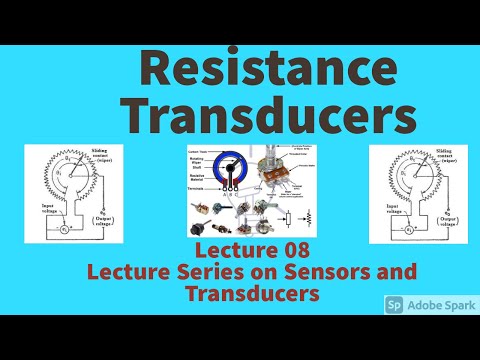
Resistance Transduces|Types|Construction|Working|Pros & Cons|Types of Errors|Resistive Transducers
Introduction to Resistive Transducers
Overview of Resistive Transducers
- The video introduces the topic of resistive transducers, inviting viewers to access a previous video for foundational knowledge.
- A resistive transducer is defined as a device whose resistance changes due to environmental factors like temperature and pressure.
- These transducers convert non-electrical quantities (e.g., temperature, pressure) into electrical signals represented by resistance.
Applications and Measurement Principles
- Resistive transducers are utilized for measuring various mechanical quantities such as temperature, pressure, displacement, and vibration.
- The principle behind these devices involves measuring changes in resistance to determine translational (linear) and rotary displacements.
Types of Resistive Transducers
Classification of Resistive Transducers
- There are two main types of resistive transducers: linear motion potentiometers and rotary motion potentiometers.
Working Principle
- The working principle is based on the formula R = rho l/A , where:
- R : Resistance,
- rho : Specific resistance (ohm-meter),
- l : Length of the conductor (meters),
- A : Area of cross-section (square meters).
Influence on Performance
- Resistance depends directly on length and inversely on the area of cross-section, affecting the performance and functionality of resistive transducers.
Linear Motion Potentiometer
Functionality
- Linear motion potentiometers measure non-electrical quantities like displacement or velocity through a slider connected to a moving object.
Mechanism
- The resistive element is connected to a constant voltage supply; as the slider moves linearly with respect to this element, it generates an output voltage that varies with position.
Output Voltage Variation
- Changes in resistance due to slider movement lead to variations in output voltage, functioning effectively as a voltage divider.
Rotary Motion Potentiometer
Measuring Circular Motion
- Rotary motion potentiometers are designed for measuring circular motions. They feature sliders arranged in circular configurations.
Operational Details
- Similar to linear potentiometers, they also connect a moving object directly to the slider which rotates during operation.
Output Generation
Understanding Resistive Transducers
Overview of Resistive Transducers
- The operation of a resistive transducer is based on the principle that changing resistance correlates with variations in input voltage, which can be measured as the slider changes.
- As a moving body performs circular motion, the output voltage varies according to its motion due to changes in resistance within the transducer.
Types of Potentiometers
- Linear and rotary motion potentiometers convert mechanical motion into electrical signals by varying resistance; linear types typically operate between 0 to 60 degrees.
- Rotary potentiometers also vary from 0 to 60 degrees, indicating both the amount and direction of movement through changes in resistance.
Measurement Capabilities
- Resistive transducers can measure various physical quantities including pressure, force, acceleration, linear velocity, angular velocity, and even liquid levels.
- Common specifications include power ratings up to 5 watts and temperature tolerances around 21°C with resistance values ranging from 10 ohms to 10 kilo ohms.
Advantages and Disadvantages
- Advantages:
- They provide a wide range of outputs and are cost-effective while being simple to operate.
- High electrical efficiency and robust construction contribute to their appeal.
- Disadvantages:
- Limited lifespan due to wear from moving parts leads to noise in output signals.
- Scale errors arise from non-uniformity leading to accuracy issues; dynamic errors occur when actual values differ over time.
Applications of Resistance Transducers
- Common applications include potentiometers, strain gauges, resistance thermometers (RTDs), thermistors, among others used for measuring temperature variations or other physical phenomena.
Conclusion on Resistive Transducers
- The session concludes with an overview emphasizing that resistive transducers convert physical phenomena like temperature or pressure into measurable electrical signals based on the equation R = rho l/A .
Overview of Resistance Transducers
Introduction to Resistance Transducers
- The speaker introduces different types of transducers, providing specifications and details about their functionalities.
- A discussion follows on the pros and cons of resistance transducers, highlighting their advantages and limitations in various applications.
Errors in System Transducers
- The speaker lists several errors that can occur within system transducers, emphasizing the importance of understanding these issues for effective application.
Applications of Resistance Transducers
- An overview is provided regarding the applications of resistance transducers, setting the stage for a deeper exploration in subsequent sessions.
Major Applications: Thermistors and RTDs
Focus on Thermistor Applications
- The upcoming session will delve into one major application: thermistors, which are specific types of resistive transducers used for temperature measurement.
Discussion on RTD (Resistance Temperature Detector)
- Following the discussion on thermistors, there will be an exploration of RTDs (Resistance Temperature Detectors), another critical application area for resistance transducers.
Invitation for Queries