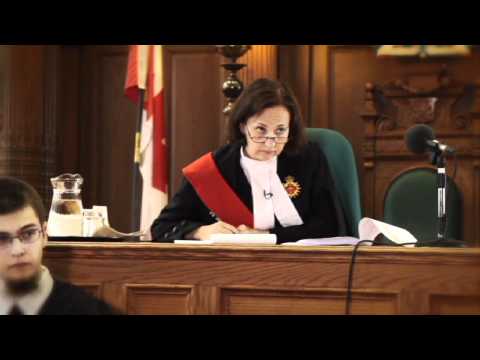
Mock Trial Step-by-Step: Direct Examination
Direct Examination and Witness Testimony
This section focuses on direct examination, where lawyers ask questions to witnesses they call to testify. The goal is to allow the witness to tell their story and provide information through open-ended questions.
Direct Examination Process
- During direct examination, lawyers aim to ask open-ended questions that begin with who, what, where, when, and why.
- The witness is given the opportunity to be the main source of information during direct examination.
Introduction and Witness Identification
- Mr. Buozis introduces himself as the lawyer conducting the direct examination of Constable Rachel DiCarlo.
- Constable DiCarlo states her name and current profession as a member of the Toronto Police Service.
- She confirms being stationed at 13 Division near Eglinton Avenue in Toronto.
Police Notes and Memory Refreshment
- Constable DiCarlo brings her police notes written at the time of the event.
- She confirms that the notes are in her own handwriting using pen.
- No additions, deletions, or corrections were made to the notes.
- Constable DiCarlo states that she has an independent recollection of events but needs her notes to refresh her memory.
Investigation Details
- Constable DiCarlo recalls being called down to inspect an assault and robbery near Eglinton Avenue around 7 PM on March 10th, 2010.
- She describes the crime scene's surroundings with a lamppost facing down and ample lighting from surrounding buildings in the alleyway.
- On March 11th, she visited Anver Williams at the hospital for a full report on his injuries sustained during the incident.
- On April 9th, she received a call from Tomorrow Secondary School regarding rumors of Donovan Tisi assaulting and robbing a younger student.
- An objection is raised regarding hearsay evidence, but it is admitted as part of the narrative to explain the officer's actions without considering its truthfulness.
Photo Lineup and Evidence Collection
- Constable DiCarlo constructed a photo lineup with six individuals who had similar characteristics to Donovan Tisi.
- Anver Williams recognized Donovan Tisi in the photo lineup as his first choice.
- On April 10th, 2010, Constable DiCarlo visited Donovan Tisi's apartment building and found a pair of basketball shoes matching the description of those stolen from Anver Williams.
Conclusion
The direct examination provided insights into the witness's role, investigation process, and evidence collection. The testimony supports the case against Donovan Tisi for assault and robbery.
Case Summary
- Through direct examination, Constable DiCarlo established her identity, profession, and involvement in investigating an assault and robbery case.
- She presented her police notes written at the time of the event and confirmed their accuracy without any alterations.
- The witness testified about visiting the crime scene, interviewing the victim at the hospital, receiving information from school authorities about rumors involving Donovan Tisi, conducting a photo lineup identification by Anver Williams, and finding stolen basketball shoes near Donovan Tisi's apartment building.
This summary provides an overview of key points discussed during direct examination.
New Section Witness Testimony
The witness identifies a pair of basketball shoes as the stolen goods and they are entered as evidence.
Identification of Stolen Goods
- The witness is shown a pair of basketball shoes.
- The witness confirms that these are the basketball shoes obtained during the arrest.
- The shoes are identified as the stolen goods by the witness.
- The prosecution requests to enter the shoes as an exhibit.
- No objections are raised, and the shoes are entered as evidence.
Arrest and Handling of Evidence
- After entering the apartment complex, the witness arrested Donovan Tisi for assault causing bodily harm and robbery.
- As they were leaving, the witness picked up the basketball shoes and placed them in a sealed evidence bag.
- The bag was then stored in their locker until it was brought to court as evidence.
Timestamps were not provided for this section.