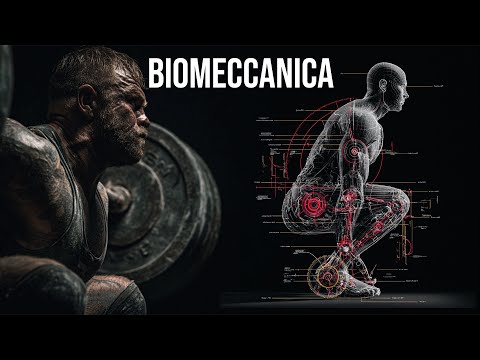
Che cos’è la biomeccanica e perché è la scienza più importante per l'allenamento
What is Biomechanics and Why Does It Matter?
Introduction to Biomechanics
- The speaker discusses the overuse of the term "biomechanics" by many individuals, often without a scientific basis.
- The speaker claims to have been studying biomechanics long before it became popular and invites viewers to check their previous content for proof.
- They emphasize the importance of understanding biomechanics rigorously, outlining its definition as physics applied to biological systems, particularly the human body.
Understanding Biomechanics
- Biomechanics is defined as a sub-discipline of kinesiology that analyzes and optimizes human movement using principles from mechanics, anatomy, and physiology.
- The language of biomechanics is based on three main aspects: physics (accelerations, forces), mechanics (statics, dynamics), and anatomy (musculoskeletal structures).
Who Can Discuss Biomechanics?
- Many trainers misuse the term "biomechanics" without proper understanding; serious knowledge requires a foundation in physics and functional anatomy.
- To discuss biomechanics effectively, one must understand rational mechanics—how bodies move based on fundamental principles like Newton's laws.
Importance of Education in Biomechanics
- Rational mechanics serves as the grammar of movement; without it, biomechanical analysis may devolve into subjective observations rather than objective understanding.
- A structured academic background in engineering or applied biomechanics is essential for accurate analysis.
Key Areas in Biomechanics
- Functional anatomy knowledge is crucial but more accessible than advanced physics concepts; however, it still requires significant study time.
- Serious commitment to learning about biomechanics involves extensive study over months or years rather than just hours.
The Two Main Branches of Biomechanics
Kinematics vs. Dynamics
- Biomechanics divides into two branches: kinematics (what happens during movement) and dynamics (why movements occur).
- Kinematics focuses on describing motion through position, velocity, acceleration, trajectories, and joint angles during activities like squats.
Understanding Forces in Movement
- Dynamics examines forces that cause or alter movement—gravity effects, frictional forces, muscular forces—and how they interact with external factors.
Understanding Biomechanics: Static vs. Dynamic
Distinction Between Static and Dynamic Systems
- The concept of biomechanics is introduced through the distinction between static (equilibrium, no movement) and dynamic systems (involving acceleration and changes in direction).
- Examples of dynamic movements include sprinting, jumping, changing direction, or executing kicks in martial arts; these involve varying speeds and forces.
- In powerlifting, the bench press is considered more static due to its controlled trajectory compared to a beginner's deadlift which exemplifies unstable dynamics.
Qualitative vs. Quantitative Analysis
- Qualitative analysis involves visual observation by coaches and athletes based on experience and understanding of mechanical laws; it can identify issues like improper squat form.
- Effective qualitative analysis requires knowledge of physics, mechanics, and anatomy; without this foundation, observations may be misleading or incorrect.
- Quantitative analysis is objective and uses technical tools such as motion capture and force plates for precise measurements in clinical or research settings.
Practical Applications of Biomechanics
- The Ner Training Center engages in biomechanical research projects with universities to advance knowledge in the field; they offer courses focused on analyzing fundamental movements like squats and bench presses.
- They also provide accelerometers for those interested in conducting quantitative analyses; purchasing these includes access to a comprehensive course on their application.
The Importance of Biomechanics in Sports
Injury Prevention and Technique Optimization
- Biomechanics plays a crucial role in preventing injuries by assessing whether exercises like squats overload tendons or joints.
- It aids in optimizing techniques—for instance, improving bench press setups to maximize lifting efficiency through better leg drive angles.
Rehabilitation and Equipment Design
- In rehabilitation contexts, biomechanics assists with motor reeducation post-injury as well as evaluating pathological movement patterns.
- It is essential for designing sports equipment (e.g., barbells, shoes), ergonomic products (e.g., chairs), and prosthetics while considering human-machine interfaces.
Integrating Biomechanics with Other Disciplines
Interdisciplinary Connections
- Studying biomechanics alone is insufficient; it must be integrated with exercise physiology to understand muscle force production mechanisms effectively.
- Knowledge of both biomechanics and motor learning dynamics is necessary for skill improvement through practice—understanding how skills are taught effectively involves feedback mechanisms.
Understanding Motor Control and Biomechanics
The Importance of Motor Control in Movement
- Analyzing push angles requires knowledge of motor control mechanisms, movement timing, and motor learning dynamics to make gestures automatic.
- Without this understanding, it is challenging to assess the effectiveness of a drive or to teach it correctly.
Open Loop vs. Closed Loop Skills
- Open loop movements are too rapid for real-time corrections; an example is the clean and jerk.
- Closed loop movements allow adjustments during execution, such as running where posture or rhythm can be modified with each step.
- Understanding these differences is crucial for effective training and teaching methods.
Biomechanical Adaptations for Individuals with Disabilities
- Individuals with disabilities or specific needs require personalized biomechanical adaptations, including exercise modifications and assistive devices.
- Paralympic athletes exemplify how targeted biomechanical work enables incredible strength and coordination despite limb absence.
Current Limitations in Biomechanics Technology
- Despite advancements, measuring complex sports (e.g., surfing or multidirectional sports) remains difficult due to simplified human body models that fail to capture true movement complexity.
- Complex systems have many interconnected variables, making precise mathematical modeling challenging—similar to weather predictions.
The Principle of Sufficiently Simple Models
- In engineering education, it's emphasized to use the simplest model that achieves desired results rather than overly complex ones.
- For practical squat evaluations, a few well-framed observations based on solid knowledge often suffice.
Advancements in Biomechanics Technology
- Technologies like inertial measurement units, 3D software, and machine learning are progressing biomechanics towards better analysis capabilities.
Everyday Applications of Biomechanics
- You don't need to be an athlete to benefit from biomechanics; using devices like Apple Watches or ergonomic chairs involves biomechanical principles.
- Optimizing movement for efficiency and safety applies biomechanical concepts even unconsciously in daily life.
Conclusion: The Ubiquity of Biomechanics
- Biomechanics plays a role across various fields—powerlifting, bodybuilding, martial arts, physiotherapy—and understanding its basics can enhance athletic performance and coaching competence.