Clase # 2 - Audiología Básica
New Section
The section introduces the field of audiology, discussing basic concepts such as sound characteristics and properties.
Introduction to Audiology
- Audiología is the complementary science of otology that studies hearing and its disorders.
- Sound characteristics include frequency (cycles per second), intensity (force of vibration), and timbre (sound quality).
- Concepts like impedance (opposition to acoustic energy transmission) and resonance (vibration capacity of a hollow body) are crucial in understanding sound behavior.
New Section
This segment delves into resonance, reflection, refraction, and other key properties related to sound perception.
Properties Affecting Sound Perception
- Resonance in structures like sinuses and pharynx is determined by mass, elasticity, and friction, influencing sound quality.
- Reflection refers to sound waves returning to their origin under suitable conditions, while refraction involves wave deviation when passing through different density mediums.
- Interference occurs when multiple pure tones overlap simultaneously, impacting sound perception significantly.
New Section
This part explores auditory pathways via air conduction and bone conduction, highlighting differences in effectiveness between the two methods.
Auditory Pathways
- Air conduction starts at the auricle, passes through the external auditory canal to vibrate the tympanic membrane before transforming into neural signals via cochlear cells for brain processing.
- Bone conduction involves vibrations directly stimulating inner ear fluids without membrane involvement; this can be assessed using tuning forks for distinct interpretations compared to air conduction evaluations.
New Section
The discussion shifts towards comparing air conduction with bone conduction in terms of sound transmission efficiency across different frequencies.
Sound Transmission Efficiency
- Bone conduction is less effective than air conduction due to higher transmission loss through skin tissues and bones; high-frequency sounds transmit better through bone than low-frequency ones.
Listening and Understanding Auditory Tests
In this section, the speaker discusses the importance of auditory tests and how individuals can take proactive steps to address potential hearing issues.
Importance of Auditory Tests
- Parents may need urgent auditory tests for children entering school; they can request an audiometry to assess external or middle ear dysfunctions.
- Differentiating between conductive and sensorineural hearing loss is crucial; conductive issues affect the middle ear while sensorineural problems involve the inner ear.
Audiometry Analysis
- Analyzing audiograms involves comparing air conduction (green line) with bone conduction (red line); discrepancies indicate hearing abnormalities.
- The gap between air and bone conduction curves signifies the degree of hearing loss; a significant difference indicates sensorineural bilateral hearing loss.
Types of Hearing Loss
- Sensorineural or neurosensorial hearing loss affects both sensory and neural components in both ears, typically below 20 decibels across all frequencies.
- Conductive hearing loss shows normal bone conduction but abnormal air conduction, highlighting issues in sound transmission through the outer or middle ear.
Understanding Audiogram Results
This section delves into interpreting audiogram results, emphasizing normal thresholds for both air and bone conduction.
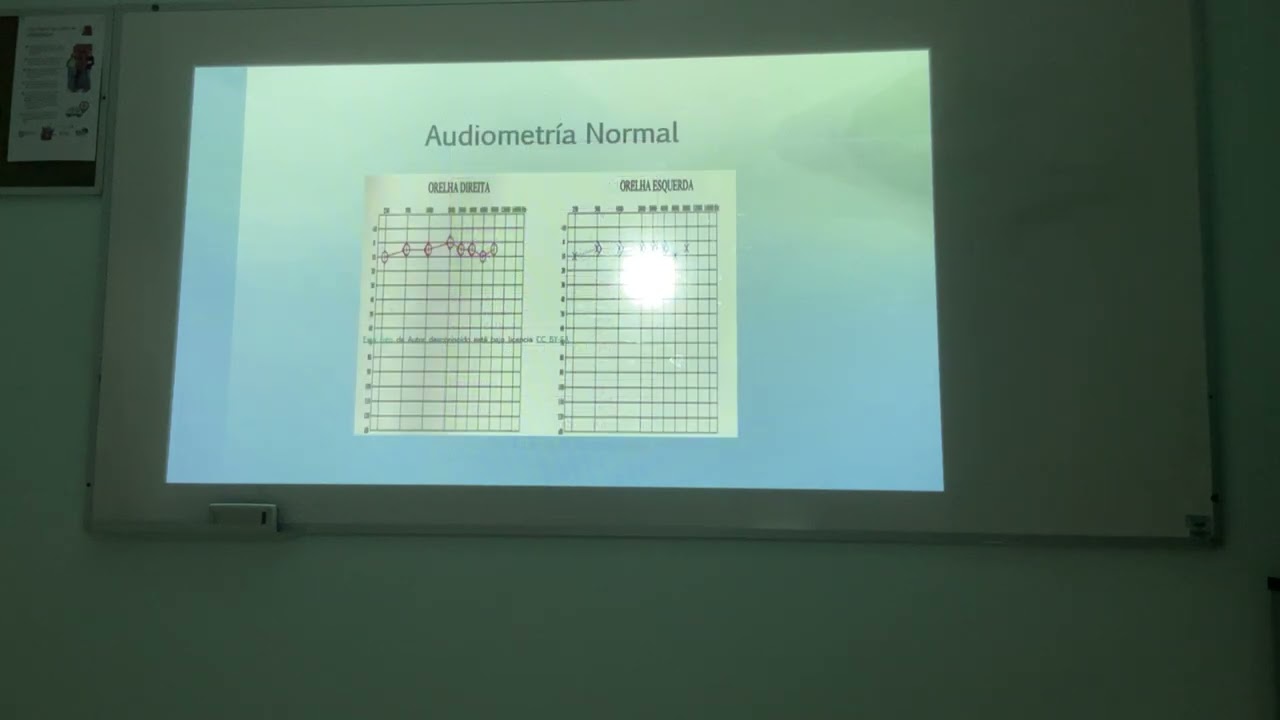
Normal Audiogram Parameters
- In a healthy individual, thresholds for air and bone conduction should exceed 20 decibels across various frequencies from 100 to 6000 Hz.
- Decibel levels reflect sound intensity; common speech tones are evaluated up to 4000 Hz, ensuring comprehensive assessment of auditory capabilities.
Differentiating Hearing Loss Types
Here, the focus shifts to distinguishing between conductive and sensorineural hearing losses based on audiometric evaluations.
Conductive vs. Sensorineural Hearing Loss
- Conductive losses manifest as discrepancies between air and bone conduction thresholds within normal ranges, while sensorineural losses exhibit consistent deficits below 20 decibels.
Identifying Unilateral Sensorineural Hearing Loss
The speaker illustrates how to identify unilateral sensorineural hearing loss through audiometric assessments.
Unilateral Sensorineural Hearing Loss
New Section
In this section, the speaker discusses different types of hearing loss and how to differentiate between them.
Types of Hearing Loss
- Conductive vs. Sensorineural Hearing Loss:
- Conductive: related to the outer or middle ear.
- Sensorineural: related to the inner ear or auditory nerve.
- Differentiating Neurosensorial and Retrocochlear Hearing Loss:
- Neurosensorial: lesion not in cochlea; cochlea functions well.
- Retrocochlear: suspect if issues beyond cochlea; towards brain.
- Retrocochlear Auditory Issues:
- May appear as sensorineural but suspect retrocochlear.
- Consider other disorders like auditory thought disorder.
New Section
This part delves into language disorders in children with normal hearing abilities but struggle with language development.
Language Disorders in Children
- Auditory Processing Difficulty:
- Children hear well but struggle with oral information retention.
- Need more time for processing instructions due to poor auditory skills.
- Challenges Faced by Children with Auditory Deficiency:
- Difficulty in attention and recalling oral information.
- Teachers may lack patience, neuropathies may be present.
New Section
The discussion shifts towards finer details of hearing disorders associated with internal ear structures and neural pathways.
Fine Details of Hearing Disorders
- Inner Ear Structure Issues:
- Problems at cellular level (ciliated cells, tectorial membrane).
- Associated with demyelinating diseases affecting neural pathways.
New Section
Exploring mixed hearing loss conditions where both conductive and sensorineural components are present simultaneously.
Mixed Hearing Loss Conditions
- Understanding Mixed Hearing Loss:
- Combination of conductive and sensorineural issues.
Detailed Overview of Audiology Concepts
In this section, the speaker introduces various symbols and concepts related to audiology, aiming to provide a foundational understanding for the audience.
Introduction to Audiology Symbols and Concepts
- The speaker discusses symbols such as "otras" and their significance in audiology.
- Explanation of how symbols like circles and triangles are used to denote right and left ears in audiology.
- Classification of hearing loss levels based on decibel ranges, emphasizing the importance of audiometry in determining auditory health.
- Mention of different types of healthcare facilities offering audiological services and the role of audiologists in diagnosing hearing impairments.
- Detailed classification of hearing loss severity levels from mild to profound, including a mention of a relatively new term - "hipoacusia mínima."
Understanding Hearing Aid Necessity
This part delves into when individuals might require hearing aids based on specific criteria related to speech frequencies.
Criteria for Hearing Aid Requirement
- Discussion on when a patient would need a hearing aid based on speech frequency levels below 30 dB.
- Emphasis on moderate hipoacusias affecting quality of life and necessitating hearing aids for improved communication.
Significance of Impedance Audiometry
The speaker highlights the importance and evaluation process involved in impedance audiometry within audiological assessments.
Impedance Audiometry Insights
- Importance of understanding impedanciometría evaluations in assessing tympanic membrane mobility and stapedial reflexes.
- Explanation of timpanometría focusing on evaluating tympanic membrane mobility and stapedial reflex presence through sound stimuli responses.
- Description of timpanogram results indicating normal or abnormal tympanic membrane compliance through type A curves.
New Section
In this section, the speaker discusses the importance of identifying specific patterns in medical tests and what they indicate.
Understanding Medical Test Patterns
- The speaker emphasizes the significance of recognizing a specific pattern known as "curva tipo ad" in medical tests, indicating a potential issue with the acicular chain.
- Patients presenting with mucus or pus in their middle ear require attention as it signifies a particular condition that needs to be addressed promptly.
- Highlighting the common scenario where patients independently seek medical tests but may not understand the results, stressing the role of healthcare professionals in interpreting and guiding further actions based on these results.
New Section
This segment delves into pressure differentials within medical examinations and their implications for diagnosing specific conditions.
Pressure Discrepancies and Diagnostic Insights
- Explaining how pressure discrepancies, particularly when equalizing pressures at zero, can indicate issues such as dysfunction in the pharyngotympanic tube.
- Discussing normal reflexes and variations observed in stapedial reflexes, shedding light on how their absence can hint at either conductive hearing loss or retrocochlear pathologies.
New Section
Here, the focus shifts towards early screening methods for detecting auditory impairments in infants.
Early Auditory Screening Techniques
- Introducing otoacoustic emissions as a screening tool for newborns to identify potential hearing issues promptly after birth.
- Detailing how audiologists use specialized equipment to conduct auditory screenings on newborns with risk factors, emphasizing timely referrals for further evaluation if necessary.
New Section
This part elaborates on different screening methods used to assess external hair cells' functionality within the cochlea.
Screening Auditory Functionality
- Exploring screening techniques that evaluate outer hair cells' responses within the organ of Corti, providing valuable insights into early detection of congenital hearing impairments.
Understanding Auditory Evoked Potentials
In this section, the speaker explains the appearance of different waves in auditory evoked potentials and how they can aid in diagnosing various auditory pathologies.
Explaining Wave Latencies
- : The first wave to appear is wave one with an approximate latency of 1.5 milliseconds.
- : Subsequent waves appear at intervals of approximately 1 millisecond after the previous wave.
Diagnostic Significance
- : Wave two has a latency of 2.5 ms, wave three is at 3.5 ms, and so on, aiding in diagnosing specific pathologies based on altered latencies.
- : Alterations in latencies can indicate sensorineural issues or retrocochlear pathologies, prompting further diagnostic tests like MRI with contrast.
Videonystagmography and Vestibular Evaluation
This part delves into videonystagmography as a tool for assessing vestibular function and responses to visual stimuli.
Videonystagmography Functionality
- : Videonystagmography evaluates vestibular pathology by observing eye movements in response to visual stimuli and head position changes.
- : The protocol includes oculomotor tests, caloric tests, and posturography to comprehensively assess balance and equilibrium.
Posturography for Vestibular Rehabilitation
Posturography's role in evaluating patients with vertigo or balance issues for vestibular rehabilitation is discussed here.
Posturography Procedure
- : Posturography involves placing the patient in a cubicle with a movable platform while assessing their stability under various visual conditions.
- : It aids not only in diagnosis but also in monitoring vestibular rehabilitation therapy progress by challenging patients with real-life balance scenarios.
Classification of Hearing Loss
The classification of hearing loss based on severity is outlined here using a simple yet effective method.
Categorizing Hearing Loss
Categorization of Hearing Loss Types
In this segment, the speaker discusses different types of hearing loss.
Types of Hearing Loss
- Four types of hearing loss are mentioned:
- Neurosensorial
- Retrococlear
- Conductive
- Neuropathic
- The speaker asks if anyone can mention a type that was missed.