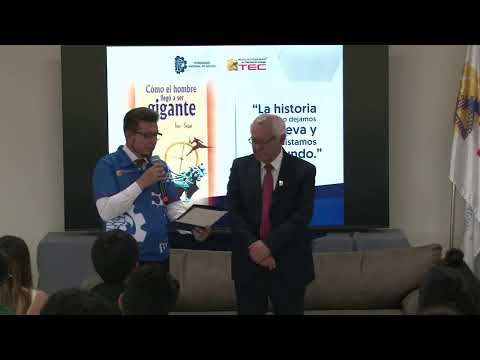
Conferencia "Como el Hombre llego a ser Gigante"
Introduction to Gustavo Amadero
Background and Role
- Gustavo Amadero served as a public official from 1997 to 2001, holding positions such as subdelegate and territorial director in the same delegation.
- From 2018 to 2022, he was the general director of the passenger transport network in Mexico City.
- In July 2022, he was appointed by President Andrés Manuel López Obrador as the general director of the National Technological Institute of Mexico.
Overview of "Cómo el hombre llegó a ser gigante"
Discussion on Human Development
- Ramón Jiménez López introduces the book "Cómo el hombre llegó a ser gigante," emphasizing its historical context from over 60 years ago.
- The title suggests an exploration of human evolution, which could now include both men and women but retains its original phrasing due to its age.
Distinction Between Humans and Animals
Unique Human Traits
- The discussion highlights that humans have developed unique traits distinguishing them from other intelligent animals like dolphins or chimpanzees.
- A key difference is humans' ability to communicate experiences across generations, unlike other species that lack this capability.
Physical Attributes and Tool Use
Manipulation and Decision-Making
- Humans possess opposable thumbs allowing for advanced manipulation of objects, setting them apart from primates like chimpanzees.
- While chimpanzees can use tools for specific tasks, humans excel in decision-making processes that involve complex reasoning.
Archaeological Evidence of Human Ingenuity
Historical Context
- The speaker references archaeological findings showing early humans created tools from wood, bone, and stone—capabilities not seen in other animals.
- This ability to produce instruments reflects a significant evolutionary advantage over other species.
Freedom vs. Constraints in Nature
Animal Behavior Analysis
- The book questions the notion of freedom among birds by illustrating their limitations based on environmental adaptations.
- It argues that while birds can fly freely within certain bounds, they are still constrained by their ecological niches.
Migration Patterns Among Species
Limitations on Animal Movement
- Monarch butterflies migrate along established routes without deviation due to genetic programming rather than conscious choice.
- Unlike animals, humans can choose where to live based on personal desires or resources available.
Core Attributes Defining Humanity
Essential Human Qualities
- Three central attributes define humanity: hands and brains for tool production; creative thinking; and social consciousness.
Creativity as a Fundamental Trait
Importance of Creative Thinking
- Creativity is highlighted as a defining characteristic of humans—the ability to imagine and create new things that did not previously exist.
Independent Thought Development
Critical Thinking Skills
The capacity for independent thought allows individuals to make choices free from external imposition—an essential aspect of human identity.
Social Consciousness
Environmental Awareness
- Developing social awareness includes understanding environmental impacts—simple actions like proper waste disposal reflect broader societal responsibilities.
Understanding the Dialectics of Nature
Types of Movement in Matter
- The book "Dialectics of Nature" by Friedrich Engels introduces five types of movement in matter, starting with mechanical movement, which includes rotation and translation.
- Mechanical movement is primarily associated with the macrocosm, while physical movement pertains to atoms and particles within the microcosm. The mesocosm represents phenomena similar to our dimension.
- Kepler's laws illustrate that planets move in elliptical orbits around the sun, emphasizing that equal areas are swept out in equal times, showcasing mechanical laws at work.
- Beyond mechanical laws, atomic movements fall under quantum physics. Engels categorizes movements into mechanical, physical (atomic), chemical (bonding), biological (life processes), and social movements.
- Social movement is unique to humans and encompasses historical materialism, outlining societal evolution from primitive communism through various economic systems.
Human Evolution vs. Animal Instinct
Limitations and Freedom
- Animals are bound to their environment for survival; however, humans have evolved significantly beyond these limitations, exploring realms like deep space.
- The complexity of human consciousness remains partially unexplored; questions about the relationship between conscious and unconscious thought persist.
- Lenin posited that matter is infinite both in extension and depth, challenging traditional views on atomic structure and encouraging deeper inquiry into existence.
Evolution of Atomic Theory
Historical Perspectives on Atoms
- Early Greek conceptions viewed atoms as indivisible units; later discoveries revealed subatomic structures like electrons through models proposed by scientists such as Thomson and Rutherford.
- Modern understanding recognizes protons and neutrons consist of quarks; this ongoing exploration suggests even smaller components may exist yet undiscovered.
Expanding Knowledge: From Micro to Macro
Cosmic Scale Insights
- Carl Sagan's works highlight vast quantities—grains of sand on beaches or cells in a human body—emphasizing the enormity of existence across scales.
- The universe contains billions of galaxies; theories suggest it is expanding but may also include regions currently unseen by telescopes.
Infinite Depth and Extent of Knowledge
Philosophical Implications
- If knowledge reflects material reality—and if matter is infinite—then knowledge itself must also be limitless in both depth and extent.
- This perspective invites contemplation on the nature of knowledge acquisition: there are no boundaries to what can be learned or discovered.
Technology's Impact on Cognition
Screen Time Concerns
- Excessive screen time can impair cognitive abilities; educational institutions are urged to promote balanced technology use while fostering critical thinking skills among students.
Technological Advancements Through History
Communication Evolution
- Communication has transformed dramatically—from telegram systems requiring hours for messages to reach recipients—to instant digital communication today facilitated by AI technologies.
Future Possibilities Beyond Current Limits
Space Exploration Potential
- As we approach 2050, advancements may allow for unprecedented space travel capabilities exceeding current speed limits defined by light speed due to new scientific discoveries.
Encouragement for Innovation
Embracing Human Potential
- Students are encouraged not to self-limit but rather harness their potential creatively. Collective effort towards innovation can lead humanity toward remarkable achievements.
Building a Supportive Community
Respectful Collaboration
- Establishing mutual respect within communities fosters collaboration over competition. A supportive environment encourages individuals to thrive without fear or bullying.
Exploring New Frontiers
Future Aspirations
- While some planetary environments pose challenges for human habitation (e.g., Venus), exploration continues toward Mars or beyond within our solar system as well as distant stars like Alpha Centauri.
Turn any video into a summary like this
YouTube links, meetings, lectures. With transcripts, search, and chat.