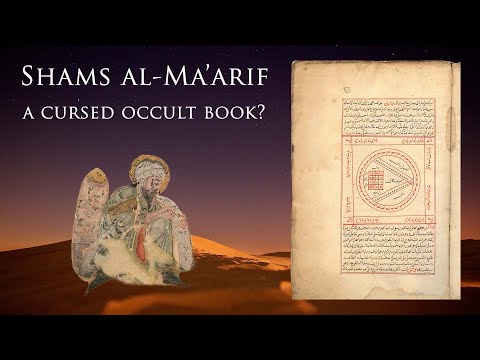
Shams al-Ma'arif - The Most Dangerous Book in the World?
New Section
In this section, the speaker introduces the topic of the occult sciences in the Islamic world and mentions previous episodes that have covered various aspects such as talismanic magic and astrology. The focus is on the book called "The Shams al-Ma'arif" or "The Son of Knowledge," which is considered to be a significant work in the history of Islamic occult sciences.
The Mysterious Book "The Shams al-Ma'arif"
- The Shams al-Ma'arif is regarded as one of the most famous occult books in the Arab and Islamic world.
- It is an extensive text that serves as an encyclopedia of various occult practices prevalent in the Islamic world historically.
- The book is attributed to Ahmed al-Buni, a 13th-century figure who was primarily known as a Sufi teacher rather than a magician.
- Al-Buni's association with Sufism and his connection to renowned Sufi figure Ibn Arabi highlight his spiritual background.
- Al-Buni's writings, collectively known as Corpus Bunionum, encompass both Sufi teachings and aspects related to esotericism within a speculative Sufi framework.
- Recent scholarship suggests that only around five works can be confidently attributed to al-Buni, including both traditional Sufi texts and those with more occult themes.
New Section
This section provides insights into Ahmed al-Buni's life and his connection to the Sufi tradition.
Ahmed al-Buni: A Sufi Master
- Little is known about Ahmed al-Buni's life, but it is believed that he originated from Buna (modern-day Algeria) and spent most of his life in North Africa.
- Al-Buni was primarily associated with Egypt and was a contemporary of the famous Sufi figure Ibn Arabi.
- Al-Buni was recognized as a revered Sufi teacher who led a group of disciples in Cairo, Egypt, engaging in various spiritual practices associated with Sufism.
- After his death, al-Buni's tomb became a place of pilgrimage, indicating his elevated status as a Sufi teacher or even a saint.
New Section
This section explores the connection between Ahmed al-Buni and Ibn Arabi, highlighting similarities in their teachings.
Connection to Ibn Arabi and Speculative Sufism
- Al-Buni had a significant connection to Ibn Arabi, as one of his own Sufi sheikhs was Abdul Azizawi, who also taught Ibn Arabi.
- Similarities can be found between the teachings of al-Buni and Ibn Arabi regarding the science of letters and certain cosmological principles.
- Al-Buni hailed from an environment rich in speculative Sufism prevalent in Western North Africa and Al Andalus (Islamic Iberia).
- The speculative Sufism of the Maghreb region attracted mystics with a philosophical inclination, including al-Buni, Ibn Arabi, and others.
New Section
This section discusses the authenticity of al-Buni's works and their relationship to "The Shams al-Ma'arif."
Authenticity of Al-Buni's Works
- Recent scholarship suggests that only a few works can be confidently attributed to al-Buni as his authentic writings.
- These include traditional Sufi texts like "The Elements" and a commentary on the names of God.
- Some of his writings also delve into occult topics within a Sufi framework but are not specifically "The Shams al-Ma'arif."
The transcript does not provide timestamps for every section.
The Shams of Ahmed al-Buni
This section discusses the book called "The Shams" written by Ahmed al-Buni, its differences from the modern version, and its reputation as a dangerous and cursed book.
The Content of "The Shams"
- The book contains descriptions of practical occult sciences and secrets of wielding occult powers.
- It focuses on the science of letters, which theorizes that Arabic letters have magical powers connected to cosmological or metaphysical principles.
- The book also discusses Jinn, angels, and provides instructions on constructing cryptograms using letters and numbers.
- Al-Buni's writings on these topics were popular among religious scholars, mystics, philosophers, and aristocracy.
Reputation and Audience
- After his death, al-Buni became known as an authority on occult sciences due to his writings.
- His works were popular among various groups but were meant for an elite Sufi audience who could grasp their meanings.
- The modern reputation of "The Shams" as a dangerous and cursed book may be attributed to its association with al-Buni's authority on occult matters.
Ahmed al-Buni's Esoteric Practices
This section explores how Ahmed al-Buni's esoteric practices were seen in the context of Sufism and how they differed from what is commonly understood as magic.
Esoteric Practices in Sufism
- Al-Buni's writings on esoteric practices were not considered magic but rather spiritual work within Sufi circles.
- These practices involved using divine powers to affect things in the world rather than calling upon forces other than God.
- The writings were taught orally from teacher to student in an initiatory context and were not meant for the wider public.
Unique Aspect of Al-Buni's Writings
- Al-Buni's writings on esoteric practices were unique because he actually wrote about them, whereas they were typically only taught orally.
- However, even in his writings, he emphasized that they were meant for the spiritually adept and not to be spread to the uninitiated.
The Infamous Reputation of "The Shams"
This section explores how "The Shams" gained its infamous reputation and discusses the modern version known as "Shams al-Ma'arif."
Ahmed al-Buni's Authority on Occult Sciences
- After al-Buni's death, his writings on occult sciences attributed to him made him seen as an authority in this field.
- His works were popular among various groups including religious scholars, mystics, philosophers, and aristocracy.
Modern Reputation of "The Shams"
- The modern reputation of "The Shams" as a dangerous and cursed book may be due to its association with al-Buni's authority on occult matters.
- The contemporary version known as "Shams al-Ma'arif" is based on al-Buni's original work but has gained fame or infamy for being considered a dangerous book around the world.
The Writings of Al-Buni and the Development of the Shams Al-Ma'arif
This section discusses the writings of Al-Buni and the development of the Shams Al-Ma'arif, a popular occult text.
The Influence of Al-Buni's Writings
- Albuni's writings were not representative of the majority at that time.
- His works continued to be popular in various circles, with people studying them and writing commentaries on them.
- A boonian occult tradition developed over the 14th to 16th centuries based on Albuni's writings.
The Evolution of Shams Al-Ma'arif
- The modern version of Shams Al-Ma'arif, known as the Great Son of Knowledge, first appeared in the 17th century.
- It is radically different from the medieval Shams al-Ma'arif attributed to Albuni himself.
- The scholarly consensus is that it is a compilation created by one or multiple writers around the early 17th century.
- While it is based on Albuni's writings, a large part of the work is from other sources, particularly later writers like Abdulrahman al-Bistami.
Understanding Shams Al-Ma'arif
- Shams Al-Ma'arif is an encyclopedic work with chapters dedicated to various occult sciences.
- It has a strong speculative Sufi framework and intricate cosmology where everything is interconnected.
- The book explores topics such as Arabic letters, planetary spheres, zodiac signs, angels, and more.
- Numbers play a significant role in constructing talismans and magical objects using Gematria.
Exploring Correspondences and Talismans in Shams Al-Ma'arif
This section delves into the esoteric aspects of Shams Al-Ma'arif, including correspondences and talismans.
Correspondences in Shams Al-Ma'arif
- The book presents a complex system of connections and correspondences between various elements.
- It explores the relationships between Divine names, Arabic letters, stars, heavenly spheres, and the human soul.
- These connections are central to understanding the text's teachings.
Talismans and Magical Objects
- Shams Al-Ma'arif provides instructions for creating talismans and magical objects.
- Gematria is used to assign numerical values to letters, allowing for the construction of talismatic symbols.
- The book emphasizes the importance of timing and celestial influences when creating these objects.
Practical Applications
- The knowledge presented in Shams Al-Ma'arif can be used for spiritual benefits as well as worldly concerns.
- It offers guidance on attracting people's favor, curing ailments like fever or scorpion stings, and even harming enemies.
- However, the author also cautions against misusing this knowledge by reminding readers of potential consequences on Judgment Day.
The summary provided covers only a portion of the transcript.
New Section
This section discusses the use of specific astrological aspects and rituals to achieve desired outcomes. It also explores the power of divine names and phrases, such as Bismillah, in invoking miracles and protection.
Astrological Aspects for Rituals
- The ritual against scorpion sting should be performed when the Moon is in Scorpio and in an unfortunate aspect with Mars. After constructing a seal, it should be dipped in water and consumed.
- To attain personal benefits, one can write the ritual on a piece of yellow silk while the Moon is in Cancer or in the house of Jupiter, ensuring no unfortunate aspects with Jupiter.
- Carrying out these rituals can help accomplish goals, gain favor from authorities, and attract love from women.
Invoking Saturn
- If one wishes to invoke Saturn for different effects, they can follow similar steps but use the letter G instead. The letter G has a numerical value of three.
- A three by three magic square is created with the letter G. Names of God associated with Saturn are written using this letter.
Power of Divine Names
- The book emphasizes that all names of God have powers that can be recited or written down for various effects.
- Different names correspond to different attributes or qualities. For example, reciting "Salam" (The Giver of Peace) can help end conflicts.
- The name Allah is considered the most powerful as it encompasses all other names. There is mention of a secret greatest name known only to prophets.
Significance of Bismillah
- The phrase "Bismillah" (In the name of God) holds immense power and has its own dedicated chapter in the book.
- It includes three names of God and is recited before major tasks by Muslims. It is believed to be one of the most powerful sentences in existence.
- The book delves into the metaphysical significance of Bismillah, stating that it contains the entire Quran and even the universe within its letters.
Talismanic Use of Bismillah
- Writing or washing objects with the phrase "Bismillah" is considered a form of talisman. It is believed to have protective and powerful effects.
- Various accounts mention instances where Bismillah was inscribed on significant objects or used by prophets to perform miracles.
New Section
This section explores the esoteric interpretations and practices described in the book. It highlights the summoning of jinn through divine power, cautioning against careless practices without proper protection.
Esoteric Interpretations
- The book connects various aspects to angelic concepts, letters, and planetary spheres. Even darker topics maintain connections to religious and Islamic themes.
- The focus remains on God, His names, the Quran, and their interconnections throughout the book.
Summoning Good Jinn
- The book describes how one can summon good jinn through invoking God's power using phrases like Bismillah or Quranic verses.
- Proper protection from God is emphasized to avoid accidentally calling upon evil jinn or experiencing misfortune.
Cautionary Measures
- Albuni, the author of these sections, advises caution when practicing these rituals. Carelessness may lead to unintended consequences or attracting malevolent forces.
- Protection against such dangers involves invoking God's power through saying Bismillah or writing names of God.
Additional Topics
- The book also delves into topics such as Solomon's Ring and its powers for controlling jinn.
- There are numerous practices mentioned in the book that cannot be covered comprehensively here due to their extensive nature.
Due to limitations in accessing specific timestamps for each bullet point, the timestamps provided are approximate and may not align precisely with the content.
The Shams al-Ma'arif and its Significance in the Islamic Occult Sciences
This section discusses the significance of the Shams al-Ma'arif in the context of Islamic occult sciences. It explores how the book covers various topics in occult sciences while remaining rooted in Islamic vocabulary and cosmology.
The Unique Aspect of Shams al-Ma'arif
- The Shams al-Ma'arif is distinct from other famous Islamic occult books like "The Hakim" or "The Picatrix."
- While "The Picatrix" focuses primarily on astrology and astral magic, the Shams al-Ma'arif is based on the Quran and Sufi concepts.
- Some consider it more pious or outright Islamic due to its strong connection to the Quran and Sufism.
Controversial Reputation of Shams al-Ma'arif
- In history, except for a few exceptions, the book was not seen as problematic.
- However, in recent times, it has gained an infamous reputation and is feared by many.
- This shift can be attributed to changes in the Islamic intellectual world and a more materialistic scientific paradigm.
- Magic has been particularly stigmatized in this new paradigm, leading to a rejection of superstitious aspects within Islam.
Factors Contributing to Infamy
- Modernistic movements within Islam have emphasized rationality and rejected superstitious elements.
- Sufism has become relatively marginalized as a result.
- There has been a de-esoterization of albuni's writings, disconnecting them from Sufi cosmologies and metaphysics.
- Grimoires written by controversial occultists connected to albuni further contributed to this trend.
Diverse Perspectives on Shams al-Ma'arif
- Today, the book is often seen as a book of black magic and devil worship, believed to bring misfortune.
- However, some groups view it as a tool for spiritual development and esoteric Sufi ideas, emphasizing the need for proper guidance.
Increasing Interest in Shams al-Ma'arif
- The first English translation of a significant portion of the book has gained attention.
- The occult sciences have historically been prominent in the Islamic world.
- Understanding the history of occult sciences enriches our understanding of history, religion, and the occult.
Conclusion
This section concludes the discussion on Shams al-Ma'arif and its significance. It highlights that while these ideas are widespread in parts of the Islamic world, their normative status within Islam is determined by Muslim scholars and theologians.
Significance of Shams al-Ma'arif
- The Shams al-Ma'arif and its attributed author Ahmed al-Buni hold great importance in understanding talismans, jinn, and magical words.
- It provides insights into history, religion, and the occult.
Normative Status
- Determining the normative status of Shams al-Ma'arif within Islam is up to Muslim scholars and theologians.
- These ideas have been popular in parts of the Islamic world dominated by Islam but do not necessarily represent Islamic religious beliefs.
Final Thoughts
- The transcript provides valuable information about this fascinating topic related to talismans, jinn, and magical words.
- Understanding this historical context enhances our knowledge of occult sciences.