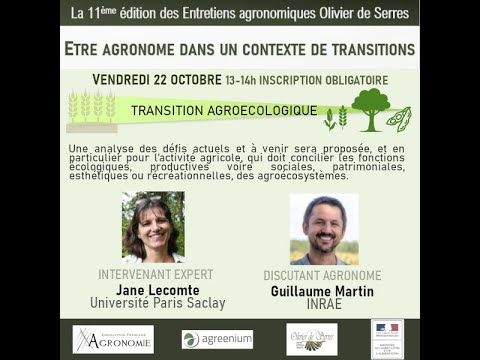
Transition écologique et implications pour l'agriculture et les agronomes
Introduction
The speaker welcomes the audience to the webinar on the impact of socio-technical positions in agricultural activities and introduces the topic of ecological transition in agriculture.
Speaker Introductions
- Jeanne Le Pot, a professor of ecology at Université Paris-Saclay, is the external speaker who will discuss the ecological transition.
- Martin, a researcher at INRA Grenoble, will be the discussant for Jeanne's presentation.
Presentation on Ecological Transition in Agriculture
Jeanne Le Pot presents an overview of ecological transition in agriculture from an ecologist's perspective.
Key Points
- Ecological transition is crucial for addressing challenges such as climate change, biodiversity loss, and resource scarcity.
- Agriculture plays a significant role in managing natural resources and living systems.
- Sustainable development goals emphasize the need to achieve objectives related to biosphere preservation, clean water availability, climate change mitigation, and life preservation.
- Ostrom's concept of planetary boundaries highlights the importance of respecting environmental limits while ensuring social justice.
- Agriculture should not be limited to food production but also consider other functions like resource management, landscape preservation, and socio-economic viability.
Multifunctionality of Agriculture
The multifunctionality of agriculture is discussed along with its challenges.
Key Points
- Agriculture serves multiple objectives beyond production, including natural resource management, landscape preservation, biodiversity conservation, and socio-economic viability.
- Challenges include maintaining or increasing production due to demographic dynamics and combating food waste.
- Changes in dietary choices and climate disruptions also pose challenges for agriculture.
Impacts of Agricultural Intensification
The impacts of agricultural intensification and the transformation of agricultural ecosystems are discussed.
Key Points
- Intensive farming practices have led to significant environmental impacts, including biodiversity loss.
- Some argue that continuing intensification may not be sustainable for both production and environmental conservation.
Conclusion
In this webinar, Jeanne Le Pot presented an overview of ecological transition in agriculture. The multifunctionality of agriculture was highlighted, along with the challenges it faces. The impacts of agricultural intensification were also discussed.
Research on Ecological Processes in Agricultural Landscapes
The speaker discusses their research on ecological processes in agricultural landscapes, focusing on three different scales: landscape, local, and habitat.
Landscape Scale
- The spatial and temporal structuring of cultivated biodiversity and semi-natural habitats shape the agricultural landscape.
- Different species, including pests, pollinators, and beneficial organisms, have distinct life histories that influence their dispersion and interactions.
- Plants also play a role in shaping the landscape by influencing various ecological functions.
Local Scale
- Interactions between organisms such as pests, beneficial organisms, and plants occur within habitats at the local scale.
- These interactions contribute to ecological dynamics and the provision of ecosystem services like pollination and pest regulation.
Habitat Scale
- The proportion of semi-natural habitats in agricultural landscapes affects the visitation rate of beneficial organisms to crop fields.
- Increasing the proportion of semi-natural habitats can enhance biological control services by reducing pest colonization time and average crop losses.
- However, there is a trade-off between optimizing pest control services and maximizing crop yield due to reduced productive land area.
Impact of Semi-Natural Habitats on Pest Control Services
The speaker explains how the proportion of semi-natural habitats in agricultural landscapes can impact pest control services provided by beneficial organisms.
Study Design
- A multi-agent spatially explicit model was used to investigate the effects of different proportions of semi-natural habitats on pest control services.
- Simulations were conducted with varying levels of stochasticity in habitat distribution, field arrangement, and auxiliary organism mortality rates.
Results
- Increasing the proportion of semi-natural habitats positively influenced the visitation rate of beneficial organisms to crop fields infested with pests.
- Optimizing pest control required a higher proportion of semi-natural habitats compared to maximizing visitation rates due to temporary trophic interactions.
- However, converting productive land into semi-natural habitats reduced the overall crop area and could potentially impact crop yield.
Modelling Synergies between Biological Control and Pollination Services
The speaker discusses the use of models to study synergies between biological control and pollination services and their implications for pesticide reduction.
Project Traverse
- The speaker mentions a project called Traverse, led by Corinne Robert, which aims to identify transition trajectories at the territorial scale for reducing pesticide usage and its impacts.
- The project utilizes ecological, economic, social, and institutional levers to understand behavior change dynamics and barriers to pesticide reduction.
Future Research
- Models similar to the one used in this study can be employed to investigate synergies or antagonisms between biological control and pollination services.
- These models can help identify landscape designs that optimize multiple ecosystem services while minimizing pesticide use.
This summary provides an overview of the main topics discussed in the transcript. For a more detailed understanding, please refer to the original transcript.
New Section
This section discusses the evolution of the agronomist profession and the need to revise its objectives. It highlights the shift from traditional agronomy focused on cultivated fields to more complex systems that require a multidisciplinary approach.
Transformation of Agronomist Profession
- The first transformation in the agronomist profession is the revision of its objectives, moving beyond traditional field cultivation to encompass complex agricultural systems with multiple objectives.
- The inclusion of ecological concepts and tools has become necessary to understand interactions between species in these complex systems.
- There is a need to consider different scales, from local to global, in agronomy, as well as diverse temporalities such as short-term and long-term cycles.
- The consideration of multiple scales allows for a better understanding of the diversity of agricultural practices and their effects.
Importance of Time and Space Scales
- Agronomy needs to consider various spatial and temporal scales, including long-term dynamics such as soil organic matter evolution and delayed effects of certain practices.
- Global-scale impacts should also be taken into account, such as the effects of consuming soybeans for livestock feed in Europe on crop systems in South America.
- Experimental systems, longitudinal farm monitoring, landscape-level studies, and modeling are essential tools for studying these different scales.
Interactions with Other Sectors
- Agronomy is no longer limited to crop production but also involves interactions with other sectors such as livestock farming, forestry, and food processing industries.
- Collaboration with stakeholders from these sectors is crucial for integrated analysis, modeling, and designing agricultural systems that meet multiple objectives.
Changing Perspectives on Agricultural Performance
- The concept of agricultural performance has expanded beyond simply feeding the world. It now includes economic viability at the farm level and ecosystem services at the landscape level.
- Evaluating agricultural performance requires considering trade-offs between different types of services and resources, as well as compromises between different levels of organization and stakeholders.
New Section
This section focuses on the need for a renewed approach to evaluating agricultural performance. It emphasizes the complexity of evaluation due to multiple criteria and perspectives.
Complex Evaluation Practices
- The evaluation of agricultural performance has become more complex, requiring consideration of trade-offs between different types of services and impacts on various natural resources.
- Evaluations should also account for differences in perspectives among actors involved, such as farmers, advisors, researchers, and policymakers.
- Balancing compromises between different levels of organization and stakeholders is crucial in evaluating agricultural systems.
The transcript does not provide further sections or timestamps beyond this point.
Integrating Performance Variability in Agriculture
The speaker discusses the need to integrate the variability of performance over time in agriculture. This requires incorporating frameworks from environmental and social sciences, such as vulnerability assessment. However, this integration is still in its early stages and there is progress to be made.
Importance of Evaluations
- Evaluations in agriculture need to better integrate the trade-offs made by different actors.
- Historically, agriculture has focused on maximizing performance, but some farmers may prefer lower income for a more reasonable workload.
- It is important to consider individual expectations and preferences when evaluating agricultural performance.
Changing Perspective on Farmers
- When discussing ecological transition in agriculture, it is crucial to understand that farmers are guided by their values and motivations.
- Farmers have expertise gained through experience and observation, which should be valued and capitalized upon.
- Agronomists need to shift their perspective from viewing farmers solely as implementers of techniques to seeing them as actors with valuable knowledge.
Complexity of Agricultural Systems
- Understanding agricultural systems requires integrating knowledge from social sciences.
- Collaborations between agronomists and social scientists can help address questions related to values and adaptation.
- Workshops and collective discussions can facilitate the exchange of experiences and perspectives.
Dealing with Uncertainties
- Farmers face uncertainties due to complex situations, feedback loops, unexpected events, etc.
- They possess the capacity to adapt and transform situations through innovation in practices or marketing strategies.
- It is essential to understand how farmers develop these adaptive capacities and identify cognitive and technical levers they rely on.
Multidimensional Challenges
- Agriculture involves multiple risks and challenges that cannot be segmented for analysis.
- Agronomists need a multidimensional approach that considers the complexity of farmers' decision-making contexts.
- Creativity plays a significant role in finding solutions for these multidimensional challenges.
Linking Agricultural Transition and Multirisk Management
The speaker emphasizes the need to move towards a multirisk approach in agriculture. Farmers must navigate multiple challenges and uncertainties, requiring agronomists to stimulate creativity and collaborate with other actors to develop innovative solutions.
Multirisk Approach
- Transitioning towards ecological agriculture requires farmers to address multiple risks and challenges simultaneously.
- Agronomists should abandon segmented problem-solving approaches and adopt a more holistic perspective.
- A multirisk approach allows for a better understanding of farmers' decision-making contexts.
Stimulating Creativity
- The complexity of the agricultural context necessitates creative thinking.
- Agronomists should encourage the creativity of farmers and other stakeholders in finding solutions.
- Developing this additional skill is crucial for addressing the evolving challenges in agriculture.
Collaboration with Social Sciences
- Collaboration between agronomy and social sciences is essential for understanding values, adaptation, and decision-making processes.
- Integrating social sciences can provide valuable insights into issues related to values and adaptation in agriculture.
Understanding Trophic Levels and Extinction Debt
The speaker briefly explains the concept of trophic levels and extinction debt in agroecosystems heavily influenced by inputs like herbicides. It can be challenging to predict how organisms will respond over time, as effects may take time to manifest.
Trophic Levels
- Trophic levels refer to the feeding relationships between organisms within an ecosystem.
- In agroecosystems, trophic levels involve interactions such as predation or mutualism.
- Research needs to integrate these complex interactions that are relatively new areas of study.
Extinction Debt
- Extinction debt refers to delayed extinctions due to changes in habitat or environmental conditions.
- In agroecosystems with high input usage like herbicides, it is difficult to predict the long-term response of organisms.
- Effects may take time to manifest, and researchers must wait for these effects to become apparent.
The transcript provided does not include timestamps for all sections.
Understanding the Challenges of Implementing Agricultural Practices
In this section, Jérôme discusses the challenges faced in implementing certain agricultural practices.
Challenges in Implementing Agroecological Practices
- Jérôme mentions that there are examples of farmers implementing practices such as grass strips and flowered strips to promote beneficial insects. However, sometimes these practices can lead to unintended consequences and generate more problems than solutions. This highlights the complexity of achieving desired outcomes in agriculture.
- He also brings up the example of wanting an agriculture system that uses fewer or no pesticides and values soil health through earthworms. While this may align with the ideals of organic farming, it is not always easy to achieve in practice.
- Jérôme emphasizes that not everything is as simple as it seems, and we need to be cautious about blindly following dogmas or fixed beliefs.
Potential for Improvement in Cereal Systems
- The conversation shifts towards cereal systems, particularly polyculture livestock systems and pure cereal systems. There is room for improvement in these systems to address biodiversity maintenance and climate change challenges.
- While there may not be exact answers yet due to the unpredictability of living organisms, leveraging agroecological knowledge can help minimize input usage in some cereal systems.
- It is worth noting that certain organic farming systems have shown potential for producing comparable or even higher yields than conventional farming methods on specific territories.
Balancing Economic and Ecological Considerations
- The discussion acknowledges the economic and social pressures faced by farmers, who prioritize income generation and market supply. These short-term constraints can sometimes overshadow ecological considerations.
- However, maintaining elements that support biodiversity development ultimately contributes to long-term economic sustainability as well.
- Despite facing challenges and being behind schedule, it is important not to regress but rather continue working towards a future that balances economic viability with ecological goals.
The Difficulty of Adaptation and the Role of Collective Intelligence
This section explores the challenges of adaptation in agricultural systems and the importance of collective intelligence.
Economic Pressures vs. Ecological Considerations
- Emmanuel highlights that economic pressures, such as adapting to market demands for food, often outpace the agronomic timeline required for system modifications and landscape changes.
- There is a recognition that farmers prioritize income generation and market supply, while agronomists may have noble intentions to evolve farming systems. Balancing these different perspectives can be challenging.
Importance of Collective Intelligence
- The conversation touches upon the concept of living labs as spaces where local stakeholders can work together to bring about meaningful change.
- However, it is noted that simply gathering people in a room is not enough; there needs to be a concerted effort to provide tools and support for stakeholders to envision and overcome existing constraints.
- The role of agronomists in facilitating this process is highlighted, as they can contribute to creating an environment conducive to collective intelligence and encourage forward-thinking approaches.
Enhancing Collective Intelligence for System Change
This section delves deeper into the topic of collective intelligence and its potential impact on driving system change.
Challenges in Implementing Collective Intelligence
- While there are existing initiatives like "Eliminar" that promote local-scale collaboration, there is still much work needed in terms of effectively utilizing these platforms.
- It is crucial to go beyond mere gatherings and focus on providing tools and resources that empower stakeholders to think outside the current system's constraints.
Envisioning an Alternative Future
- To foster collective intelligence, it is essential for stakeholders to break free from certain limitations imposed by the current agricultural system.
- Agronomists play a vital role in supporting this process by encouraging stakeholders to project themselves into a future that deviates from traditional practices.
Conclusion
The transcript highlights the challenges faced in implementing agricultural practices and the need for a balance between economic considerations and ecological goals. It emphasizes the importance of collective intelligence in driving system change and calls for a shift towards envisioning alternative futures.
The Month of December
This section discusses the significance of the month of December.
Importance of December
- December is a significant month.
- It holds special meaning for various cultures and religions.
- Many holidays and celebrations take place in December.
Cultural Significance
- In many Western countries, Christmas is celebrated in December.
- Christmas is a Christian holiday commemorating the birth of Jesus Christ.
- It is a time for family gatherings, gift-giving, and spreading joy.
Religious Observances
- Hanukkah, also known as the Festival of Lights, is observed by Jewish people in December.
- It lasts for eight days and involves lighting candles on a menorah.
- Hanukkah celebrates the miracle of oil that lasted for eight days in the ancient temple.
Winter Solstice
- The winter solstice occurs in December in the Northern Hemisphere.
- It marks the shortest day and longest night of the year.
- Many cultures celebrate this astronomical event with festivals and rituals.
Please note that this summary may not cover all aspects discussed in the transcript.