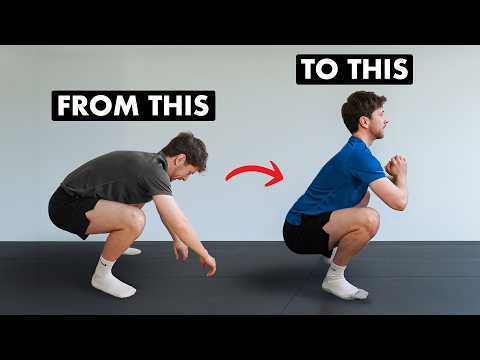
I Couldn’t SQUAT For Years...Until I Did This
Deep Squat Progression for Pain-Free Movement
Introduction to Deep Squats
- The speaker shares a personal experience of overcoming back and hip issues through deep squatting, emphasizing its importance as a fundamental human movement.
- Deep squats are presented as the best remedy for those who spend long hours sitting, promoting better mobility and comfort.
The Importance of Deep Squats
- Many adults have lost the ability to perform deep squats due to lifestyle changes, leading to tight hips, unstable knees, and stiff ankles.
- Common myths about deep squatting include the belief that it is harmful to knees; however, studies indicate that proper execution strengthens knees and prevents injuries.
- Another myth suggests some individuals are not built for deep squatting; in reality, most can improve their squat with targeted work on limitations.
Benefits of Unlocking Your Deep Squat
- Improved hip flexibility leads to easier everyday movements and enhanced performance in sports and gym activities.
- Increased power during activities like running and jumping is another benefit of mastering the deep squat.
- Regular practice reduces stiffness after prolonged sitting, contributing to overall joint stability and injury prevention.
Assessing Your Current Squat Ability
- A self-test involves attempting a deep squat while observing if heels lift or if there’s rounding in the back; these indicators help identify areas needing improvement.
- If only heels lift or there's excessive tension in specific muscles (like tibialis), ankle mobility may be the primary issue requiring attention.
Individual Variability in Squatting Mechanics
- Each person's squat will look different based on individual anatomy (e.g., femur length vs torso length), which is normal and should be embraced rather than seen as a limitation.
- Maintaining a straight back during squats is crucial to avoid unnecessary lower back tension while performing this movement correctly.
Level One: Starting Point for Beginners
- For those whose heels lift off the ground or have rounded backs, starting with elevated heels using plates or towels can aid deeper squatting by reducing ankle restriction.
- Practicing holding the bottom position for 10 seconds helps acclimate your body to this new range of motion; repeat 5–8 times gradually increasing time spent at depth.
Level Two: Improving Ankle Mobility
- If ankle mobility is identified as an issue (with heels lifting), progress by performing level one without holding onto anything while focusing on knee alignment over toes during descent.
- To enhance stability during this phase, brace your core before lowering into the squat position—this helps maintain balance throughout the movement.
Level Three: Active Flexibility Development
- At this stage, individuals often attempt deep squats but may struggle due to misconceptions about flexibility versus strength; passive flexibility differs from active flexibility needed for functional movement use.(258)
- Incorporating light weights into your routine teaches control within deeper ranges rather than just stretching passively—this builds usable flexibility essential for various physical activities.(296)
Practical Application of Weight Training in Deep Squats
- Start with light kettlebells or dumbbells held at chest height while sinking into a deep squat; hold this position briefly before standing up again.(333)
- Gradually increase weight based on personal strength levels—beginning around 20%–30% of body weight is recommended—and focus on controlled repetitions across three sets.(333)
Conclusion & Challenge
- Spend at least five minutes daily practicing deep squats over seven days to accelerate progress towards improved hip freedom.(372)
- View additional resources provided by the speaker for further guidance on related topics such as hamstring unlocking techniques.(372)