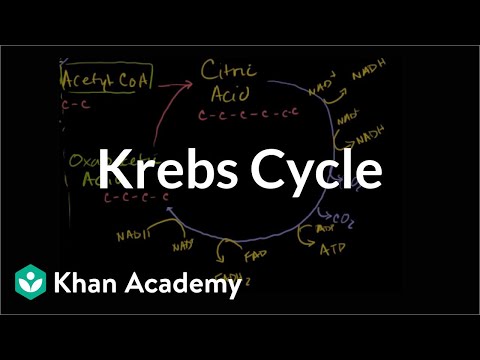
Krebs / citric acid cycle | Cellular respiration | Biology | Khan Academy
Glycolysis and the Krebs Cycle Overview
Glycolysis Process
- Glycolysis begins with a glucose molecule, a 6-carbon structure, which is split into two pyruvate molecules (3-carbons each).
- This process occurs in both the presence and absence of oxygen, resulting in a net gain of two ATPs after using two ATPs during the investment phase.
- In addition to ATP, glycolysis produces two NADH molecules as byproducts.
Cellular Structure and Location of Glycolysis
- Glycolysis takes place in the cytoplasm of eukaryotic cells, where various organelles are suspended in fluid.
- The next step following glycolysis is the Krebs cycle (or citric acid cycle), which occurs within the mitochondria.
Mitochondrial Structure
- Mitochondria consist of an outer membrane and an inner membrane; the inner membrane forms structures called cristae.
- The space between these membranes is divided into two compartments: the outer compartment and the matrix.
Pyruvate Preparation for Krebs Cycle
- Before entering the Krebs cycle, pyruvate undergoes oxidation to form acetyl-CoA by cleaving off one carbon atom from each pyruvate.
- Acetyl-CoA is a 2-carbon compound that also reduces NAD+ to NADH during this preparation step.
Initiation of Krebs Cycle
- Acetyl-CoA enters the Krebs cycle by merging with oxaloacetic acid (a 4-carbon molecule), forming citrate (citric acid), a 6-carbon molecule.
- The entire process within the Krebs cycle involves enzyme-catalyzed reactions that facilitate multiple steps leading to further oxidation of citrate.
Carbon Dioxide Production
- As citrate undergoes oxidation through several steps, it releases carbon atoms as CO2.
Understanding the Citric Acid Cycle and ATP Production
Overview of Carbon Dioxide Production
- The process involves two cycles, resulting in the production of six carbon dioxides, which accounts for all carbons from glucose. Each turn removes two carbons, but ultimately three are removed per pyruvate.
Role of NADH, FADH2, and ATP
- The cycle's primary goal is to generate NADHs, FADH2s, and ATP. This simplification highlights the importance of these molecules in cellular respiration.
- During the cycle, NAD+ is reduced to NADH multiple times. Additionally, ADP converts to ATP while FAD is oxidized into FADH2.
Importance of Electron Transport Chain
- NADHs and FADH2 produced are crucial inputs for the electron transport chain (ETC), where most ATP is generated through oxidation processes.
Breakdown of Glycolysis and Krebs Cycle Contributions
- The left side represents glycolysis; however, pyruvate oxidation is a preparatory stage before entering the Krebs cycle. Acetyl-CoA merges with oxaloacetic acid to form citric acid.
- For each glucose molecule processed:
- Glycolysis yields 2 net ATP and 2 NADHs.
- Pyruvate oxidation produces an additional 2 NADHs (1 per pyruvate).
Total Yield from Krebs Cycle
- In total:
- From one turn of the Krebs cycle:
- 3 NADHs,
- 1 ATP,
- 1 FADH2.
- Multiplying by two for both pyruvates results in:
- 6 NADHs,
- 2 ATP,
- 2 FADH2.
Accounting for Total Energy Output
- Cumulatively:
- 4 ATP from glycolysis and Krebs cycle combined.
- 10 NADHs total (including those from glycolysis).
- 2 FADH2 produced.
- Each NADH generates approximately three ATP in ETC (30 total), while each FADH2 generates about two (4 total).
Final Calculation of Theoretical Maximum ATP
- Summing up gives a theoretical maximum of 38 ATP, accounting for all stages including glycolysis, preparatory steps, Krebs cycle outputs feeding into ETC.
Broader Metabolic Context
Understanding Energy Production in the Body
The Role of Fat and Energy Generation
- The body can utilize stored fat as an energy source, theoretically generating ATP from it. This highlights the potential for fat to serve as a fuel source.
- Acetyl-CoA is identified as a key catabolic intermediary that can be derived from proteins (broken down into amino acids) and fats (which can also convert to glucose), allowing entry into the Krebs cycle.
Overview of Cellular Respiration Mechanisms
- The Krebs cycle serves as a central hub for energy production, capable of processing various fuels including carbohydrates, proteins, and fats to generate ATP.
- A complex diagram often found in biology textbooks illustrates cellular respiration; it may appear daunting but contains essential steps that are crucial for understanding the process.
Key Steps in Glycolysis and Krebs Cycle
- Glycolysis produces two pyruvates, which undergo oxidation to yield carbon dioxide and reduce NAD+ to NADH before entering the Krebs cycle.
- Throughout the Krebs cycle, multiple NADH molecules are generated—four total when including preparatory steps—indicating significant electron transport potential.
Energy Sources Beyond ATP