The Peculiar Institution
Understanding the "Peculiar Institution" of Slavery
Euphemisms and Terminology
- In the 19th century, the term "slavery" was often avoided in polite conversation; instead, people used the euphemism "peculiar institution" to refer to it.
- A euphemism is a softer term used in place of harsher words; for example, "passed away" is used instead of "died."
Historical Context and Justifications
- Some argued that slavery had always existed in wealthy societies, questioning why the U.S. should abolish it.
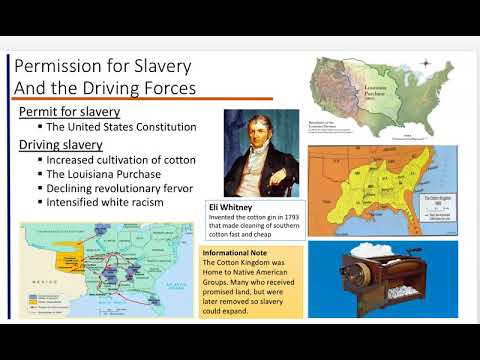
- The U.S. Constitution permitted slavery, allowing slaveholders to dehumanize enslaved individuals.
Driving Forces Behind Slavery's Existence
- The invention of Eli Whitney's cotton gin significantly increased cotton production, which fueled the demand for enslaved labor.
- The Louisiana Purchase expanded U.S. territory and allowed for further expansion of slavery into southern states.
Decline of Revolutionary Ideals
- After the Revolutionary War, discussions about freedom diminished; freedom became increasingly associated with slavery rather than universal rights.
- White racism solidified during this period due to constitutional support and societal laws promoting white supremacy.
Legislative Actions Regarding Slavery
Abolition Efforts and Compromises
- Congress abolished the international slave trade in 1807, making it illegal to import enslaved individuals from Africa.
- The Missouri Compromise established an arbitrary line determining free versus slave states based on geographical location.
Emancipation vs. Manumission
- Emancipation refers to freedom granted by government legislation, while manumission involves individual owners freeing their slaves voluntarily.
Life Under Slavery
Conditions Faced by Enslaved Individuals
- Enslaved people's living conditions were dire: they faced poor diets, inadequate clothing, overcrowded quarters, and harsh work environments.
- Child mortality rates among enslaved children were alarmingly high at 50%, compared to 30% for white children during this period.
Population Dynamics
- From 1790 to 1860, the enslaved population grew significantly—doubling then tripling—contrary to claims that slavery was diminishing.
Economic Aspects of Slavery
Ownership Trends Among Whites
- By 1860, only 4% of whites owned enslaved people despite an increasing number of enslaved individuals due to wealth concentration among elite owners.
Labor Distribution Among Enslaved People
- Approximately 55% of enslaved individuals worked in cotton cultivation; others were involved in various agricultural or domestic roles.
Domestic Slave Trade Emergence
Transition from International Trade
- With the end of international slave trade, a domestic slave trade emerged driven by demand from expanding cotton plantations in southern states.
Breeding Practices
- Some plantation owners began breeding enslaved people as a means to increase their workforce supply for sale within domestic markets.
Colorism and Internal Dynamics
Discrimination Within Enslavement
- Colorism affected treatment among enslaved populations; lighter-skinned individuals often received preferential treatment over darker-skinned counterparts.
Black Slave Owners
Economic Motivations
- A small number of black individuals owned other black slaves primarily due to economic pressures within a capitalist society where wealth accumulation often required participation in slavery.
Family Protection Strategies
- Some free black people purchased family members into enslavement as a strategy for protection against potential reenslavement by ensuring documentation existed proving ownership.
Punishments During Slavery
Harsh Treatment Methods
- Punishments included whipping and mutilation; overseers enforced these punishments often leading to psychological trauma among both punisher and punished.
Sexual Exploitation Under Slavery
Rape Culture Within Enslavement
- Many judges historically denied that African American women could be raped under law due to their status as property rather than persons with rights.
The Harsh Realities of Enslaved Women
Abuse and Escape Attempts
- Enslaved women often faced severe abuse, both sexually by their masters and physically/verbally from the master's wife due to jealousy.
- Many enslaved women attempted to escape with their children, driven by desperation for freedom.
A Tragic Escape Story
- One woman fled with her four children, believing she had reached safety after crossing the Ohio River.
- Upon being discovered, three of her children were found dead; she attempted to kill her youngest child but was stopped before doing so.
The Depth of Despair
- The mother’s actions stemmed from a history of rape and abuse; she believed death was preferable to slavery for her children.
- Court records reveal her statement that she would rather have her children in God's hands than endure slavery's horrors.
Interracial Relationships in Historical Context
Tolerance Among Higher Classes
- There existed a certain tolerance for interracial relationships among higher social classes in the U.S., exemplified by Thomas Jefferson's relationship with Sally Hemings.
Political Figures and Interracial Dynamics
- Vice President Richard Mentor Johnson had a half-black wife, Julia Chen, indicating acceptance of such unions at high societal levels.
Implications on Society
- These relationships challenge perceptions of race relations during this period, suggesting complexities beyond simple racial divides.
Turn any video into a summary like this
YouTube links, meetings, lectures. With transcripts, search, and chat.