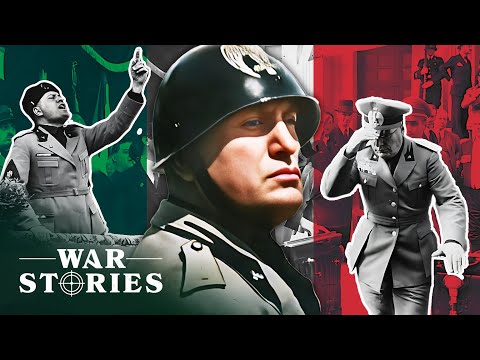
The Rise and Fall of Benito Mussolini | Italy's Greatest Evil
Mussolini: The Rise of a Dictator
Early Life and Influences
- Mussolini was seen as a unifying force for the Italian people, instilling faith and belief in his leadership. His background as a writer and editor allowed him to understand the power of ideas and expression.
- He developed a nationalist ideology that resonated with those who felt dispossessed or socially dislocated by World War I, particularly due to dissatisfaction with the Treaty of Versailles in 1919.
- Mussolini captivated audiences through effective body language and facial expressions during his speeches, while also employing violence from the start of his regime to suppress opposition.
Family Background
- Mussolini's mother, Rosa, was an ardent Catholic and local school teacher who ensured her children attended church regularly. His father, Alessandro, worked as a blacksmith and influenced Mussolini's early political thoughts.
- Young Benito admired revolutionary leaders like Karl Marx but also feared his father's disciplinary methods. This complex relationship shaped his personality—combining admiration with fear.
Childhood Behavior
- As a child, Mussolini exhibited willfulness and aggression; he struggled with speech initially but later became bright yet difficult.
- At age 10, he was expelled from school for stabbing another student—a sign of early violent tendencies. His time at boarding school left him feeling rejected due to perceived lack of warmth at home.
Political Awakening
- Between 1912 and 1914, Mussolini served as editor for the Italian Socialist Party newspaper "Avanti," where he honed journalistic skills while preparing for revolution.
- With the outbreak of World War I, he supported Italian intervention against party lines; this led to his expulsion from both the Socialist Party and "Avanti" in 1914.
Establishing Influence
- After starting his own publication "Il Popolo d'Italia," Mussolini gained support from industrialists eager for war benefits and foreign governments wanting Italy on their side.
- He served in the military until June 1917 when injury led to discharge; he leveraged wartime experiences to promote solidarity among soldiers while developing a nationalist ideology appealing to many disillusioned Italians post-war.
Capitalizing on National Discontent
- Post-war Italy faced significant unrest due to unmet territorial promises from treaties; this national pride wound provided fertile ground for Mussolini’s rise.
The Rise of Fascism in Italy
Introduction to Mussolini's Ideology
- Mussolini's new party aimed to create a third way between liberalism and bolshevism, introducing a unique ideology.
- Central to fascist ideology was the establishment of a strong totalitarian state that controlled all aspects of life, including politics, economy, culture, and private life.
The Role of the Black Shirts
- The Black Shirts served as the paramilitary wing of the Fascist Party, engaging in violent actions against socialist and communist organizations.
- They were perceived as defenders against communism, gaining support from industrialists and landowners who feared a Red Revolution.
Mussolini's Leadership Style
- Mussolini became a unifying figure for Italians through his vision and charisma; he captivated audiences with effective body language and speeches.
- His public persona created a cult of leadership around him, fostering national unity not seen in recent history.
The March on Rome
- By October 1922, the Fascists felt empowered to stage their coup known as the March on Rome on October 28th.
- Although mythologized as an unstoppable force with claims of 100,000 marchers, only about 20,000 participated while waiting outside Rome for orders.
Seizure of Power
- Political power shifted to the Fascists without armed conflict when King Victor Emmanuel III invited Mussolini to form a government after overruling Prime Minister Facta’s call for a state of siege.
- Following this transfer of power, violence became integral to maintaining control; opposition was swiftly suppressed under anti-fascist laws enacted by Mussolini.
Consolidation of Control
- In 1925, suspicion alone could lead to imprisonment without trial under new laws targeting anti-fascist sentiments.
- The establishment of OVRA (Organization for Vigilance and Repression of Anti-Fascism), acted as secret police tasked with eliminating political opposition.
Legislative Measures Against Opposition
- After surviving multiple assassination attempts in 1926, Mussolini introduced laws that dissolved all political parties opposing fascism.
The Rise of Mussolini and Fascism in Italy
The Electoral Manipulation and Violence
- Mussolini's regime gained two-thirds of the parliamentary seats through a law designed to favor fascists, marking a significant shift in Italian politics.
- The 1924 elections were characterized by violence and intimidation, solidifying Mussolini's power after the introduction of this law.
- Socialist politician Giacomo Matteotti publicly denounced electoral fraud and violence, questioning the legitimacy of the election results shortly before his assassination by fascists.
The Aventine Secession
- In response to Matteotti's murder, anti-fascist parties abandoned the Chamber of Deputies in a protest known as the Aventine secession, demanding action from King Victor Emmanuel III against Mussolini.
- Mussolini countered this political maneuver with a notorious speech on January 3, 1925, asserting his leadership over fascism while challenging anti-fascists to prosecute him for their claims.
Consolidation of Power
- In his speech, Mussolini claimed sole responsibility for all actions taken under his regime, signaling a decisive turn towards dictatorship in Italy. He emphasized that stability was necessary for Italy’s future.
- This marked the end of any remaining liberal state structures as Mussolini aimed to establish a one-party totalitarian state.
Propaganda and Public Support
- As an adept propagandist, Mussolini understood the importance of media control in maintaining power; he utilized his background as a journalist to shape public perception effectively.
- The fascist government introduced various popular policies including youth groups and social organizations that promoted mass leisure activities like tourism and cultural events. These initiatives significantly increased public support for the regime.
Key Policies and Economic Impact
- A pivotal policy was the Lateran Treaty (1929), which recognized Vatican City as sovereign and established Catholicism as Italy's official religion—this move resonated well with Italy’s predominantly Catholic population.
The Rise of Mussolini: A Complex Legacy
Early Perception of Mussolini's Regime
- In the early years, Mussolini was viewed positively due to successful public works schemes and policies that kept the economy stable and the population content.
- Many international figures praised Mussolini, claiming he was a genius who transformed Italy from a demoralized state into a thriving nation, famously noted for making "the trains run on time."
- Despite surface-level successes, deeper scrutiny revealed underlying issues; Mussolini's earlier socialist roots contrasted sharply with his later expansionist ambitions.
Expansionist Ideology and Military Ambitions
- By 1925, Mussolini had shifted to advocating for "spazio vitale," or living space, reflecting a fascist ideology focused on territorial expansion reminiscent of Hitler’s Lebensraum concept.
- His vision included creating a new Roman Empire by expanding Italian influence beyond the Mediterranean Sea.
- Historical context showed Italy's previous failures in territorial acquisitions, particularly in Ethiopia, which fueled Mussolini's desire for revenge and expansion.
The Invasion of Ethiopia
- On October 1935, Italian troops invaded Ethiopia as part of their aggressive expansionist policy under Mussolini’s regime.
- The invasion was marked by violations of international law; Italy used chemical weapons against both military and civilian targets despite being signatories to the Geneva Protocol banning such actions.
International Response and Consequences
- The League of Nations condemned Italy’s invasion and attempted to impose economic sanctions; however, these measures proved largely ineffective due to insufficient global support.
- This failure highlighted the ineffectiveness of the League before World War II and demonstrated that dictators like Mussolini could act without fear of repercussions from international bodies.
Domestic Impact and Popularity Surge
- Surprisingly, sanctions against Italy increased Mussolini's popularity domestically; celebrations erupted following military victories in Ethiopia in May 1936.
The Relationship Between Mussolini and Hitler: A Complex Alliance
Early Influences and Ideological Affinities
- Mussolini's policies evolved as the Italian fascist state aligned more closely with Hitler's Nazi regime, leading to financial support for the Nazi party in the late 1920s.
- Mussolini viewed the rise of Nazism as a validation of his own ideology, believing that fascism was spreading beyond Italy to Germany and potentially elsewhere.
- Despite this public alignment, Mussolini privately scorned Hitler, finding his ideas simplistic and even describing "Mein Kampf" as boring.
- Hitler admired Mussolini’s March on Rome, which influenced his own failed coup attempt in November 1923; however, Mussolini held a low opinion of Hitler's ascent to power.
Initial Meetings and Cultural Differences
- The first meeting between Mussolini and Hitler in Venice (June 1934) was disastrous due to language barriers; Mussolini assumed he could manage without a translator.
- During their discussions, Mussolini found himself bored by Hitler's lengthy monologues and was unimpressed by his ideological views.
- While both leaders shared some beliefs about European superiority, Mussolini rejected Hitler’s extreme anti-Semitism, focusing instead on Italian nationalism rooted in ancient Roman glory.
Diverging Views on Race
- In one speech, Mussolini expressed pity for Nazi racial theories, viewing Germans as inferior descendants of illiterate Romans from Caesar’s time.
- Following their summit in Venice, both leaders left with little respect for each other; they recognized significant differences in their ideologies.
Strengthening Ties Through Military Displays
- In September 1937, during a state visit to Germany, Mussolini witnessed grand military parades designed to impress him and solidify their ideological camaraderie.
- This visit led to the formation of the Rome-Berlin Axis in 1936 and later culminated in the Pact of Steel formalized in 1939.
Shift Towards Racial Policies
- By the late 1930s, there was a noticeable shift where Mussolini began adopting policies heavily influenced by Nazi ideology.
- New reforms included mandatory goose-stepping for Italian forces and military uniforms for civil servants—signifying closer ties with Nazi practices.
- In 1938, Italy enacted racial laws restricting civil rights for Jews—mirroring aspects of Nazi legislation but stopping short of systematic extermination.
The Rise and Fall of Mussolini: A Historical Overview
Early Successes and Growing Jealousy
- Mussolini's initial reaction to Hitler's aggressive expansion was one of jealousy, as he observed Germany's swift victories in Poland and the West. He hoped for a German defeat to alleviate his bitterness about their success.
- As Germany continued its advance, capturing the Low Countries and France, Mussolini felt compelled to declare war on June 10, 1940, despite Italy's military unpreparedness.
Deteriorating Military Position
- By 1943, Italy's military situation became untenable with defeats in North Africa during the Tunisian campaign and setbacks on the Eastern Front against the Soviet Union. This marked a significant turning point for Italian forces.
- The Allies' invasion of Sicily further exacerbated Italy’s struggles, leading to widespread bombing campaigns that crippled factories and caused severe shortages of essential resources like coal, oil, and food. This resulted in rampant inflation and a burgeoning black market.
Public Discontent and Loss of Support
- As conditions worsened by March 1943, strikes erupted in Northern Italy’s industrial heartland due to discontent with Mussolini’s regime amid increasing dependence on Nazi Germany. Public opinion began shifting against him as people viewed Allied forces as liberators rather than invaders.
- On July 24-25, 1943, Mussolini was ousted from power through a vote of no confidence amidst widespread public discontent; his downfall was met with celebration rather than resistance from the populace.
Final Days and Death
- By late April 1945, Mussolini recognized his impending doom; he attempted to flee but was captured by partisans who executed him on April 28th. His death symbolized not only personal failure but also the collapse of fascism in Italy.
Turn any video into a summary like this
YouTube links, meetings, lectures. With transcripts, search, and chat.