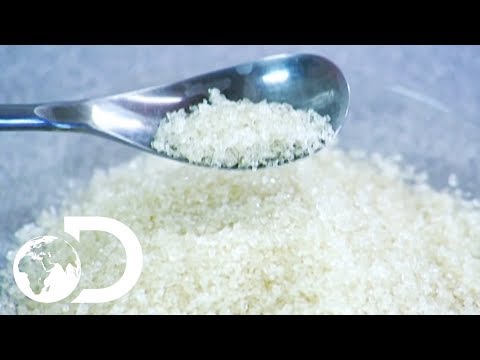
SUGAR | How It's Made
How is Sugar Extracted from Sugar Cane?
Harvesting and Initial Processing
- The harvesting machines cut the sugar cane at its base, allowing for efficient collection.
- After cutting, the heavier lengths of cane are transported via a conveyor to a transport bin, which leads to trucks that unload onto a receiving table.
- The cane undergoes two washes to ensure cleanliness before juice extraction; it is then crushed by rotating hammers into small pieces.
Juice Extraction Process
- In the milling tandem, the crushed cane passes through multiple mills where large cylinders compress the fiber, extracting juice while leaving behind dry pulp known as bagasse.
- A worker supervises each mill operation; juice collected from both top and bottom flows into a vat for further processing. Samples are tested in the Sugar Mills Laboratory for purity.
Clarification and Alkalization
- A thickener is added to bind impurities in the juice before filtering it for clarity; this process includes measuring sugar concentration with a polarometer.
- Sulphatation occurs as sulphur dioxide vapors rise through a 10-meter tower, bleaching the juice before pH measurement takes place. Workers prepare lime solution to mix with the juice for alkalization over six hours, changing its color from brown to yellow.
Settling and Further Processing
- The clarified juice settles in clarifier tanks for over two hours, allowing impurities (sludge) to fall while clear juice rises to the top; mud residue is filtered out for additional sugar extraction. No waste is produced as mud fertilizes fields and bagasse serves as fuel.
- The clarified juice then boils in evaporators, increasing sugar concentration from 15% up to 60%. It collects in tanks where sediment floats on top and is skimmed off by rotating paddles. This syrup undergoes more processing with sucrose crystals added suspended in alcohol to draw out sugar effectively.
Crystallization and Centrifugation
- Boiling continues in vacuum pans until thick crystallized paste (masquite) forms; workers monitor crystallization closely during this phase. Next, masquite enters high-speed centrifugal machines that spin at 1,200 RPM to separate molasses from sugar crystals effectively.
- Water sprays wash away remaining moisture from crystals post-separation; this centrifuge functions similarly to a washing machine's spin cycle but for sugar production purposes. Raw sugar retains more molasses compared to bleached plantation white sugar produced hereafter.
Final Drying and Packaging
- Dried raw or white sugar exits through conveyor belts into large dryers where air reduces humidity levels down to 0.02%, suitable for table use; bags fill when they reach 1000 kilos weight before being hoisted away for packaging processes at scale of 200,000 bags daily!