AP Bio Unit 8: Ecology Simplified — The Complete Crash Course
Preparing for Ecology and AP Biology Exams
Overview of Topics Covered
- The video aims to prepare students for the comprehensive unit A test on ecology and the AP Biology exam, covering essential topics.
- Key areas include responses to the environment, energy flow in ecosystems, matter flow (biogeochemical cycles), population growth formulas, community ecology, biodiversity (Simpson biodiversity index), and ecosystem disruption.
- A checklist for studying AP Biology Unit 8 is available at apbiosuccess.com/checklist.
Responses to the Environment
- Topic 8.1 focuses on responses to environmental stimuli; it lacks specific guidance due to general objectives set by the College Board.
- The discussion will utilize case studies and examples to help students interpret data sets relevant for exams.
Case Study: Predator Warnings in Belding's Ground Squirrels
Understanding Alarm Signals
- Predator warnings or alarm signals are calls made by social animals when facing predator threats; studied extensively in Belding's ground squirrels.
- These squirrels have distinct warning calls for aerial predators (e.g., hawks, eagles) versus terrestrial threats (e.g., bobcats, coyotes).
Altruism in Animal Behavior
- Alarm calls are altruistic behaviors that increase risk to the caller but protect others; this raises questions about why animals would sacrifice themselves.
- Concepts of kin selection and inclusive fitness explain altruism: genes may promote survival not just of individuals but also their relatives.
Kin Selection and Inclusive Fitness Explained
Definitions and Implications
- Kin selection refers to gene value based on its effect on relatives' survival rather than just individual survival.
- Inclusive fitness suggests that sacrificing oneself can benefit close relatives sharing similar genes, increasing those genes' frequency in a population.
JBS Haldane's Perspective
- British biologist JBS Haldane famously stated he would sacrifice himself for two brothers or eight cousins, illustrating kin selection principles through genetic relationships.
Paul Sherman's Study on Belding's Ground Squirrels
Research Methodology
- Paul Sherman conducted a study observing Belding's ground squirrels' behavior regarding alarm calls based on age class (juveniles vs. adults).
Findings from Graph Analysis
- The study revealed significant differences between male and female movement patterns from their natal burrows over time; females remain closer while males venture further away.
Understanding Kin Selection and Inclusive Fitness
Alarm Calls in Ground Squirrels
- Sherman observed alarm calls among ground squirrels, prompting predictions about which calls were made by males versus females based on kin selection and inclusive fitness.
- Females emitted over 60% of the first alarm calls despite being only 30% of the population, while males, representing 20%, called less than 5% of the time.
- The disparity indicates that females are more likely to take risks for calling than males, suggesting a higher level of altruism among females.
- Females call to warn close relatives (e.g., sisters, daughters), while males do not see sufficient benefit to offset their risk when calling.
- This behavior exemplifies kin selection and inclusive fitness principles in animal behavior.
Altruism and Usociality
- The concept of usociality is introduced as a social structure where some individuals breed while others remain non-reproductive; this is seen in species like bees and ants.
- In bee colonies, a single queen reproduces while thousands of worker bees care for larvae without reproducing themselves.
- Other examples include ants, wasps, termites, and certain mammals like naked mole rats that exhibit similar reproductive structures.
Haplodiploidy Explained
- Haplodiploidy explains reproductive roles in eusocial animals: females are diploid with two sets of chromosomes; males are haploid with one set.
- A diploid queen produces gametes through meiosis passing on half her genes to daughters; haploid drones pass on all their genes since they develop from unfertilized eggs.
- Sisters share an average genetic relatedness of 75%, making it genetically advantageous for them to support the queen's reproduction rather than producing their own offspring.
Implications of Eusociality
- The genetic explanation highlights why female workers prioritize creating more sisters over having their own offspring due to higher relatedness.
- Notably, eusociality can exist independently from haplodiploidy as seen in termites and naked mole rats.
Metabolism Overview
- Transitioning into metabolism concepts: metabolism encompasses all chemical processes within an organism affecting energy use and expenditure.
- Understanding metabolic rates is crucial for comprehending how organisms utilize energy during various activities.
Metabolic Rates and Ecosystem Dynamics
Understanding Metabolic Rate
- The basal metabolic rate (BMR) is the energy consumed by an organism at rest in a comfortable environment, not necessarily while sleeping.
- BMR can be measured through oxygen consumption and carbon dioxide production using specialized metabolism measuring machines.
- Two major metabolic strategies are discussed: ectotherms (cold-blooded) and endotherms (warm-blooded), with endotherms generating heat metabolically from cellular respiration.
Ectotherms vs. Endotherms
- Endotherms maintain a constant internal body temperature regardless of environmental conditions, allowing for activity in various temperatures.
- Ectotherms' body temperature aligns with the surrounding environment, leading to lower energy requirements—about one-tenth that of endotherms per gram of tissue.
- Examples include polar bears and penguins as endothermic animals thriving in cold environments due to their ability to regulate body heat.
Temperature's Impact on Metabolism
- In ectotherms, metabolic rates increase with temperature; higher temperatures lead to higher metabolic activity.
- For endothermic organisms, metabolic rates must be high at low temperatures to generate sufficient heat for maintaining a stable internal environment.
Ecosystem Structure
- An ecosystem comprises living populations and abiotic factors like air, soil, water, and energy flow within it.
- Food chains represent the transfer of energy and matter between organisms; food webs illustrate interconnected food chains within an ecosystem.
Trophic Levels Explained
- Trophic levels indicate an organism's position in a food chain or web: producers create energy via photosynthesis; primary consumers eat producers; secondary consumers eat primary consumers; tertiary consumers eat secondary consumers.
- Decomposers play a crucial role by breaking down dead organisms at any trophic level but are often omitted from basic diagrams.
Energy Flow in Ecosystems
- The pyramid of energy illustrates harvestable chemical energy available at each trophic level, showing that only 10% of energy is transferred up each level.
- This 10% rule arises because some energy is lost as heat during transformations according to the second law of thermodynamics.
Understanding Trophic Levels and Energy Transfer
Harvest Efficiency in Ecosystems
- Organisms, such as caterpillars, do not consume all parts of their food sources; they leave behind leaves' stems and roots, indicating limits to harvest efficiency.
- The 10% rule illustrates the average energy transfer between trophic levels, emphasizing that not all consumed energy is assimilated by organisms.
Ecological Pyramids
- The pyramid of biomass represents the dry weight of living mass transferred from producers to consumers, which can sometimes appear counterintuitive due to rapid producer growth.
- In certain ecosystems like the English Channel, biomass pyramids may not follow traditional shapes due to varying growth rates between producers and consumers.
- The pyramid of numbers can also vary in shape; for example, one tree may support thousands of herbivores, leading to a non-pyramidal structure.
Biogeochemical Cycles Overview
- A biogeochemical cycle illustrates how elements move between biotic (living) and abiotic (non-living) components within an ecosystem through reservoirs and fluxes.
- Reservoir examples include carbon dioxide in the atmosphere and carbon stored in plants. Fluxes describe processes like photosynthesis that transfer these elements.
Exploring the Carbon Cycle
Carbon's Versatility
- Carbon's four valence electrons allow it to form diverse structures essential for life’s key molecules including carbohydrates, lipids, proteins, and nucleic acids.
Mechanisms of the Carbon Cycle
- The cycle begins with atmospheric carbon dioxide being fixed into carbohydrates during photosynthesis. Respiration returns some carbon back into the atmosphere.
- Animals consume plant carbohydrates, transferring carbon into their bodies. Cellular respiration by animals also contributes to atmospheric CO2 levels.
Decomposition and Fossilization
- Upon death, both plants and animals contribute their carbon compounds to decomposers like fungi and bacteria which return CO2 through decomposition processes.
- Fossilization occurs when plant matter accumulates beyond decomposition capacity over time, forming fossil fuels such as coal or oil.
The Nitrogen Cycle: An Essential Element
Nitrogen's Abundance
- Nitrogen constitutes 78% of Earth's atmosphere but exists as N2 gas held together by a strong triple bond requiring significant energy (16 ATP molecules needed for reduction).
This structured approach provides clarity on complex ecological concepts while allowing easy navigation through timestamps for further exploration.
Understanding the Nitrogen Cycle
Importance of Nitrogen in Biology
- Nitrogen is crucial for biological processes, found in polypeptide backbones and amino acids, which are essential for protein formation.
- It is also a component of nitrogenous bases in nucleic acids (DNA and RNA) and modified polysaccharides like chitin, which forms insect exoskeletons.
The Process of Nitrogen Fixation
- Atmospheric nitrogen (N2) enters the biosphere through nitrogen fixation, converting N2 into ammonia compounds that plants can absorb.
- This process occurs via symbiotic bacteria in legume root nodules or free-living archaea and bacteria in soil.
Nitrification and Assimilation
- Nitrifying bacteria convert ammonia compounds into nitrites and nitrates, making them accessible to non-nitrogen-fixing plants.
- Animals obtain nitrogen by consuming plants; when organisms die, decomposers return nitrogen to the soil through ammonification.
The Complete Nitrogen Cycle
- Denitrifying bacteria convert nitrates back into nitrogen gas (N2), completing the cycle from atmosphere to biosphere and back again.
Exploring the Water Cycle
Overview of the Hydrosphere
- The hydrosphere encompasses all water on Earth, including liquid (oceans, lakes), frozen (ice caps), and gaseous states (water vapor).
Mechanisms of Water Movement
- Water does not change its chemical form during the cycle but transitions between liquid, gas, and solid states.
- Evaporation from oceans initiates the water cycle as heat causes water to enter the atmosphere as vapor.
Cloud Formation and Precipitation
- As water vapor rises, it cools and condenses into clouds—composed of liquid droplets—not steam.
- Transpiration from plants also contributes to atmospheric moisture before precipitation returns water to Earth.
Groundwater Flow and Runoff
- After precipitation, water runs off into streams/rivers or percolates into groundwater. This flow eventually returns water to oceans.
The Phosphorus Cycle: Key Concepts
Role of Phosphorus in Biological Systems
- Phosphorus exists primarily as phosphate ions or groups within biological systems; it's vital for energy transfer as seen in ATP.
Phosphorus Cycle and Population Dynamics
Understanding the Phosphorus Cycle
- The phosphorus cycle begins with phosphate as part of the sugar phosphate backbone in cellular communication, highlighting its dual nature due to hydrophobic and hydrophilic properties.
- Phosphate is initially locked in rocks and released into soil through weathering, becoming available for plant uptake.
- Plants assimilate phosphate from the soil, which can then be consumed by animals; upon death, their phosphate returns to decomposers for recycling back into the soil.
- In aquatic systems, weathering leads to phosphate runoff into water bodies, where it can be assimilated by algae before entering the food chain through consumption.
- Sedimentation removes phosphates from biosphere circulation for millions of years until geological processes return them to the surface.
Impending Phosphate Crisis
- A phosphate crisis looms as sedimentation in aquatic systems prevents quick replenishment of phosphates; mining is unsustainable since it's a nonrenewable resource.
Factors Influencing Population Size
- Four primary factors affect population size: births (increase), deaths (decrease), immigration (increase), and emigration (decrease).
Exponential Growth Explained
- Exponential growth occurs when populations double at consistent rates over time intervals, leading to rapid increases proportional to current population size.
- The formula for exponential growth is Δn/Δt = r * n, where n is population size, t is time, and r represents the rate of increase.
Conditions for Exponential Growth
- Ideal resources allow exponential growth; however, this phase is limited by environmental carrying capacity represented by K.
- Historical examples include early phases of epidemics like COVID-19 showcasing rapid population spread under ideal conditions.
Understanding Population Dynamics and Carrying Capacity
Limiting Factors in Population Growth
- The environment imposes limiting factors that restrict population growth as it approaches its carrying capacity (K). Increased environmental resistance occurs, slowing down exponential growth.
- Density-dependent limiting factors become significant as population density increases. These include competition for resources, parasitism, and increased predation risk.
- As populations grow denser, stress levels rise among individuals, which can lower their reproductive rates and overall population growth.
Logistic Growth Model
- To better understand population dynamics under limiting factors, the logistic growth model is introduced. This model illustrates how a population's growth rate decreases as it nears its carrying capacity (K).
- The formula for logistic growth is presented: Δn/Δt = r * n * (K - n)/K, where n is the current population size, t is time, r is the intrinsic rate of increase, and K represents carrying capacity.
Application of the Logistic Growth Formula
- An example demonstrates how to apply the logistic growth formula with K set at 1,000. If n equals 10 initially, the expression (K - n)/K results in a value close to 1 (0.99), indicating exponential growth.
- When increasing the population to 900, the expression changes significantly to reflect a much lower potential for further growth due to nearing K.
Types of Limiting Factors
- Limiting factors affecting populations can be classified into extrinsic and intrinsic categories. Extrinsic factors arise from outside influences like predation and competition; intrinsic factors stem from internal physiological stresses within the growing population.
- Density-independent limiting factors are also discussed; these are unrelated to population size or density. Examples include natural disasters such as hurricanes or human-induced events like oil spills.
Understanding Population Regulation through Graph Analysis
- A student experiment involving duckweed serves as an illustration for identifying key concepts: carrying capacity (B), exponential growth phase (A), and density-independent regulation (C).
- Two scenarios are presented regarding what happens when populations exceed their carrying capacities: oscillation due to resource depletion versus catastrophic overshoot leading to severe declines in populations.
This structured overview captures essential insights into how populations interact with their environments through various limiting factors while emphasizing key models used in ecological studies.
Population Dynamics and Symbiosis in Ecology
Population Growth Patterns
- A catastrophic overshoot of carrying capacity can lead to environmental collapse, resulting in a crash of shrub and deer populations without recovery, causing serious degradation.
- Predator-prey population cycles are illustrated through data on lynxes (predators) and hares (prey), with historical data collected from trading companies in Canada during the 1800s.
- The lynx population increases as hare numbers rise due to more available food; however, this leads to a decline in hare populations as they are over-predated.
- Hare population dynamics are also influenced by food availability and interspecific competition, showcasing the complexity of biological interactions.
- Encouragement is given for students to utilize resources like learn-mology.com for tutorials and unit reviews to better understand these complex concepts.
Understanding Symbiosis
- Symbiosis refers to close interactions between two species where one may benefit while the other is harmed, both may benefit, or one may be unaffected.
- A shorthand system is used to describe symbiotic relationships: plus (+) indicates gain, minus (-) indicates loss, and zero (0) indicates no effect.
Types of Symbiotic Relationships
Competition
- Competition occurs when two species require the same resource leading to a minus-minus interaction; examples include leopards and lions competing for prey or Douglas fir trees competing for light and nutrients.
Mutualism
- In mutualism, both species benefit from their interaction (plus-plus). An example includes clownfish living among anemones where both parties gain safety and food respectively.
Predation
- Predation involves one animal killing another for food (plus-minus relationship). Examples include leopards hunting bushbucks or kingfishers catching tadpoles.
Herbivory
- Herbivory describes animals eating plants (also a plus-minus relationship), such as deer grazing on trees or caterpillars consuming leaves.
Commensalism
- Commensalism benefits one species while leaving the other unaffected (plus-zero relationship); examples include cattle egrets perching on cattle or moss growing on tree trunks.
Parasitism
- Parasitism involves a parasite living on or within a host organism causing harm (plus-minus relationship); viruses serve as an example of obligate intracellular parasites that reproduce at the host's expense.
Understanding Parasitism and Ecological Niches
Types of Parasitism
- Viruses act as parasites by infecting various types of cells, including those from humans, animals, plants, and bacteria. The host is the organism that the virus infects.
- Giardia is a single-celled eukaryote that causes intestinal issues in humans when ingested through contaminated food or water. It reproduces in the intestines and spreads via feces.
- Brood parasitism occurs when one bird species lays its eggs in the nest of another species, leading to the host species raising the parasite's young at the expense of its own.
- Parasitoidism primarily involves insects where one species lays eggs on or inside another species' larvae or eggs, eventually killing them. This relationship is also characterized as win-lose.
- There are more parasitic species than any other animal niche, indicating a significant ecological role for parasitism in ecosystems.
Competition and Co-evolution
Defining Ecological Niche
- An ecological niche describes how an organism makes a living within its environment. Various organisms have adapted different niches based on their roles (e.g., predators, herbivores).
Gaus's Competitive Exclusion Principle
- Gaus's principle states that two competing species cannot coexist in the same ecological niche without some form of differentiation; otherwise, one will outcompete and lead to extinction of the other.
- In experiments with two paramecium species occupying different niches (bottom vs. surface), they coexisted successfully due to differing lifestyles.
Resource Partitioning and Character Displacement
- Over time, competition can lead to resource partitioning where competing species evolve traits allowing them to exploit different parts of shared resources effectively.
- Character displacement refers to evolutionary changes that reduce competition by enhancing differences between similar species (e.g., variations in beak shape among shorebirds).
Economic Analogy for Resource Partitioning
- An analogy using coffee companies illustrates resource partitioning: Starbucks targets mainstream consumers with specialty drinks; Peet’s focuses on coffee purists; Phil’s offers customizable pour-over options—each catering to distinct customer preferences while minimizing direct competition.
Resource Partitioning and Ecomorphs
Understanding Resource Partitioning
- Resource partitioning leads to the development of ecomorphs, species that are morphologically adapted to specific niches. In Caribbean islands, lizards have adapted to various parts of the forest canopy.
- Different types of lizards include crown giants, trunk crown, trunk ground, and grass bush lizards, showcasing how resource partitioning influences their adaptations.
Convergent Evolution in Ecomorphs
- Ecomorphs from different regions can develop similar traits through convergent evolution. For example, crown giant lizards exist on multiple Caribbean islands but are not closely related.
- This phenomenon is also observed in other lizard types like trunk crowns and trunk grounds across these islands.
Case Study: Beak Depth in Galapagos Finches
Beak Adaptations
- A dataset on beak depth among three Galapagos finch species illustrates adaptation for exploiting different food types.
- On islands with multiple finch species (island sets A and B), there is no overlap in beak depth due to niche partitioning driven by competition.
Implications of Competition
- In smaller islands (D & E), where only one bird species exists, there is an overlap in beak depth due to lack of competition.
- The absence of competition allows for character displacement to decrease as seen in single-species scenarios.
Niche Concepts: Fundamental vs Realized Niche
Definitions and Examples
- The fundamental niche represents the potential range of resources a species could exploit without competition; the realized niche reflects what it actually exploits within its competitive context.
- An intertidal zone study involving two barnacle species shows that when one is removed, the other expands into its territory—demonstrating differences between fundamental and realized niches.
Species Comparison
- Species A has a wider fundamental niche than its realized niche since it can colonize areas occupied by Species B when removed.
- Conversely, Species B's fundamental niche aligns closely with its realized niche as it cannot expand into areas dominated by Species A.
Evolutionary Arms Races
Mechanisms of Adaptation
- Evolutionary arms races involve positive feedback loops where adaptations in one species lead to counter-adaptations in another. These dynamics are common in predation and parasitism contexts.
- Such adaptations may relate to speed, camouflage, or weaponry—both physical and chemical—as seen with cheetahs evolving speed due to prey selection pressures.
Examples of Counter-Adaptive Strategies
- The remarkable camouflage abilities of certain insects or alligators arise from evolutionary pressures exerted by predators or prey with acute sensory capabilities.
Understanding Keystone Species and Trophic Cascades
What are Keystone Species?
- Keystone species are crucial in structuring biological communities, often acting as predators that regulate herbivore populations, thereby enhancing overall biodiversity.
Example of Sea Stars
- Sea stars serve as a prime example of keystone species; they prey on various animals in the intertidal zone, particularly mussels.
- The removal of sea stars leads to a significant drop in biodiversity because their predation creates ecological space for other invertebrates.
- A notable experiment by Robert Payne in the 1960s demonstrated that when sea stars were removed, mussels overgrew the intertidal zone, causing a decline in species diversity.
Trophic Cascades Explained
- Keystone species are linked to trophic cascades—system-wide changes triggered by the addition or removal of a single species affecting multiple trophic levels.
Case Study: Wolves in Yellowstone
- The reintroduction of wolves into Yellowstone National Park in the 1990s illustrates a trophic cascade; wolves preyed on elk, which had previously overgrazed aspen and willow trees.
- This regrowth provided habitats for beavers, leading to increased biodiversity among amphibians, fish, and songbirds due to improved aquatic environments.
Predator Dynamics
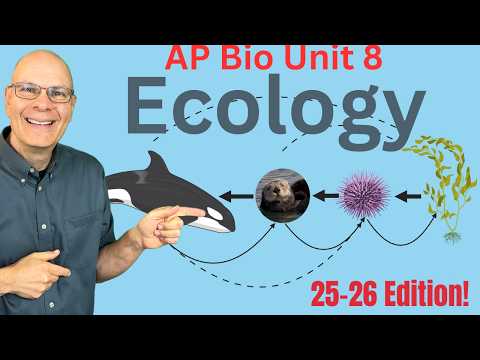
- Notably, top predators aren't always keystone species. James Estes' study revealed that orcas shifting from seals to otters led to unchecked urchin populations that devastated kelp forests.
Data Interpretation Importance
- Understanding data sets related to these dynamics is essential for AP Biology exams; they illustrate how predator-prey relationships impact ecosystem health.
Ecosystem Engineers
- Not all keystone species are apex predators; beavers act as ecosystem engineers whose dams create habitats for numerous other species, thus increasing biodiversity.
The Importance of Biodiversity
Defining Biodiversity
- Biodiversity encompasses the variety and variability of life within an area and includes components like ecosystem diversity (e.g., mountains vs. meadows), species diversity (number of different species), and genetic diversity (variability within a species).
Resilience Through Diversity
- Increased biodiversity enhances resilience—the ability of ecosystems to respond to change. For instance, monoculture fields with low genetic diversity are more susceptible to pathogens compared to diverse grasslands where multiple species can withstand threats.
The Importance of Biodiversity and Ecosystem Resilience
The Connection Between Biodiversity and Ecosystem Resilience
- Converting grasslands into cornfields is not sustainable; maintaining biodiversity is crucial for ecosystem resilience.
- Biodiversity is intrinsically beneficial, providing joy through the variety of ecosystems and species.
- An example of biodiversity's benefit to humanity includes the Pacific Yew shrub, which contains anti-cancer compounds used in treatments.
Benefits of Maintaining Biodiversity
- Loss of species leads to loss of potential benefits; many undiscovered compounds in diverse ecosystems could be vital for human health.
- Ecosystem services provided by biodiversity include oxygen production from photosynthesis and carbon dioxide absorption by healthy oceans, both essential for mitigating climate change.
Understanding Diversity in Ecological Communities
- Within the AP biology curriculum, diversity is discussed in two units: Unit 7 focuses on variability within species, while Unit 8 emphasizes species diversity.
- Species richness (number of species in an area) and species evenness (distribution among those species) are key components for comparing community diversity.
Analyzing Community Diversity
- Community A has three evenly distributed species; Community B has four evenly distributed species; Community C has four but unevenly distributed individuals.
- Community B ranks as the most diverse due to its higher species richness and evenness compared to Communities A and C.
Calculating Simpson Diversity Index
- To compare communities accurately, the Simpson diversity index formula is introduced. It considers individual counts per species relative to total community size.
- For Community A, calculations show a diversity index value of 0.67 after summing squared proportions of each species' individuals over total individuals.
Continuing with Other Communities
- For Community B, similar calculations yield a lower diversity index than expected due to equal distribution across four species despite having more members overall.
Understanding Community Diversity Through the Simpson Diversity Index
Analyzing Community C's Diversity
- Community C has 12 individuals, with 9 belonging to species 1. The calculation for species richness yields a value of 75 when using little n / big n (12) and squaring it results in 563.
Calculating Species Diversity
- For species 2, 3, and 4, each has one individual. The calculations yield a diversity value of approximately 0.08 for each species after applying the same formula as before. Squaring this gives a result of about 0.7 for each species.
Comparing Communities A and C
- After summing the values from all species in community C, we find a total of 0.583 which leads to a final diversity index of 0.42 when subtracted from one. This indicates that community C has lower diversity than community A despite having four species due to low evenness among them.
Insights on Community Diversity Rankings
- The analysis shows that community B exhibits the highest diversity at an index of 0.75 due to both high richness and evenness; community A follows with slightly lower richness but still high evenness; while community C’s low evenness results in its lower diversity index compared to A despite higher richness than A itself.
Ecosystem Disruption and Biodiversity Loss
Human Impact on Biodiversity
- Human activities are driving biodiversity loss globally by creating isolated populations that face genetic drift and inbreeding, leading to reduced genetic diversity and fitness over time, ultimately resulting in smaller populations through a vicious cycle or positive feedback loop.
Understanding Eutrophication
- Eutrophication occurs when water bodies become overly enriched with nutrients like phosphorus and nitrogen, primarily due to agricultural runoff and sewage discharge, leading to excessive algae growth which disrupts aquatic ecosystems and reduces biodiversity significantly.
Mechanism of Eutrophication
- Agricultural runoff introduces excess nitrates/phosphates into waterways which removes limiting factors for algae growth; as algae die off, decomposers consume oxygen during respiration leading to hypoxic conditions causing fish die-offs and plant mortality—resulting in dead zones within aquatic environments.
Biomagnification: The Dangers of Pesticides
Concept of Biomagnification
- Biomagnification refers to the increasing concentration of certain substances like pesticides as they move up trophic levels within an ecosystem; historical examples include DDT nearly wiping out bald eagles during the mid-20th century due to its accumulation through food chains.
Pathway of DDT Accumulation
- DDT is hydrophobic and accumulates in fat rather than being excreted; it enters ecosystems via aerial spraying or agricultural runoff at low concentrations but builds up significantly as primary consumers eat producers containing DDT, further concentrating it as secondary consumers feed on primary ones until reaching apex predators like eagles where levels peak dramatically.
Impact of DDT on Bald Eagles and Ecosystem Disruption
Effects of DDT on Bald Eagles
- The accumulation of DDT in bald eagles led to metabolic effects, notably eggshell thinning, which caused the eggs to break easily.
- This eggshell thinning resulted in decreased reproductive success and a significant population decline among bald eagles exposed to DDT.
- Following the ban of DDT in 1972, there was a gradual recovery of the bald eagle population, allowing its removal from the endangered species list in 2007.
Human Impact on Ecosystems
Habitat Alteration and Destruction
- Urban development, agriculture, and recreational areas like golf courses destroy natural habitats for various species.
- A large portion of Earth's surface has been modified for human use, contributing significantly to species extinction.
Overexploitation of Resources
- Overharvesting and hunting have led to the extinction of species such as the Tasmanian wolf and passenger pigeon; American bison were nearly hunted to extinction.
Habitat Fragmentation
- Fragmenting large habitats into smaller patches through roads or development creates isolated populations that suffer from reduced adaptability.
- Increased edge habitat disrupts conditions necessary for survival compared to interior habitats.
Introduction of Invasive Species
- Invasive species are adaptable generalists with high reproduction rates that can outcompete local species and disrupt food chains.
Deforestation
- Cutting down forests disrupt ecosystems; tropical rainforests are particularly rich in biodiversity but are severely affected by deforestation.
Climate Change as an Ecosystem Disruptor
Carbon Emissions and Global Warming
- Since the Industrial Revolution, fossil fuel combustion has reintroduced carbon into the atmosphere, increasing levels from under 300 ppm to over 400 ppm today.
Greenhouse Gas Effects
- Elevated carbon dioxide levels trap heat more effectively than natural levels would allow, leading to global temperature increases.
Consequences of Rising Temperatures
- Increased temperatures result in forest fires, glacier retreat, flooding due to increased precipitation, and drought in other regions.
Unpredictable Ecological Impacts
- Changes caused by climate change lead to unpredictable disruptions in animal and plant habitats globally.
Path Forward: Renewable Resources
- Urgent action is needed towards adopting renewable energy sources like solar or wind power to mitigate these environmental issues effectively.