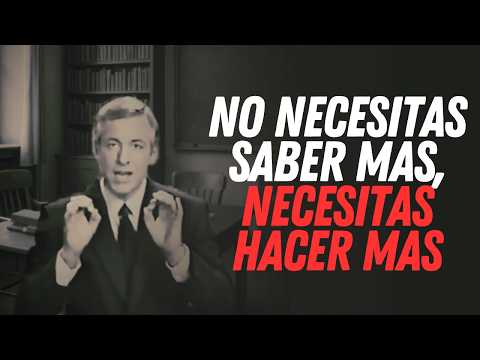
No necesitas más información, necesitas más acción | Brian Tracy
The Illusion of Knowledge and Action
The Accumulation of Knowledge vs. Action
- Accumulating knowledge without application leads to a mountain of excuses rather than progress; reading and consuming content without action creates a false sense of advancement.
- Procrastination becomes more sophisticated as one accumulates knowledge, leading to elaborate justifications for inaction, creating an illusion of intellectual progress while actually hindering real growth.
The Moment of Clarity
- There is a specific moment after consuming insightful content where clarity strikes, revealing necessary changes; however, this feeling can be mistaken for actual change.
- The brain releases similar chemicals during understanding and actual transformation, making it easy to confuse comprehension with genuine life changes.
The Trap of Rationalization
- Intelligent individuals often rationalize their inaction by convincing themselves they need more knowledge before acting; these arguments seem logical but are ultimately detrimental.
- Reflecting on the past six months reveals how little learned information has translated into tangible change, highlighting a disconnect between knowledge and action.
Practical Wisdom (Fronesis)
- Ancient Greeks recognized "phronesis," or practical wisdom, which only manifests through correct actions rather than mere discussion or theoretical understanding.
- Accumulating unutilized knowledge creates an "implementation debt," where the gap between what one knows and does grows larger over time.
The Cycle of Learning Without Application
- Many people find themselves trapped in a cycle where they seek more knowledge to feel better about not applying what they already know.
- Repeatedly learning the same fundamental lessons without change indicates that the acquired knowledge remains unintegrated into daily habits.
True Integration of Knowledge
- Real knowledge becomes irreversible once integrated into life; it transforms one's worldview and automatic responses to situations.
- Crossing the bridge from understanding to repeated action requires effort and humility, as it involves admitting ignorance through practice rather than mere discussion.
The Power of Implementation Over Accumulation
The Essence of Practical Knowledge
- The speaker emphasizes that true knowledge comes from hands-on experience rather than theoretical learning, illustrated by the example of a carpenter who improves through practice rather than reading extensively.
- They argue that knowledge embodied in habits and automatic responses is the only real possession, contrasting it with mere information that lacks practical application.
Shifting Mindsets: From Collector to Implementer
- A radical shift is proposed: moving from being a collector of ideas to an implementer who measures success by transformation rather than accumulation.
- When encountering a resonant idea, one should stop seeking more information and instead apply it immediately in small, manageable ways.
The Importance of Deep Commitment
- The speaker stresses the need for deep commitment to a single idea until it becomes part of one's identity before pursuing new concepts.
- This focus may feel restrictive but reveals the problem of being overwhelmed by excessive information without committing deeply to any single concept.
Mastery Through Simplicity
- True mastery involves understanding one thing thoroughly rather than having superficial knowledge across many topics; depth in simplicity outweighs breadth in complexity.
- Engaging with an integrated idea teaches more about oneself and reality than numerous understood concepts because implementation confronts real-world challenges.
Bridging Theory and Practice
- An example illustrates this point: practicing daily gratitude reveals insights about genuine feelings and personal resistance that theoretical understanding cannot provide.
- Sustained practice leads to profound realizations about gratitude as a developed muscle rather than just an emotion, highlighting the value of experiential learning.
Taking Action Now
- The speaker encourages immediate action to close the gap between knowledge and practice by starting with simple tasks one knows they should be doing but aren’t yet implementing.
- By consistently applying what one already knows, individuals can transform their identities from passive learners into active practitioners.
Identity Transformation Through Action
- Consuming knowledge without application reinforces a disconnect between thoughts and actions, leading to unfulfilled potential over time.
- Ultimately, taking action does not require additional knowledge but demands using existing understanding effectively; comfort in learning must be replaced with discomfort in change.
What Action Will You Take After Listening?
The Importance of Taking Action
- The speaker emphasizes that having a detailed map (knowledge) is useless if one does not take action towards their goals.
- Listeners are challenged to consider what specific, actionable steps they will take immediately after the talk, rather than just thinking or understanding differently.
- Acknowledgment of being stagnant under the guise of preparation is crucial; real change begins with recognizing this and deciding to act now.
- Unapplied knowledge can be harmful as it creates a false sense of progress while wasting time that could be used for actual change.
- Admitting to oneself that one has accumulated unnecessary information can be liberating, allowing for a shift from seeking knowledge to taking meaningful actions.