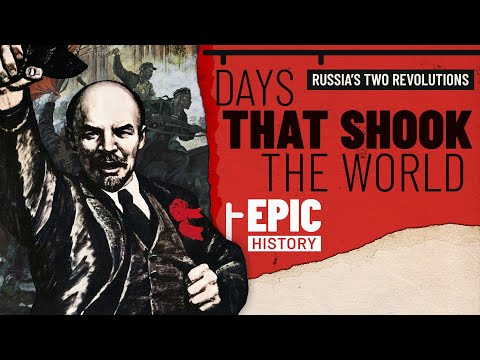
Days That Shook The World: Russia's Two Revolutions of 1917
The Fall of the Romanov Dynasty
The Context of Nicholas II's Reign
- In 1894, Nicholas II ascended to the throne of a vast Russian empire, home to 126 million people from 194 ethnic groups, marked by stark contrasts between the impoverished masses and the opulent elite.
- A history of struggle against systemic injustices culminated in the 1905 revolution, which forced Tsar Nicholas to establish a state duma (national assembly), albeit with limited power.
The Impact of World War I
- By 1914, Russia was embroiled in World War I, exacerbating existing divisions within the empire and leading to widespread crisis.
- The war resulted in catastrophic military defeats for Russia and severe domestic issues like food shortages and economic turmoil; Nicholas II was blamed as he held command over the army.
Rasputin's Influence and Public Unrest
- Empress Alexandra's alleged support for Germany and her family's reliance on mystic Grigory Rasputin fueled public discontent. His assassination in December 1916 did little to alleviate tensions.
- On February 23, 1917, protests erupted in Petrograd for International Women's Day amid bread shortages. These demonstrations escalated as workers joined with anti-Tsar sentiments.
The Abdication of Tsar Nicholas II
- As protests intensified and troops mutinied against orders to suppress them, Tsarist authority crumbled. On March 2nd, under pressure from ministers, Nicholas abdicated after three centuries of Romanov rule ended swiftly.
Formation of Provisional Government
- Following the February Revolution’s bloodless nature, hopes rose for a democratic Russia. Members of the State Duma formed a Provisional Government pending a new constitution through an elected Constituent Assembly.
- However, this government shared power with the more radical Petrograd Soviet that controlled essential city functions but supported continued involvement in WWI—a decision that would prove detrimental.
Rise of Bolshevik Influence
- Vladimir Lenin returned from exile advocating for immediate land redistribution and transferring power to local Soviets. His slogan "Bread, Peace and Land" resonated deeply amidst growing crises.
- A disastrous military offensive led to massive casualties in June; subsequent unrest saw soldiers mutinying alongside workers despite violent crackdowns by loyalist forces.
Kornilov Affair and Bolshevik Ascendancy
- Alexander Kerensky became Prime Minister amid chaos while General Kornilov attempted a coup under claims that Lenin was undermining efforts—Bolsheviks defended Petrograd successfully during this crisis.
- This event solidified Bolshevik status as protectors of revolution; by late September they gained majority control within the Petrograd Soviet.
October Revolution: Seizing Power
- On October 25th (Julian calendar), Bolsheviks executed their plan seizing key locations across Petrograd culminating in storming the Winter Palace—their propaganda immortalized this moment.
The Fate of Tsar Nicholas II and the Russian Civil War
The Fall of the Romanov Family
- Some factions among the White forces aimed to restore Tsar Nicholas II to power after his abdication, during which he and his family were held under guard at Tsarskoye Selo.
- In July 1918, as White forces neared Yekaterinburg, Bolshevik soldiers executed Nicholas II, his wife Alexandra, their son Alexei, four daughters (Olga, Tatiana, Maria, Anastasia), and four servants in a cellar.
Impact of the Russian Civil War
- The civil war resulted in approximately 2 million military deaths; additionally, a typhus epidemic and famine led to an estimated 9 million civilian casualties.
Establishment of Soviet Power
- By late 1921, the Bolsheviks had secured victory in the civil war. Under Lenin's leadership, they began constructing a new socialist state.
- The Soviet Union was officially established in 1922 and later emerged as a global superpower following its role in defeating Nazi Germany during World War II.
Suppression of Dissent
- Despite initial hopes for democracy post-February Revolution, these aspirations were quashed by the Bolshevik October Revolution.
- The Soviet regime became characterized by single-party rule where opposition was systematically suppressed for decades.
Additional Information