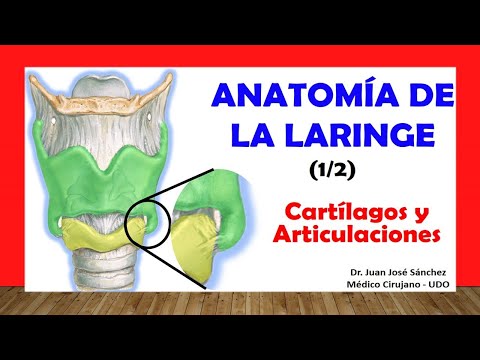
🥇 ANATOMÍA DE LA LARINGE 1/2, (Cartílagos y Articulaciones). Fácil, Rápido y Sencillo
Anatomy of the Larynx: General Overview
In this section, the speaker introduces the topic of laryngeal anatomy, discussing its generalities and its role as a crucial organ in the respiratory system.
Generalities of the Larynx
- The larynx is a hollow organ that connects upwards to the pharynx and downwards to the trachea. It serves as the initial organ of the respiratory tract.
- The larynx plays vital functions such as allowing air passage and acting as a valve with the epiglottis closing to prevent food from entering the airways.
- Anatomically, it extends from the superior border of the thyroid cartilage (approximately C3 level) to the inferior border of the cricoid cartilage (C6 level), with variations in size between genders.
Cartilages of the Larynx
This section delves into detailing the different cartilages that form and protect the larynx.
Thyroid Cartilage
- The thyroid cartilage is a shield-shaped structure located in front of the neck below C4 level, consisting of two plates interrupted by a central depression known as "thyroid notch."
- It features oblique lines, superior horns, and inferior horns for articulation purposes within its structure.
- The prominence seen in males on this cartilage is referred to as Adam's apple or laryngeal prominence.
Anatomy of the Larynx
In this section, the speaker delves into the anatomy of the larynx, highlighting key structures and their functions.
Cartilage Structures in the Larynx
- The Cricoid cartilage is crucial as its lower border marks the beginning of the trachea and esophagus.
- The cricoid cartilage has an anterior arch-like structure and a posterior lamina.
- The Epiglottis cartilage is unique as it is made of elastic cartilage, with a wider upper part tapering to a narrower lower part known as pedicle.
- The Arytenoid cartilages resemble pitchers or vocal cords, with a conical shape resting on the cricoid cartilage's shoulder.
Corniculate and Cuneiform Cartilages
- Corniculate cartilages have a horn-like shape and articulate with arytenoid cartilages.
- Cuneiform cartilages are less common, floating structures supported by ligaments.
Articulations of the Larynx
- The aditus marks the entrance to the larynx, bordered by various cartilages like corniculate and cuneiform.
New Section
In this section, the speaker discusses the muscles involved in controlling the thyroid cartilage and vocal cords, highlighting their role in producing different vocal tones.
Muscles Involved in Vocalization
- The cricothyroid muscles play a crucial role in adjusting the position of the larynx by contracting and elongating the vocal cords to produce various tonalities in voice.
Articulation and Functionality
- The cricothyroid ligament allows for the opening at the entrance of the larynx, facilitating sound production through adjustments made by the cricothyroid muscles.
Laryngeal Ligaments
- The thyroid membrane connects the upper edge of the thyroid cartilage to the hyoid bone, contributing to structural support within the larynx.
- The lateral thyroid ligament extends from the greater horn of the thyroid cartilage to the greater horn of the hyoid bone, providing additional stability to these structures.
New Section
This segment delves into further details regarding laryngeal ligaments and their anatomical significance for vocalization.
Ligamentous Structures
- The lateral thyrohyoid ligament envelops a circular cartilage known as "cricoid," aiding in structural integrity within the larynx.
Neurovascular Passage
- Perforations within both sides of the thyroid membrane allow passage for neurovascular bundles essential for laryngeal function and innervation.
Vascular Anatomy
- Detailed discussion on how nerves such as internal branch of superior laryngeal nerve, superior laryngeal artery from external carotid artery, and superior laryngeal vein contribute to vascular supply and innervation within this region.
New Section
Exploring further insights into critical ligaments within the larynx that aid in structural support and functionality during phonation.
Thyrohyoid Ligament Details
- Description of how thyrohyoid ligament connects superior borders of thyroid cartilage with hyoid bone, emphasizing its role in maintaining stability within this anatomical region.
Ligamental Composition
- Discussion on two components forming thyrohyoid ligament: a central median ligament (medial thyrohyoid ligament) and lateral ligaments (lateral thyrohyoid ligaments), crucial for structural reinforcement.
Anatomical Significance
Detailed Ligament Structures in the Throat
In this section, the speaker discusses various ligaments that support and connect different structures in the throat.
Ligament Connections
- The ligament connecting the ventricular ligament to all false vocal cords is known as the same ligament. This ligament runs from the epiglottic pedicle to the back of the thyroid cartilage.
- Another important ligament is the thyroepiglottic ligament, which extends from the epiglottic pedicle to the dorsum of the thyroid cartilage.
- There is a ligament between the epiglottis and hyoid bone called the hyoepiglottic ligament, along with a fat pad named pre-epiglottic fat pad.
Epiglottis-Lingual Connection
- A ligament connects the epiglottis to the tongue known as glossoepiglottic midline and lateral ligaments, creating spaces between them.
Membranes in Throat Structure
- The membranous structure extending from vestibular ligament to lateral part of epiglottic cartilage and thyroid cartilage dorsum is termed triangular membrane.
- The quadrangular membrane spans from vestibular ligament to lateral edge of epiglottic cartilage, covered by mucosa.
Surgical Membrane Usage
- A surgical clip separates and maintains dilation behind a membrane used for surgical purposes in tracheal procedures.