Permutación explicación completa | Lineal, Circular y con elementos repetidos
Explanation of Permutations
In this section, the instructor introduces the concept of permutations and discusses different types of permutation cases.
Types of Combinatorics
- There are three main types of combinatorics: combination, permutation, and variation. This lesson focuses specifically on permutations.
- Some sources may combine permutation and variation into one category due to the relationship between them.
Permutation Cases
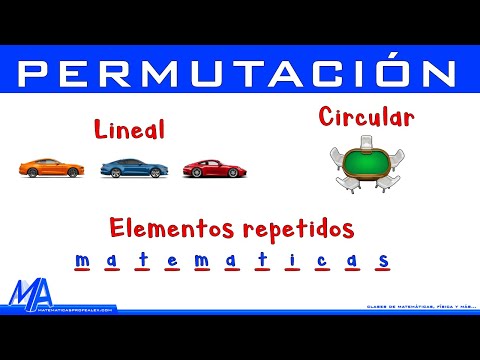
- Three main cases of permutations are discussed: linear permutation, circular permutation, and permutations with repeated elements.
- Linear permutation involves arranging elements in a straight line or path.
- Circular permutation entails arranging elements in a circle or oval.
- The method of "cajitas" (boxes) is introduced as a way to visualize and solve permutation problems effectively.
Example: Permutation Calculation
This section delves into an example problem involving permutations to illustrate the application of concepts discussed earlier.
Problem Solving Process
- Five students compete in a race, each wearing a different colored shirt. The task is to determine the number of ways they can finish the race.
- Exploring how each student can be placed in different positions based on their shirt color.
- Calculating options for each subsequent position based on previous placements.
New Section
In this section, the speaker discusses the concept of permutations and introduces the fundamental rule of counting.
Understanding Permutations
- The speaker explains that permutations involve multiplication to determine different options for positions.
- Introduces the concept of factorial (n!) as a shorthand notation for multiplying consecutive integers.
- Formula for linear permutation: n factorial (n!) where n is the number of elements.
- Demonstrates calculating permutations using factorials, providing a clear example with 5 students resulting in 120 ways.
New Section
This part delves into circular permutations and highlights differences from linear permutations.
Circular Permutations Explained
- Illustrates a scenario of people sitting around a table, discussing how positions are determined differently due to circular arrangement.
- Emphasizes that rotations in circular permutations do not change relative positions.
Permutation Concepts and Examples
In this section, the speaker explains circular permutations and provides examples of linear permutations with and without repeated elements.
Circular Permutations
- Circular permutations are calculated using the formula n-1!, where n is the number of elements.
- Simply apply the formula: for five people, it would be 5-1! = 4! = 24 different ways to arrange them.
Linear Permutations with Unique Elements
- Linear permutation example: How many different words can be formed from the letters in "luna"?
- The word "luna" has unique letters, allowing for various arrangements resulting in 24 possibilities.
Linear Permutations with Repeated Elements
- Exploring permutations with repeated elements using the word "matemáticas."
- When dealing with repeated elements like 'a' and 't,' calculations involve dividing by factorials of repetitions to find unique arrangements.
Permutation Formula for Repeated Elements
This part delves into the formula for permutations involving repeated elements, emphasizing division by factorials of repetitions.
Formula Breakdown
- The permutation formula for repeated elements involves dividing by factorials of each repeating element's count.
Explanation of Permutations with and without Repeating Digits
In this section, the speaker explains permutations using the example of arranging the letters in the word "matemáticas." The audience is given an exercise to solve involving forming numbers with specific digits.
Permutations without Repeating Digits
- The method of "cajitas" (boxes) is introduced for organizing numbers without repeating digits.
- Demonstrates how to calculate permutations without repeating digits using a step-by-step approach.
- Explains the concept of factorial (n!) in calculating permutations without repetition.
Permutations with Repeating Digits
- Discusses how to calculate permutations when digits can be repeated.
- Illustrates the process of determining permutations with repeated digits using examples.
- Provides the total number of ways to write numbers using specific digits when repetition is allowed.
Conclusion and Call to Action
The speaker concludes by inviting viewers to explore more content on the topic, offers recommendations, and encourages engagement through subscribing, commenting, and sharing.