Vértice de una parábola
How to Find the Vertex of a Parabola
Understanding Parabolas
- The video introduces parabolas, illustrating five examples: three opening upwards (in red) and two downwards (in blue).
- It emphasizes that the direction of opening is crucial; parabolas can start from various heights but will always open either up or down.
Importance of the Vertex
- The vertex is highlighted as the most significant point on a parabola, representing either its highest or lowest point depending on its orientation.
- The vertex divides the parabola into two equal halves, one extending left and the other right.
Finding Points in Functions
- A brief overview of graphing functions is provided, noting that values for x are typically chosen to find corresponding y-values.
- The function notation f(x) = x + 2 is introduced, demonstrating how to calculate outputs based on input values.
Calculating the Vertex Coordinates
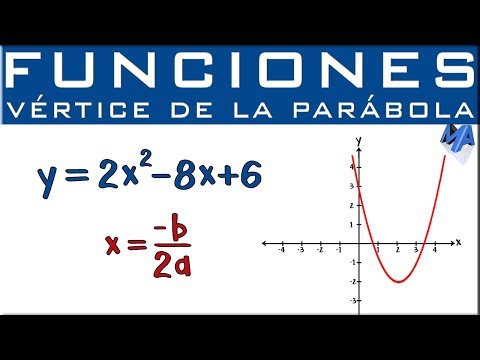
- The process for finding the vertex coordinates (x,y) begins with identifying a quadratic function: y = x² - 8x + 6.
- To find the x-coordinate of the vertex, use the formula: x = -b / (2a), where 'a' and 'b' are coefficients from the quadratic equation.
Steps to Determine Vertex Coordinates
- Coefficients are identified: a = 2 (from x²), b = -8 (from -8x), c = 6.
- Substituting these values into -b / (2a): results in x = 2 after calculations.
Finding y-coordinate of Vertex
- To find y, substitute x back into the original function. Replace 'x' with 2 in y = 2x² - 8x + 6.
Finding the Vertex of a Quadratic Function
Introduction to the Vertex
- The vertex of the quadratic function is identified as the point (2, -2). This serves as a key reference for understanding the function's graph.
Calculating the X-coordinate of the Vertex
- To find the x-coordinate, use the formula -b/(2a). Here, a is 1 (coefficient of x^2), and b is 6 (coefficient of x).
Substituting Values into the Formula
- The calculation proceeds with -6/(2*1), resulting in -3. It's important to note that negative signs must be handled carefully during calculations.
Evaluating the Function at X-coordinate
- Substitute x = -3 back into the function: f(-3) = (-3)^2 + 6(-3) + 3. It’s recommended to perform operations in this order: exponentiation, multiplication, then addition/subtraction.
Final Calculation and Conclusion
Turn any video into a summary like this
YouTube links, meetings, lectures. With transcripts, search, and chat.