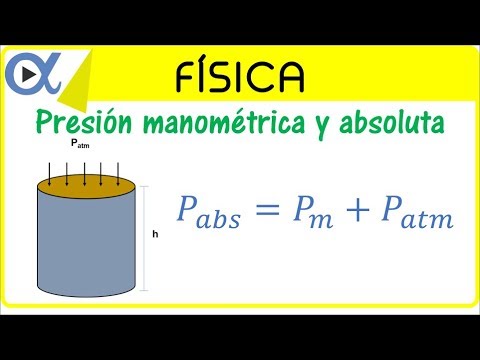
Presión manométrica y absoluta ejemplo 1 | Física: fluidos - Vitual
Calculating Absolute Pressure in a Tank
Introduction to the Problem
- The task involves calculating the absolute pressure at the bottom of a tank filled with oil, which is open to the atmosphere. The tank has a height of 1.8 meters and the density of oil is given as 800 kg/m³.
Key Information Provided
- The height of the tank is specified as 1.8 meters, and the density of oil is noted to be 800 kg/m³.
- Since the tank is open to atmospheric pressure, it’s essential to consider atmospheric pressure in calculations, which is approximately 1.013 x 10^5 Pascals.
Formula for Absolute Pressure
- To find absolute pressure at the bottom of the tank, we use:
- Absolute Pressure = Gauge Pressure + Atmospheric Pressure
- Here, gauge pressure refers to hydrostatic pressure exerted by the fluid.
Understanding Hydrostatic Pressure
- Hydrostatic pressure can be calculated using:
- Hydrostatic Pressure = Density × Gravitational Acceleration × Depth
- This formula indicates that hydrostatic pressure depends on fluid density, gravitational force, and depth measurement.
Calculation Steps
- Substituting known values into our equation:
- Absolute Pressure = (Density × Gravitational Acceleration × Depth) + Atmospheric Pressure
- Using values: Density = 800 kg/m³; Gravitational Acceleration = 9.8 m/s²; Depth = 1.8 m.
Final Computation and Units Conversion
- After performing calculations:
- Resulting units from hydrostatic calculation convert from kg/(m·s²) to Newton per square meter (N/m²), equivalent to Pascals.