Quality Function Deployment & the House of Quality - Simplest Explanation Ever
Understanding Quality Function Deployment
Introduction to Quality Function Deployment (QFD)
- The tutorial introduces Quality Function Deployment (QFD) and the concept of the House of Quality, emphasizing its importance in aligning products with customer expectations.
- QFD is described as a customer-driven quality management process that translates the Voice of Customer (VoC) into engineering specifications.
- The necessity of QFD arises from competitive market pressures, where organizations must meet customer perceptions of quality and value.
Four-Step Process of QFD
- Level 1: Product Definition - Collecting VoC and translating it into product specifications, including competitive analysis.
- Level 2: Product Development - Identifying critical parts and characteristics to create detailed specifications for the product.
- Level 3: Process Development - Outlining manufacturing processes and creating flow diagrams for assembly.
- Level 4: Process Quality Control - Developing control mechanisms for inspection and testing procedures.
The House of Quality
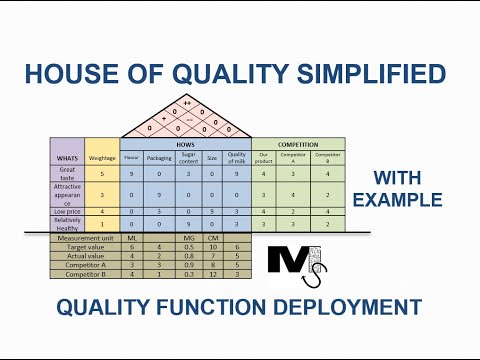
- The House of Quality visually resembles a house, containing sections like customer requirements, product attributes, and competitive assessments.
- An example using a chocolate bar illustrates how to populate the House of Quality by aligning product features with customer needs.
Populating the House of Quality
- Initial step involves listing out customer requirements on the left wall, termed as "the watts" which represent VoC.
- Customer requirements identified include great taste, attractive appearance, low price, and healthiness; these are rated on a scale from one to five based on importance.
Competitive Assessment
- Ratings against competitors are gathered through marketing efforts using prototypes presented to customers for feedback on various factors.
- Assumed ratings for the chocolate bar against competitors are provided based on perceived strengths in each category.
Product Design Features
- Input from engineering outlines necessary design features such as flavor, packaging, sugar content, size, and milk quality that align with VoC.
Relationship Mapping
- The bottom half of the central part rates how well components from VoC relate to product characteristics using ratings indicating strong (9), moderate (3), or weak (0).
Understanding the House of Quality in QFD
Mapping Product Attributes and Relationships
- The attractive appearance in the second row (purple) is strongly related to packaging (blue), while it likely has no relationship with flavor or sugar content. This illustrates how logical ratings are assigned based on interrelationships.
- A system of markers (+, -, 0) indicates whether one product attribute supports, opposes, or has no relationship with another. For example, increasing milk quality enhances flavor (double positive), whereas larger size negatively impacts packaging due to increased requirements.
- The exercise focuses on balancing dependent attributes by examining their intersections and assigning appropriate markers. This helps manage individual attributes effectively.
Completing the House of Quality
- The house of quality is nearly complete; weightage and competitive assessments have been done, but further calculations regarding overall importance of product attributes remain.
- Overall importance is calculated by comparing product attributes against customer feedback. This prioritization process identifies which attributes should be emphasized or deprioritized.
- To calculate importance weight for an attribute like sugar content, multiply its weightage by its relationship values. For instance, sugar content's importance weight calculation yields a total value of 24.
Relative Importance Weight Calculation
- Relative importance weight is derived by dividing the calculated importance weight by the total sum (204 in this case), resulting in a percentage that reflects each attribute's significance—e.g., sugar content at 11.76%.
- Technical specifications from engineering detail actual measures required to meet customer needs and are compared against competitor values for accuracy and relevance.
Finalizing the House of Quality
- The completed house includes all necessary components: weights, competitive assessments, relationships mapping, and technical specifications from engineering teams.
Benefits of Using QFD and House of Quality
- The primary goal of this exercise is to understand customer requirements clearly and allocate resources accordingly to meet those needs effectively.
- Implementing QFD fosters cross-functional collaboration among departments towards common objectives—ensuring alignment on priorities reduces waste and optimizes resource utilization.
- While initially complex, simplifying the house into manageable components allows effective completion using inputs from relevant departments for better clarity in fulfilling customer demands.