Leo Strauss on Existentialism
Introduction to Leo Strauss on Existentialism
In this section, the speaker introduces the article by Leo Strauss on existentialism and its significance. The focus is on Martin Heidegger's influence on Strauss and the importance of understanding existentialism.
Leo Strauss and Martin Heidegger
- Leo Strauss delivered a lecture in 1956 at the Hillel foundation of the University of Chicago discussing Martin Heidegger.
- Heidegger was of great significance to Strauss and considered the greatest thinker of their time.
- Understanding Heidegger's ideas is crucial for comprehending Strauss's works.
Purpose of Going Over the Article
- The speaker finds it interesting to analyze this article or speech given by Strauss on existentialism.
- It aims to help Jewish students face the perplexities of modern Jewry with greater clarity.
Existentialism and Socratic Warning
- Existentialism reminds us that thinking is incomplete if we forget ourselves as individuals.
- This concept aligns with Socratic philosophy, which also emphasized self-awareness.
- The lecture explores whether there is a direct correspondence between existentialist and Socratic thought.
Thinking Individual and Self-Knowledge
This section delves into the idea that thinking individuals must not forget themselves and emphasizes self-knowledge over scientific knowledge.
Importance of Self-Knowledge
- Existentialism highlights that thinking individuals should not forget who they are.
- It references Plato's dialogue "Theaetetus" where Theodorus represents a purely objective person who lacks self-awareness.
- Science cannot answer questions about one's identity or personal defects.
Limits of Scientific Knowledge
- Science provides provisional and hypothetical results, making it insufficient for answering questions about oneself honestly.
- Existentialism suggests that examining ourselves without the pride and pretense of scientific knowledge can be more helpful.
Existentialism as a Nameless Movement
This section explores the nature of existentialism as a nameless movement and its association with Martin Heidegger.
The Nature of Existentialism
- Existentialism is a school of philosophical thought that lacks a specific name like other philosophies.
- It is compared to pragmatism or positivism, which are also nameless movements.
Significance of Martin Heidegger
- Martin Heidegger revolutionized philosophical thought in Germany and Continental Europe.
- His influence even extended to Anglo-Saxon countries.
- Leo Strauss was deeply impressed by Heidegger's seriousness, profundity, and concentration in interpreting philosophical texts.
Leo Strauss's Encounter with Franz Rosenzweig
This section recounts Leo Strauss's encounter with Franz Rosenzweig and their discussion about Martin Heidegger's impact on philosophy.
Impression of Martin Heidegger
- Leo Strauss first heard Martin Heidegger speak in 1922 and was greatly impressed by his precision, probing nature, competence, seriousness, profundity, and concentration.
- Comparisons were made between Heidegger and Max Weber, another influential figure at the time.
- The breadth of Heidegger's revolutionary thinking became evident to Strauss over time.
Dethroning Established Schools of Philosophy
- Heidegger's ideas caused a significant shift in German philosophy, leading to the downfall of established schools.
- A famous debate between Heidegger and Kasir in Davos exposed the limitations of traditional academic philosophy.
Summary
Leo Strauss delivered a lecture on existentialism focusing on Martin Heidegger's influence. Existentialism reminds us not to forget ourselves as thinking individuals, emphasizing self-knowledge over scientific knowledge. It is a nameless movement that owes its significance to Heidegger's revolutionary ideas. Leo Strauss was deeply impressed by Heidegger's interpretation of philosophical texts and witnessed the impact of his thinking on German philosophy.
The Disappearance of Ethics in Philosophy
This section discusses the shift in philosophy where ethics was no longer considered important. Heidegger declared that ethics is impossible, leading to an abyss in philosophical thought.
New System of Philosophy without Ethics
- Heidegger introduced a new system of philosophy where ethics had disappeared.
- Ethics was silently dropped without facing the problem it posed.
Heidegger's Awareness of the Abyss
- Heidegger acknowledged that the absence of ethics opens up an abyss.
- His whole being was permeated by this awareness.
Influence of Edmund Husserl and Edmund Hospital
- Edmund Husserl's phenomenology was critiqued by Heidegger, which became decisive.
- Strauss highlights that Heidegger's critique radicalized Hospital's own questioning.
- The Marburg neoconton School, where Strauss was trained, made the mistake of starting with science instead of a deeper understanding.
Science as a Modification of Pre-scientific Understanding
- Science is not the perfection or ultimate understanding of the world but a specific modification.
- It is derived from our primary pre-scientific understanding.
- A scientific social or political science also rests on this modification.
Need for Pre-scientific Phenomenology
- To have a solid foundation in science, one must grasp the pre-scientific understanding.
- Dismissing everything pre-scientific as irrational or mythological undermines scientific knowledge.
The Primacy of Pre-scientific Understanding
This section emphasizes the importance of pre-scientific understanding before engaging with scientific explanations. It explores how our primary understanding is not based on objects but on pragmata (things we handle and use).
Primary Understanding Before Scientific Explanation
- Our primary understanding precedes scientific explanations and mathematical physics interpretations.
- There exists something simpler, more naive, and fundamental before scientific constructions.
Analysis of the Sensibly Perceived Thing
- Heidegger's inquiry into "what is a thing" focuses on the analysis of sensibly perceived things.
- The merely sensibly perceived thing is derivative and not the first encounter with things.
Understanding Pragmata Instead of Objects
- Our primary understanding is not of things as objects but as pragmata (things we handle and use).
- This understanding forms the basis for our engagement with the world.
The Life World and Being-in-the-World
This section explores Heidegger's concept of the life world, which precedes scientific interpretations. It highlights how our embeddedness in this world shapes our actions and understanding.
Attention to the Life World
- Heidegger directs attention to our life world, where we are embedded and have all our doings.
- The life world exists before scientific interpretations through mathematical physics.
More Fundamental than Husserl's Phenomenology
- According to Strauss, Heidegger's emphasis on the life world is even more fundamental than Husserl's phenomenology.
The Genesis of Science from Pre-scientific Understanding
This section delves into the genesis of science from pre-scientific understanding. It emphasizes that starting with science alone misses important aspects of interpretation and valuation.
Problem of Meaningful Genesis
- The meaningful genesis of science from pre-scientific understanding poses a problem.
- Primary theme: philosophical understanding of the pre-scientific world and analysis of sensibly perceived things.
Importance of Pre-scientific Understanding
- Pre-scientific understanding is crucial before engaging in scientific explanations or interpretations.
Taking Steps Back in Philosophical Inquiry
This section discusses the need to take steps back in philosophical inquiry, beyond valuing objects, to understand the world and our actions.
Objects and Valuation
- Heidegger's response to Hospital is that we don't encounter objects that get valued.
- Understanding objects solely through valuation is not the primary approach.
Cup of Coffee Example
- Using the example of a cup of coffee, Heidegger highlights that it is best understood within our life world.
- It is not merely an object or a bundle of sense perceptions but has practical significance in our daily activities.
Attention to Life World and Doings
- Heidegger turns attention to our life world and how it shapes our understanding and actions.
- This perspective goes beyond scientific interpretations.
Understanding Objects and Consciousness
In this section, the speaker discusses the concept of objects and consciousness as explored by the Greeks and phenomenologist Edmund Husserl. The Horizon within which Husserl analyzed pre-scientific understanding was pure consciousness as absolute being.
Pragmata - Things We Handle and Use
- The Greeks referred to objects as "pragmata," which are things we handle and use in our daily lives.
- Examples of pragmata include cups of coffee, pens, hammers, utensils, and implements.
Pure Consciousness as Absolute Being
- Husserlian phenomenology emphasizes that pure consciousness is the absolute being.
- This insight radicalizes Descartes' idea of objects in consciousness.
- According to Husserl, for consciousness, the world is reduced to the world for oneself.
Heidegger's Depth vs. Husserl's Consciousness
- Heidegger takes a different approach from Husserl regarding depth of understanding.
- Heidegger believes that consciousness alone does not reach the depth he aims for.
- The Horizon within which Husserl analyzed pre-scientific understanding was pure consciousness as absolute being.
Competing Philosophical Positions
In this section, the speaker discusses how philosophical positions have lost significance and power in Continental Europe. Rational liberal philosophic positions are considered inadequate by Strauss.
Loss of Significance in Power
- Rational liberal philosophic positions have lost their significance in power according to Strauss.
- Neotomism and Marxism are mentioned as existing philosophic positions apart from rational liberalism.
Need for a Solid Basis for Rational Liberalism
- Strauss suggests that a solid basis for rational liberalism needs to be found through great thinkers.
- However, he points out that only Heidegger stands out as a great thinker in their time.
Competence to Judge Great Thinkers
- The question of whether Heidegger's teaching is true or not is more important than its compatibility with liberalism.
- Strauss questions the competence of judging the thought of great thinkers, suggesting that only great thinkers themselves may be competent to judge.
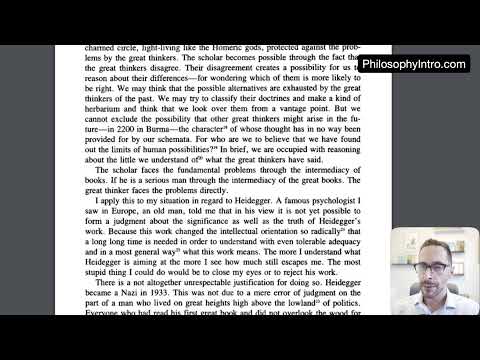
The Scholar and the Great Thinker
In this section, the speaker explores the distinction between scholars and great thinkers. Scholars depend on the work of great thinkers but approach problems cautiously and methodically.
The Role of Scholars
- Scholars are dependent on the work of great thinkers and face fundamental problems through books.
- They are cautious, methodic, and do not become lost in inaccessible heights like great thinkers.
Boldness vs. Caution
- Great thinkers are bolder than scholars but also more cautious.
- They see pitfalls where scholars are sure of their ground.
- Scholars live in a protected circle due to the work of great thinkers.
Reasoning About Differences
- Disagreements among great thinkers create possibilities for scholars to reason about their differences.
- Scholars reason about what they have understood from the little they comprehend from the works of great thinkers.
Reasoning About Great Thinkers
In this section, the speaker emphasizes that although it may be challenging to judge a great thinker's correctness, scholars can engage in reasoning by comparing different accounts and thinking through their disagreements.
Occupied with Reasoning
- Scholars are occupied with reasoning about what they have understood from the works of great thinkers.
- This includes at least Heidegger since he is considered one of the greatest thinkers since Hegel.
Engaging with Disagreements
- Disagreements among great thinkers provide an opportunity for scholars to reason about their differences.
- By putting accounts against each other, scholars can try to think through the various perspectives.
Limits of Human Possibilities
- Scholars cannot exclude the possibility of new great thinkers emerging in the future with thoughts beyond current understanding.
- The limits of human possibilities are not yet fully known, and scholars continue to reason about what they have understood.
Conclusion
The transcript discusses the concepts of objects and consciousness, the loss of significance in power for rational liberal philosophic positions, and the role of scholars in reasoning about great thinkers. It highlights Husserl's emphasis on pure consciousness as absolute being and Strauss' questioning of competence in judging great thinkers. The distinction between scholars and great thinkers is explored, emphasizing the cautious approach of scholars compared to the boldness and caution of great thinkers. Scholars engage in reasoning by comparing different accounts and thinking through disagreements among great thinkers.
Understanding Heidegger's Work
The speaker discusses the difficulty in forming a judgment about the significance and truth of Heidegger's work. It is emphasized that a thorough understanding of his work requires time and effort.
Significance of Heidegger's Work
- It is not yet possible to fully comprehend the meaning of Heidegger's work due to its radical intellectual orientation.
- The more one understands his work, the more they realize how much still escapes them.
- Closing one's eyes or rejecting his work would be a foolish mistake.
Heidegger and Nazism
- In 1933, Heidegger became associated with the Nazi movement.
- There is a clear connection between Heidegger's thought and the Nazis, evident in his contempt for reasonableness and praise for resoluteness.
- When he was Rector of the University of Freiburg, he delivered an official speech aligning himself with the Nazi movement.
Controversy Surrounding Heidegger
- Despite this association, Heidegger has not openly acknowledged his speech or mentioned it in his writings.
- In 1953, he published lectures from 1935 where he spoke positively about the National Socialist movement.
- The case of Heidegger can be compared to Nietzsche, who also had connections to fascism despite not supporting Hitler directly.
Justification for Rejecting Heidegger's Work
The speaker explores whether there is any valid justification for rejecting Heidegger's work based on his association with Nazism.
Understanding Heidegger's Thought
- Those who have read Heidegger's first great book could see similarities between his thought and Nazi ideology.
- The contempt for reasonableness and emphasis on resoluteness in his work align with extremist movements.
Lack of Mentioning Controversial Speech
- Heidegger has not dared to mention his speech aligning himself with the Nazi movement in any of his writings.
- Despite this omission, he published a book in 1953 where he praised the National Socialist movement.
Comparisons to Nietzsche
- The case of Heidegger is similar to Nietzsche, who also had connections to fascism but would not have supported Hitler directly.
- Both philosophers rejected conservative constitutional monarchy and democracy in favor of a new aristocracy.
Challenges Faced by Democracy
The speaker discusses the challenges faced by democracy and questions whether it can adequately address them.
Decline of Europe
- The decline of Europe poses a significant danger to Western heritage, comparable to the threats faced by Mediterranean civilization around 300 CE.
- The United Nations organization is insufficient as an answer to political problems and the decline of Europe.
Criticisms of Democracy
- France and logical positivism are mentioned as examples that highlight the limitations of democracy.
- While these systems may not lead to concentration camps or gas chambers, their shortcomings raise concerns about the absence of unspeakable evils being sufficient justification for their flaws.
Specialization and Universal Philistianism
The speaker reflects on the dangers posed by specialization and universal philistianism in society.
Specialization's Impact
- Nietzsche described how specialization in Continental Europe during the second half of the 19th century led to a lack of focus on essential matters.
- Knowing more about less resulted in an inability to concentrate on crucial aspects necessary for human wholeness.
Sham Universality
- Specialization is compensated by a sham universality that stimulates various interests and curiosities without true passion.
- This leads to dangers such as universal philistianism (lack of cultural appreciation) and creeping conformism.
The Jewish Problem and Cultural Pluralism
The speaker explores the Jewish problem and the challenges of cultural pluralism.
Israel's Role
- Israel is praised for its nobility, but it does not provide a solution to the Jewish problem.
- The concept of "Judeo-Christian tradition" blurs differences and cultural pluralism at the cost of losing distinct identities.
Listening to Critics of Democracy
- It is important for thinking individuals to listen to critics of democracy, even if they are enemies of democracy.
- Great thinkers can offer valuable insights into the flaws and challenges faced by democratic systems.
This summary provides an overview of the main points discussed in the transcript. For a more comprehensive understanding, it is recommended to refer to the original transcript.
New Section
This section discusses the concept of existentialism and the experience of anxiety as a fundamental aspect of human existence. It also explores the notion that this uneasiness is not limited to modern times but is essential to all humans throughout history.
Existentialism and Anxiety
- Existentialism refers to a certain experience of anguish or anxiety.
- The basic character of anxiety is not guaranteed by the experience itself, but rather by argument.
- There is a vaguely felt uneasiness that is not faced directly, which existentialism considers as the authentic interpretation of this fundamental uneasiness.
- This uneasiness must be regarded as essential to all humans, not just present-day individuals.
Uneasiness and Belief in Progress
- The vaguely felt uneasiness can be seen as the culmination of what earlier ages have thought.
- A belief in progress is another element generally accepted today.
- Modern science has failed to reveal the true nature of the universe and man's place in it, leading to a change in its character and claim towards the end of the 19th century.
- Science cannot provide guidance on how to use its power wisely or answer questions about its meaningfulness or goodness.
New Section
This section delves into the limitations of science in providing value judgments and establishing its own meaningfulness. It highlights how science has led to a flight from scientific reason and challenges the assumption that science can guide rational action.
Science and Value Judgments
- Science cannot make value judgments or establish meaning on its own.
- The assertion that value judgments are impermissible for scientists has shifted towards recognizing that rational conclusions can be drawn from scientific findings.
- The flight from scientific reason is a consequence of science distancing itself from reason and rationality.
Due to limitations in the provided transcript, the summary may not capture the full context and depth of the video.
New Section
The nature of modern science and its relationship to classical political science is discussed, highlighting the absence of value judgment in science and the concept of progress being replaced by change.
The Value-Free Nature of Science
- Science in modern times lacks the ability to make value judgments.
- Classical political science treated man as a rational being and addressed the concept of a well-lived life.
- Science no longer allows for discussions on progress in a meaningful human sense.
- The concept of progress has been replaced by the concept of change.
New Section
The absence of value judgment in science leads to a groundless choice in pursuing scientific orientation, as well as alternative orientations. The idea that science is based on fundamental hypotheses is introduced.
Groundless Choice in Scientific Orientation
- Science does not provide a rational basis for choosing it over other alternatives.
- Choosing science or alternative orientations becomes a groundless decision.
- Science acknowledges that it is based on fundamental hypotheses that remain unproven.
- The structure of science does not rest on evident necessities.
New Section
The acceptance of scientific orientation presupposes freedom, leading to existentialist implications. The groundlessness of science opens the door to existentialism.
Existential Implications
- The choice of scientific orientation implies accepting a groundless choice and an abyss.
- Fundamental freedom is the only non-hypothetical phenomenon.
- Existentialism arises from recognizing the limitations and groundlessness of science.
New Section
The failure of positivistic science to address meaningful aspects of human life creates an opportunity for rational philosophy. A search for true metaphysics and ethics begins.
In Search of Rational Philosophy
- Positivistic science fails to provide meaningful insights into human life.
- Existentialism and positivism do not offer a satisfactory solution.
- The search for a rational philosophy that encompasses true metaphysics and ethics begins.
- The neo-Thomists are mentioned as one possible source of rational philosophy.
New Section
The challenge of finding a rational philosophy in the midst of profound disagreements among great thinkers is discussed. The danger of weak eclecticism is highlighted.
Challenges in Finding Rational Philosophy
- Sitting at the feet of great philosophers like Plato and Aristotle may lead to weak eclecticism.
- Disagreements among past thinkers make it difficult to appeal to them without blurring their differences.
- Rational philosophy is being replaced by the theory of comprehensive views or worldviews.
- The abandonment of the idea of truth as a rational concept leads back to the abyss of freedom.
New Section
The difficulty in finding true teachings from past philosophers is acknowledged, raising questions about blending different schools of thought and exposing oneself to weak eclecticism.
Blending Different Schools of Thought
- Sitting at the feet of old philosophers may lead to weak eclecticism.
- Profound disagreements among great thinkers raise doubts about their teachings' validity.
- Avoiding weak eclecticism requires recognizing the singleness of purpose and inspiration characterizing every great thinker.
New Section
Rational philosophy is being replaced by theories of comprehensive views or worldviews, which admit that there are multiple ways to answer fundamental questions without any being superior. This leads back to the abyss of freedom.
Theory of Comprehensive Views
- Rational philosophy is increasingly replaced by theories that acknowledge multiple answers to fundamental questions.
- No single metaphysical or ethical teaching from past thinkers can be considered rationally superior.
- The abandonment of the idea of truth as a rational concept leads back to the abyss of freedom.
New Section
The transcript concludes with a reflection on the profound disagreements among great thinkers and the challenge of finding a rational philosophy that encompasses true metaphysics and ethics.
Reflection on Disagreements Among Great Thinkers
- The profound disagreements among great thinkers make it challenging to find a rational philosophy.
- Plato's doctrine of ideas and Aristotle's doctrine of Noose are mentioned as examples.
- Sitting at the feet of old philosophers may expose one to weak eclecticism.
- Finding a philosopher who possesses true metaphysics and ethics remains elusive.
Existential Freedom
In this section, Leo Strauss discusses the concept of comprehensive views and their limitations in understanding the fundamental questions of human existence. He emphasizes the importance of recognizing the true nature of great thinkers' teachings and cautions against treating them merely as worldviews.
The Limitations of Comprehensive Views
- Comprehensive views presuppose that all fundamental possibilities are available and that human creativity has reached its end.
- There is a radical disproportion between analysts of comprehensive views who do not directly face the fundamental questions and great thinkers themselves.
- Analysts often separate themselves from thinkers by claiming knowledge of the utopian character of original philosophy, which creates a deep gulf between them.
- Treating great thinkers' doctrines as mere worldviews from an analytical perspective leads to a misunderstanding of their significance.
- Great thinkers did not perceive their teachings as worldviews but rather as true accounts of the nature of being and humanity.
Understanding Thinkers on Their Own Terms
- Scholars analyzing philosophers like Kant, Plato, or Aristotle solely as worldviews miss out on understanding the profound significance of each doctrine.
- Scholars who believe they are superior to great thinkers because they view their thoughts as worldviews are delusional.
- It is challenging for scholars to truly understand thinkers if they do not approach them in the way these thinkers intended to be understood.
- The history of moral philosophy demonstrates that rational philosophers may have profound disagreements in other respects but still agree regarding human conduct.
Grounding Comprehensive Views in Human Existence
- The only way out for comprehensive views is to find their grounding in the human soul or more broadly, in the Human Condition.
- Taking this step brings one closer to existentialism, as it recognizes that multiple worldviews can be grounded in human existence itself.
The Value Problem and Existentialism
In this section, Leo Strauss explores the relationship between values, society, and existentialism. He discusses how values are often seen as relative to a particular society and how this perspective aligns with existentialist thinking.
Relativity of Values to Society
- Some argue that we must adopt the values of our society, considering them as our highest principles.
- The principles or categorial system of a society are ultimately rooted in its existence.
- The decay or emergence of societies can shape the principles and categories of philosophy.
- Basic concepts such as liberty, equality, hierarchy, etc., are shaped by the specific type of society one finds themselves in.
Existence Precedes Essence
- If values are relative to a particular society, then the existence of that society precedes the categorial system or essence derived from it.
- This notion aligns with an existentialist formula: existence precedes essence.
- Accepting societal values solely because they belong to a specific society is seen as shirking one's responsibility.
The transcript ends abruptly after this section.
Individuality and Authenticity
This section discusses the importance of individuality and authenticity in society. It emphasizes the need to think critically about societal principles rather than blindly following them.
The Importance of Individuality and Critical Thinking
- Society should not dictate one's beliefs or values.
- Merely following societal norms without critical thinking is akin to being a lemming.
- Relativism is acknowledged but seen as a problem, not a solution.
- Existentialism is a reaction to relativism, emphasizing the importance of individual freedom.
Existentialism and Human Freedom
- Existentialism recognizes that all truth and meaning are ultimately derived from human freedom.
- Objective rational knowledge is lacking; instead, meaning is created through individual freedom.
- Man's existence is characterized by an unsupported project or ideal within which understanding and life are possible.
Being in Time and Authenticity
- Being in Time by Heidegger explores the concept of authenticity.
- Man lives within a horizon formed by his own project but often remains unaware of its nature.
- Authenticity involves being true to oneself while also being authentic with others.
Possibility of an Existentialist Ethics
- There exists the possibility of an existentialist ethics, although it would be strictly formal.
- Heidegger's comments on "being with others" have been interpreted as ethical considerations, but he himself did not believe in the possibility of ethics.
Living Authentically and Embracing Uncertainty
This section delves into living authentically by embracing uncertainty and taking responsibility for one's choices. It explores the idea that objective certainties can limit our understanding and hinder our ability to truly experience life.
Living Authentically with Others
- To be human means to be with other human beings.
- Being authentic requires being authentic with others and true to oneself.
- The possibility of an existentialist ethics is suggested, although it would be a formal ethics.
Embracing Uncertainty and Risk
- Living dangerously involves thinking exposedly, embracing the unknown, and risking uncertainty.
- Objective certainties create an artificial setting that conceals the abyss of existence.
- By accepting uncertainty, one can see things in the world as they truly are.
Human Ignorance and Lostness
- Man cannot understand himself in light of the whole or his origin and end.
- This irredeemable ignorance forms the basis of human lostness or the core of the human situation.
Existentialism and Kant's Unknowable Thing-in-Itself
- Existentialism restores Kant's notion of the unknowable thing-in-itself.
- It acknowledges man's ability to grasp his freedom beyond objective knowledge.
- Unlike Kant, existentialism does not involve a moral law or belief in another world.
Analyzing Human Existence
This section explores Heidegger's analytics of existence or analytic of the sign in Being in Time. It discusses how this inquiry aims to uncover the essential structures of human existence.
Fundamental Ontology: What is Being?
- Heidegger's analytics of existence is considered fundamental ontology.
- It revisits Plato and Aristotle's question: What is being?
- Heidegger agrees with them on the importance of understanding what constitutes being.
Human Existence and Essential Structures
- The inquiry into human existence seeks to bring to light its essential structures.
- This analysis is called analytics of existence or analytic of the sign in Being in Time.
Conclusion
The transcript covers various aspects related to individuality, authenticity, existentialism, living authentically, embracing uncertainty, human ignorance, and analyzing human existence. It emphasizes critical thinking, freedom, and the importance of being true to oneself while also being authentic with others. The transcript references Heidegger's work, particularly Being in Time, to explore these concepts.
New Section
Heidegger's concept of existence and its distinction from Plato and Aristotle's understanding of being. The kinship between Heidegger and Plato in their critique of the scientific outlook, but also the fundamental difference in their views on being as finite or eternal.
Heidegger's Concept of Existence
- Heidegger argues that to be in the highest sense means to exist, which is to be constituted by mortality.
- There is a kinship between Heidegger and Plato in their critique of the scientific outlook, emphasizing the inadequacy of purely objective contemplation.
- However, there is a fundamental distinction between them: for Plato and Aristotle, being in the highest sense means eternal existence, while for Heidegger it means finite existence.
New Section
Philosophy as an analytics of existence based on a specific ideal. The subjective nature of existential philosophy and its contrast with traditional rational philosophy.
Analytics of Existence
- Philosophy becomes an analytics of existence, revealing the essential structures and unchangeable character of existence.
- This approach aligns with Heidegger's project in "Being and Time," which presents a coherent exposition based on the experience of human existence.
- The new philosophy is not absolute knowledge but rather based on a specific ideal or commitment that cannot be examined objectively.
- Existential philosophy emphasizes subjective truth about the subjectivity of truth itself, challenging traditional distinctions between objective and subjective.
New Section
Superficiality of former notions under existentialism. Strauss's critique regarding Strauss's interpretation of Heidegger.
Superficiality Under Existentialism
- Under existentialism, what was formerly considered objective reveals itself as superficially problematic, while what was formerly called subjective reveals itself as profoundly assertoric.
- There is no apodicticity (indisputable certainty) in existentialism, challenging traditional notions of knowledge.
New Section
Strauss's critique of Strauss's interpretation of Heidegger and his own perspective on the philosophical level.
Strauss's Critique
- The meaning of Heidegger's work, according to Strauss, is where he finds Strauss's interpretation to be weak at the philosophical level.
- While acknowledging his admiration for Strauss in political philosophy, the speaker disagrees with some characterizations made by him regarding Heidegger.
- The speaker suggests that a deeper understanding of Heidegger's work may lead to a different interpretation than what Strauss presents.
New Section
Heidegger's achievement in presenting a coherent exposition of human existence. His departure from existentialism and search for a new basis.
Coherent Exposition of Existence
- Heidegger achieved a coherent exposition based on the experience of existence, revealing its essential character.
- Kierkegaard had spoken about existence within the traditional horizon, but Heidegger sought to understand existence from its own perspective.
- However, the analytics of existence faced serious difficulties that led Heidegger to break with existentialism and find a fundamentally new basis.
New Section
Difficulties faced by Heidegger in his analytic approach. His demand for philosophy to liberate itself from traditional notions.
Difficulties Faced by Heidegger
- One difficulty was that Heidegger demanded philosophy to completely free itself from traditional or inherited notions that were remnants of previous ways of thinking.
- Concepts with Christian theological origins were particularly mentioned as examples.
- However, it becomes evident that despite this demand, his understanding of existence still had Christian origins, evident in notions like conscience, guilt, and being unto death.
The transcript ends here.
New Section
This section discusses the analytics of existence and the assertion that there can be no truth or "to be" without human beings. It also explores the relationship between finiteness and infinity in knowledge.
The Analytics of Existence
- The analytics of existence is based on a specific ideal of existence, which may be arbitrary.
- It concludes that there can be no truth or "to be" without human beings.
- While beings like the Sun and Earth still exist without humans, there is no being without humans.
- This idea is challenging and hard to comprehend.
Finiteness and Infinity in Knowledge
- The highest form of knowledge is said to be finite knowledge of finiteness.
- However, how can finiteness be understood if it is not seen in the light of infinity?
- Awareness of the whole presupposes awareness of infinity.
- These objections raised by Heidegger are similar to those made by Hegel against Kant.
New Section
This section explores the relationship between love, despair, and awareness of the whole. It also discusses Heidegger's rejection of returning to metaphysics.
Love and Awareness
- Love is seen as ultimately directed towards God or the ultimate ground.
- To truly love, one must have awareness of the whole or infinity.
- Despair arises when one is only aware of limited aspects such as finances.
Rejection of Metaphysics
- Heidegger rejects the idea that we can return to metaphysics.
- Instead, he suggests understanding existence in relation to that which all beings are grounded upon.
- The analytics of existence still seems influenced by modern subjectivism according to Strauss.
New Section
This section examines Heidegger's criticism towards existentialism and its relation to the decline of Europe or the West. It also compares Heidegger's philosophy to Hegel's.
Existentialism and Historicity
- Existentialism claims to understand the essential character of man and his historicity.
- However, it does not reflect on its own historicity or belonging to a specific situation.
- The situation to which existentialism belongs is seen as liberal democracy in decline.
Hegel's Philosophy
- Hegel's philosophy recognized its belonging to a specific time, the post-revolutionary state of Europe under Napoleon.
- It advocated for a strong government guided by recognition of human rights and dignity.
- Hegel believed that history had come to its end with the completion of philosophy.
New Section
This section discusses the completion of history as the beginning of the decline of Europe or the West. It also highlights Heidegger's criticism towards Kierkegaard and existential individualism.
Completion of History
- The completion of history marks the beginning of Europe's decline according to Hegel.
- Heidegger criticizes Kierkegaard's existing individual who rejects Hegel's understanding in terms of universal history.
Liberal Democracy in Decline
- Existentialism is seen as belonging to a liberal democracy uncertain about its future.
- The insight that existentialism belongs to the decline has significant consequences.
The transcript provided does not cover all aspects discussed in the video.
The Vision of a World Society
This section discusses the vision of a world society and the implications it has for the working class. It explores the idea of complete collectivization and the abolishment of specialization and division of labor.
The Problem of the Working Class
- The vision of a world society presupposes and establishes forever the complete victory of the town over the country, and the occident over the Orient.
- This vision would make possible the full potentialities of each individual, based on man having become completely collectivized.
The Man of World Society
- In this society, all specialization and division of labor has been abolished.
- The man in this society is perfectly free and equal because there are no divisions based on private property.
- He can engage in various activities throughout his day such as hunting, painting, philosophizing, and working in the garden.
Nietzsche's Critique
- Nietzsche questioned and criticized this communist vision with great energy.
- He identified the man of communist world society as "the last man," representing an extreme degradation of humanity.
- However, Nietzsche did not accept non-communist 19th-century society or its future either.
Incompatibility with Conservatism
- Nietzsche saw communism as only completing democratic egalitarianism and liberalistic demands for freedom.
- Unlike European conservatives, he believed that conservatism was doomed because defensive positions were futile in face of progress.
- Democracy and nationalism were seen by Nietzsche as incompatible with what he perceived to be the task of the 20th century.
The Age of World Wars
- Nietzsche envisioned that the 20th century would be an age dominated by world wars leading up to planetary rule.
- To achieve a future for mankind, this rule had to be exercised by a United Europe rather than weak governments dependent on democratic public opinion.
Emergence of a New Aristocracy
- The new situation required the emergence of a new aristocracy, a nobility formed by a new ideal.
- Nietzsche's notion of the Superman represents this new aristocracy that can handle the enormous tasks of planetary rule.
Philosophers of the Future
- Nietzsche believed that philosophers of the future would be the invisible rulers of this possible future.
- They would be concerned with the Holy and their philosophizing would be intrinsically religious.
- While they may not believe in God, they are waiting for a God who has not yet shown himself.
Heir to the Bible
- Nietzsche's philosopher of the future is an heir to the deepening of the soul influenced by biblical belief in a holy God.
- This philosopher is concerned with loyalty to Earth and rejects otherworldliness or asceticism.
- Their focus is on embracing reality and accepting its terrifying and perplexing nature.
Nietzsche's Philosophy vs. European Conservatism
This section explores Nietzsche's critique of conservatism and his belief in democracy and nationalism as incompatible with the task of the 20th century. It also discusses his vision for a United Europe ruling over planetary affairs.
Doomed Conservatism
- Nietzsche saw conservatism as doomed because it relied on defensive positions and backward-looking perspectives.
- He believed that progress was with democracy and nationalism, which were incompatible with conservatism.
The Task of the 20th Century
- According to Nietzsche, democracy and nationalism were regarded as incompatible with what he saw as the task of the 20th century.
- He envisioned an age dominated by world wars leading up to planetary rule, which required a United Europe.
Weak Governments vs. New Aristocracy
- Weak governments dependent upon democratic public opinion were deemed inadequate for exercising planetary rule.
- The new situation called for a new aristocracy, formed by a new ideal represented by Nietzsche's notion of the Superman.
The Meaning of the Superman
- Nietzsche's concept of the Superman represents a new nobility capable of handling the enormous tasks of planetary rule.
- This is the most obvious and superficial meaning of his notion, but there are deeper implications as well.
Nietzsche's Philosophy vs. Plato's Philosophy
This section compares Nietzsche's philosophy of the future with Plato's philosophy, highlighting their similarities and differences. It also discusses Nietzsche's view on philosophers' role in shaping society.
Nietzsche vs. Plato
- Nietzsche's philosopher of the future shares similarities with Plato's philosophers.
- Both philosophers recognized certain features and insights about human greatness.
Decisive Difference
- The decisive difference between Nietzsche and Plato lies in their philosophies' relationship to religion.
- Nietzsche's philosopher is an heir to the Bible and concerned with the Holy, making their philosophizing intrinsically religious.
Philosophers as Invisible Rulers
- According to Nietzsche, philosophers of the future would be the invisible rulers in a possible future world society.
- He believed that no one has ever spoken so greatly and nobly about what a philosopher is as he did.
Atheism and Waiting for God
This section delves into Nietzsche's atheism and his belief in waiting for a God who has not yet shown himself. It also touches upon Heidegger's notion of "the last God."
Atheism with a Twist
- Although an atheist, Nietzsche believed in waiting for a God who has not yet revealed himself.
- His atheism was rooted in breaking away from biblical faith, particularly because it presented an otherworldly view.
The Last God
- There may be indirect allusions to Heidegger's notion of "the last God" in this context.
- Breaking away from biblical faith, Nietzsche rejected the biblical God as the creator of the world and sought a different understanding.
Loyalty to Earth
- Nietzsche emphasized that the highest human excellence lies in remaining or becoming fully loyal to Earth.
- Concern for anything outside of the world alienates man from his world and is rooted in a desire for comfort and escape from reality.
Europe's Crisis and Hope
This section discusses Europe's crisis after World War I, loss of faith in progress, and Nietzsche's hope for a United Europe ruling over planetary affairs. It also touches upon Heidegger's disappointment with the Nazis.
Shaken Foundations
- The First World War shook Europe to its foundations, leading to a loss of direction and faith in progress.
- Only the Communists maintained their belief in progress, while others became disillusioned.
Decline of the West
- Oswald Spengler's "Decline of the West" appeared more credible than ever during this time.
- Many wondered if there was any hope left for Europe and mankind.
Heidegger's Disappointment
- In 1933, Heidegger perversely welcomed Hitler's rise to power with hopes for a revitalized United Europe ruling over planetary affairs.
- However, he soon became disappointed with the failure of the Nazis and withdrew his support.
Conclusion: Delusion of Progress
This section concludes by discussing how Nietzsche's vision for a United Europe ruling over planetary affairs proved to be a delusion. The possibility of a world society controlled by either Washington or Moscow emerged instead.
Delusion Revealed
- Nietzsche's hope for a United Europe ruling over planetary affairs turned out to be a delusion.
- A world society controlled by either Washington or Moscow seemed more likely than Nietzsche's vision.
The Victory of a Technological West
This section discusses the predicted victory of an urbanized and technological West over the entire planet, leading to complete leveling and uniformity. It explores the idea of a world society devoid of individuality and genuine human connection.
The Unity of the Human Race on the Lowest Level
- The speaker predicts the triumph of an urbanized and technological West over the entire planet.
- This victory would result in complete leveling and uniformity, whether enforced through iron compulsion or promoted through mass production advertisements.
- The consequence would be a unity of the human race on the lowest level, characterized by emptiness and lack of individuality.
The Desire for Something Genuine
This section delves into the inherent desire within humans for something genuine that cannot be satisfied by a technologically-driven world society. It emphasizes that previous ideals were based on societies that were not truly global.
The Incompleteness of Previous Ideals
- Previous ideals expressed man's desire for nobility and greatness.
- However, these ideals were related to societies that were not truly global or encompassing.
- As technology advances, these old ideals are insufficient to overcome its power.
World Society and Religion
This section explores the concept that a world society can only be truly human if it is united by a world religion. However, existing religions are being undermined by technological progress, necessitating a concealment of their incompatibility with each other.
A World Society Requires a World Religion
- For a world society to be genuinely human, all individuals must be united by a common world religion.
- Existing religions are steadily losing their effective power due to technological progress.
- The religions form an alliance against their common enemy, atheistic communism, but they must conceal their incompatibility with each other.
Concealing Incompatibility and the Need for Receptivity
This section discusses the need to conceal the incompatibility of existing religions while also acknowledging that a fabricated world religion is not possible. Instead, individuals must become receptive to a world religion by deeply contemplating themselves and their situation.
Concealing Incompatibility and Receptivity
- The existing religions must hide from themselves and the world the fact that they are incompatible with each other.
- Man cannot create or fabricate a world religion; he can only prepare for it by becoming receptive to it.
- Receptivity is achieved through deep introspection about oneself and recognizing the threat technology poses to humanity.
Technology Threatening Humanity
This section highlights how technology poses a threat to human existence, as it is rooted in rationalism which leads to the ultimate degradation of man. It emphasizes that there is no hope beyond technological mass society unless essential limitations are discovered.
Technology as a Threat to Humanity
- Technology is the product of rationalism, which itself stems from Greek philosophy.
- Greek philosophy assumes that the whole is intelligible and accessible to man, enabling human mastery over it.
- However, this mastery ultimately leads to the degradation of man.
- There is no hope beyond technological mass society unless essential limitations are recognized.
Rationalism's Limitations and Eastern Understanding
This section explores how rationalism rests on dogmatic assumptions and proposes an alternative understanding of being based on elusiveness or mystery. It suggests that hope lies in transcending rationalism and learning from the East, particularly China.
Rationalism's Limitations and Eastern Understanding
- Rationalism is based on non-rational and unevident assumptions, despite its apparent power.
- An alternative understanding of being is intimated by the notion that being is elusive or a mystery, as found in Eastern thought.
- The East offers hope beyond technological world society, but it succumbs to Western rationalism.
- A meeting between the West and the East is necessary for genuine world society.
Meeting of West and East
This section emphasizes the need for a meeting between the West and the East to overcome technology. It suggests that the West must recover its deepest roots to enable this meeting, which includes recognizing the limitations of rationalism.
Meeting of West and East
- The West must make its own contribution to overcoming technology before a genuine meeting with the East can occur.
- The West needs to rediscover its deepest roots within itself, including moving beyond rationalism and bridging the separation between West and East.
- A true meeting between West and East cannot happen at present-day superficial levels but requires an exploration of their deepest roots.
Biblical Tradition as Eastern Thought
This section discusses how biblical thought represents one form of Eastern thought within Western man. It highlights that taking the Bible as absolute blocks access to other forms of Eastern thought, emphasizing that biblical elements are part of Western man's inner connection with the East.
Biblical Tradition as Eastern Thought
- The limitations of rationalism were always recognized within Western biblical tradition.
- The justification for incorporating biblical elements into Heidegger's earlier thought lies in their connection to Eastern thought.
- However, taking the Bible as absolute prevents access to other forms of Eastern thought.
- The Bible represents an Eastern influence within Western man, not just as a religious text but as a source of deeper understanding.
The transcript provided is in English, and the notes have been written accordingly.
The Primary Experience of Being
This section discusses the different experiences of being in the East and the West. The Eastern experience focuses on investigating beings, while the Western experience allows for coherent speech about being.
Understanding the Eastern and Western Experiences of Being
- The primary experience of being in the East is used solely for investigating beings.
- In contrast, the Western experience of being enables coherent speech about being.
- The Eastern experience prevents a deeper investigation into beings due to its focus on mastery.
- By exploring the problematic nature of the Western understanding of being, we can access the deepest roots of the East.
Meeting of East and West through Understanding Being
This section highlights how an understanding of being is crucial for bridging the gap between East and West. It also mentions Alexander Dugan's Eurasianism as a philosophical concern related to this topic.
Key Concerns for Bridging East and West
- The meeting of East and West depends on an understanding of being.
- Specifically, it requires an understanding of what distinguishes beings from non-beings.
- Heidegger's concept of "to be" (Essa) plays a significant role in this understanding.
- Crudely described, Essa combines elements from Platonic ideas and the biblical God.
- Essa is impersonal like Platonic ideas but elusive like the biblical God.
Leo Strauss on Existentialism
This section introduces Leo Strauss' thoughts on existentialism, with references to his essay published in "The Rebirth of Classical Political Rationalism."
Insights from Leo Strauss' Thoughts
- Leo Strauss considers Heidegger as one of the greatest thinkers who can help us in our intellectual plight.
- It is important to listen to critics of democracy, even if they are enemies of democracy, as long as they are thinking men and great thinkers.
- This reading provides a glimpse into Strauss' thoughtfulness and offers an understanding of Heidegger.
- However, it should not be considered the final word on Heidegger or Strauss.
Conclusion and Additional Resources
The section concludes the discussion on Leo Strauss' thoughts on existentialism and provides additional resources for further exploration.
Final Remarks and Resources
- The lecture by Leo Strauss on existentialism was originally given but can be found in "The Rebirth of Classical Political Rationalism."
- The transcript includes crucial lines about Heidegger being the greatest thinker and the importance of listening to critics of democracy.
- This reading aims to offer insights into Strauss' thoughtfulness and help understand Heidegger better.
- For more readings like this, visit Michael Millerman's channel. A free introduction to philosophy is available at philosophyintro.com.
The summary has been created based on the provided transcript.