Organização de Computadores - Aula 05 - Arquitetura do conjunto de instruções
New Section
The discussion delves into the architecture of computers, focusing on the organization and structure of instructions.
Understanding Computer Organization and Architecture
- Computer organization and architecture are distinct yet interconnected concepts crucial for understanding how computers function.
- Computer organization pertains to operational units and their interconnections, while computer architecture is more visible to programmers, involving instructions and memory access.
- The term ISA (Instruction Set Architecture) encapsulates the set of instructions a computer can execute, influencing programming capabilities and performance.
- Different computer manufacturers share a common ISA despite internal differences in processors, ensuring software compatibility across platforms.
- ISA comprises common elements that define instruction sets, facilitating code generation by programmers for diverse implementations.
Exploring Instruction Set Architecture Elements
This section delves into the five key elements characterizing ISA functionality.
Key Elements of Instruction Set Architecture
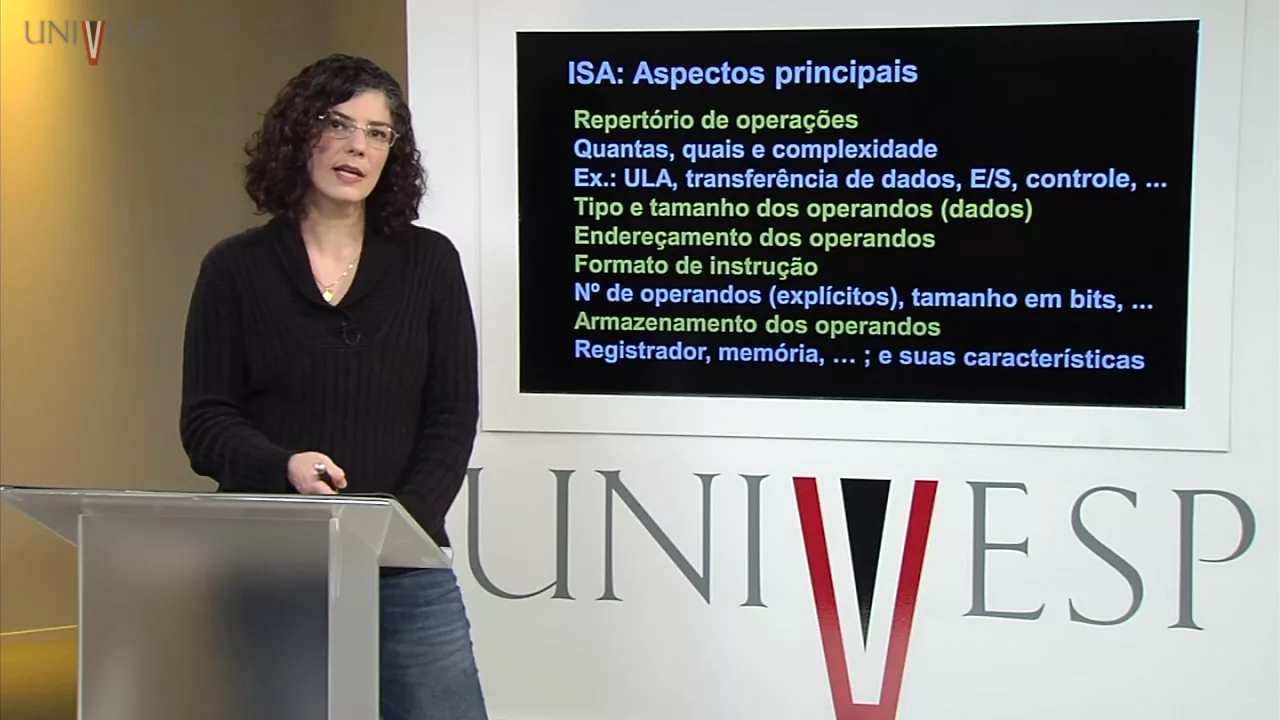
- Repertoire of operations encompasses arithmetic, logical, data movement instructions essential for executing programs efficiently.
- Data movement instructions involve transferring data between memory and registers or stacks within the architecture.
- Control instructions govern program sequencing through conditional statements and loops for efficient program execution control.
Detailed Overview of Computer Architecture
In this section, the speaker discusses various aspects of computer architecture, including instruction sets, data types and sizes, addressing modes, instruction formats, and operand storage.
Exemplifying Instruction Sets
- The importance of operand types and sizes in architectures is highlighted.
- Different word sizes in architectures are explained (e.g., 8-bit vs. 64-bit).
- Mapping data types like integers to platform-specific sizes is discussed.
Addressing Modes and Operand Access
- Addressing modes for operations like addition are explored.
- Various ways to access operands are characterized by the instruction set architecture (ISA).
Instruction Formats and Control Units
- Defining the format of instructions for processor control unit recognition is crucial.
- Determining operand count and destination in instruction formats is essential for control unit understanding.
Variable Instruction Formats
- Discussion on instructions with two operands simplifying instruction format but requiring clear interpretation by the control unit.
- Variability in instruction size across architectures (e.g., fixed vs. variable length).
Operand Storage Considerations
- Different sources of operands such as constants, registers, or memory locations are outlined.
- Importance of defining operand retrieval methods within the ISA for efficient operation execution.
Evolution of Computing History
This part delves into the historical evolution of computing from specialized purpose machines using relays to modern-day computers with vast memory capacities.
Historical Progression
- Transition from early specific-purpose computers operated via switches to Von Neumann architecture introducing program storage concepts.
Understanding Computer Architecture Evolution
In this section, the speaker discusses the evolution of computer architecture from the 1950s to more recent times, focusing on the transition from Complex Instruction Set Computing (CISC) to Reduced Instruction Set Computing (RISC).
The Era of Complex Instructions (CISC)
- CISC in the 1950s featured compact instructions with a multitude of possible functions.
- The motivation behind developing complex instructions was to maximize functionality within limited memory space due to cost constraints.
- Microprogramming played a crucial role in enabling complex instructions by aligning them closely with human-programmed instructions.
Characteristics and Flexibility of CISC Instructions
- CISC instructions often combined multiple operations into a single instruction for efficiency.
- Various modes of combining instructions were possible, such as working with two registers or register-memory combinations.
- Multiple addressing modes and memory access methods contributed to the flexibility and complexity of CISC architectures.
Variable Instruction Width and Hardware Considerations
- The variability in instruction width led to complex instructions that required multiple clock cycles for execution.
- Limited registers in hardware design necessitated efficient addressing modes for optimal performance.
Transition to Reduced Instruction Set Computing (RISC)
This part delves into the shift towards RISC architecture in the late '70s and early '80s, emphasizing simplicity, regularity, and performance benefits over CISC.
Introduction of Reduced Instructions
- RISC introduced a smaller set of simpler instructions compared to CISC architectures.
- Simplified instruction formats with fixed sizes (e.g., all RISC instructions being exactly 32 bits) streamlined design and decoding processes.
- Fewer addressing modes enhanced predictability and reduced complexity within RISC designs for improved efficiency.
Advantages of RISC Architecture
- Despite having more individual instructions, RISC's streamlined nature allowed many operations to be executed within a single clock cycle by control units.
- While requiring more total instructions than CISC for similar tasks, RICS's shorter execution cycles could lead to faster overall program completion times under certain conditions.
Desempenho de Processadores - Arquitetura RISC e CISC
The discussion delves into the performance of processors, focusing on the differences between RISC and CISC architectures, their evolution over time, and how advancements in technology have influenced their design and implementation.
Número de Ciclos e Desempenho
- The number of cycles to execute each instruction can significantly impact performance, leading to varying outcomes based on project specifics.
- Projects from the 1980s, such as those in the risk era, laid foundations for current processor lineages.
Evolução da Arquitetura de Processadores
- The ARM processor's lineage began with projects like Spark, which are widely used in embedded systems today.
- Intel's transition from a predominantly CISC architecture to incorporating RISC features reflects technological advancements and memory capacity growth.
Impacto da Tecnologia na Arquitetura
- Technological advances in memory capacity have reduced constraints on code generation within CISC implementations.
- RISC architecture allows for performance-enhancing strategies due to its adaptability and evolution capabilities.
Evolução das Técnicas de Projeto
- Changes in requirements and evolving design techniques have blurred distinctions between microprogrammed organizations within both RISC and CISC architectures.