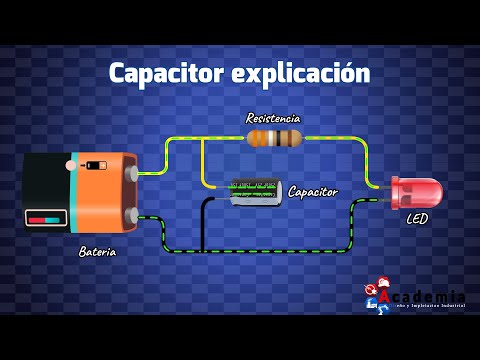
Explicación del Capacitor o Condensadores: Conceptos básicos y Principio de funcionamiento !
Understanding Capacitors: Function, Importance, and Applications
Introduction to Capacitors
- The video introduces capacitors, explaining their function in storing electrical charge and emphasizing the importance of safety when working with electricity.
- A capacitor is compared to a battery; it stores energy differently and can release it more quickly, making it essential in various electronic applications.
How Capacitors Work
- The analogy of a water pipe is used to explain how capacitors store energy. When water flows into a tank (the capacitor), it continues to supply water even after the valve is closed.
- In circuits, capacitors act like tanks that smooth out interruptions in power supply. They prevent flickering lights by discharging energy during brief outages.
Structure of a Capacitor
- A basic capacitor consists of two metal plates separated by an insulating material (dielectric). This structure allows for the storage of electrical charge.
- One plate accumulates electrons while the other loses them when connected to a battery, creating a voltage difference between the plates.
Voltage and Electric Fields
- Voltage is likened to pressure in a water system; it's the potential difference between two points. This concept helps understand how capacitors maintain stored energy.
- The electric field created by opposing charges holds electrons in place until they find a path to flow through, such as when connected to a lamp.
Practical Applications of Capacitors
- Capacitors are commonly found on circuit boards and come in various sizes for different applications, including motors and air conditioning units.
Understanding Capacitors and Their Applications
Voltage Ratings of Capacitors
- Capacitors are rated to handle specific voltage levels; exceeding this rating can cause them to fail or "pop."
- A separate video covers the details of voltage in relation to capacitors.
Power Factor Correction
- One common application of capacitors is in power factor correction, especially when inductive loads cause current and voltage waveforms to become out of sync.
- Capacitor banks are utilized to realign the current with the voltage, improving circuit efficiency.
Smoothing AC to DC Conversion
- Capacitors help smooth out spikes during the conversion from AC power to DC power using a full bridge rectifier.
- The rectification process creates gaps between spikes, which can be mitigated by capacitors releasing energy during these interruptions.
Measuring Capacitance and Voltage
- To measure capacitance and stored voltage, a multimeter is used; however, not all multimeters have a capacitance function.
- Caution is advised as capacitors can store high voltages even when disconnected from circuits.
Safe Handling Procedures
- When checking capacitor voltage, connect the multimeter leads correctly: red for positive and black for negative.
- If readings exceed several volts, discharge safely using a resistor until it reaches millivolt range before handling.
Practical Measurement Example
- To measure capacitance with a multimeter, switch it to the capacitor function and connect leads appropriately.