Generalidades y características de los forrajes
Introduction to Forages
Overview of Class Objectives
- The first class aims to introduce the content of the subject, focusing on generalities and characteristics of forages.
- The discussion will cover classifications of forage species and forages themselves, leading to identification of specific types.
Key Concepts in Forage
- Definitions will be established: what constitutes a forage and a forage plant, including their importance as animal feed.
- Emphasis on key families used for forage, particularly grasses and legumes, along with their chemical composition.
Characteristics of Forage Plants
Essential Characteristics
- Important traits include palatability (acceptance by animals), non-toxicity, ability to reproduce, and resilience under grazing pressure.
Desirable Traits
- Desired characteristics encompass high production rates, quality, digestibility, longevity, regrowth capacity, adaptability to various conditions, and resistance to becoming weeds.
Forage Species Classification
Main Families Used for Foraging
- Primary families include grasses (Poaceae) and legumes (Fabaceae). Secondary families like Asteraceae (e.g., chicory) are also noted.
Unique Features of Grasses
- Grasses have growth tips protected underground which aids in their survival during grazing; they recover quickly after being grazed due to their regenerative capabilities.
Ecological Adaptations of Grasses
Growth Conditions
- Grasses exhibit plasticity allowing them to thrive in diverse environmental conditions; many propagate through rhizomes or stolons covering soil effectively.
Nutritional Contributions
- They provide essential fiber and energy in animal diets depending on the phenological state of the crop at harvest time.
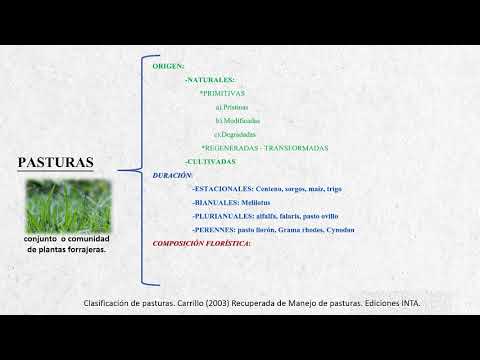
Types of Pastures
Classification Based on Origin
- Pastures can be natural or cultivated; cultivated pastures are human-made while natural ones exist without human intervention but may still be modified by external factors like fire or grazing animals.
Degradation and Regeneration
- Natural pastures can degrade due to poor management practices such as overgrazing but can also regenerate through proper rest periods or closure from grazing activities.
Classification of Pastures and Forage Plants
Types of Pastures Based on Duration
- Pastures can be classified into seasonal, annual, biannual, perennial, and plurennial based on their production cycles. Seasonal pastures have a production cycle within the year but may not last a full calendar year. Examples include winter cereals like rye and wheat.
- Annual pastures include legumes such as Elmer and Lotus that complete their life cycle in two years. Plurennial pastures, like alfalfa and certain grasses, last around four to five years. Perennial pastures can endure for ten to fifteen years, with examples including Rhodes grass and weeping grass.
Composition of Pastures
- The floristic composition of pastures can be categorized as pure (monospecific), mixed (bifloral), or complex (polyspecific). Monospecific pastures consist of one species; bifloral includes two species; polyspecific contains more than two species. Natural grasslands are typically polyspecific.
Response to Photoperiod
- Pasture plants respond differently to photoperiods: some are long-day plants while others are short-day plants or indifferent to photoperiod changes. Short-day plants flower when daylight hours decrease below a certain threshold, while long-day plants flower when daylight hours exceed a specific threshold.
Growth Habits of Forage Plants
- Forage plant growth habits can be categorized into erect (direct) and creeping (prostrate) types. Erect plants have upright stems growing above ground level; creeping plants have stems that spread along the soil surface through runners or rhizomes.
Photosynthesis Pathways in Plants
- Plants are classified based on their carbon fixation pathways during photosynthesis into C3 and C4 types:
- C3 Plants: Utilize the enzyme Rubisco for CO2 fixation in the Calvin cycle; approximately 85% of plant species fall under this category.
- C4 Plants: Use PEP carboxylase for CO2 fixation in specialized cells called bundle sheath cells, which prevents photorespiration—a common issue in C3 plants due to Rubisco's affinity for oxygen instead of CO2. This adaptation allows C4 plants to thrive in warmer climates with higher temperatures.