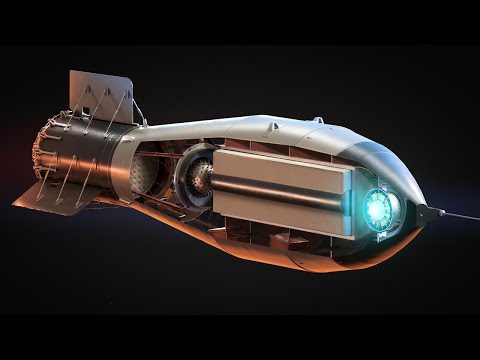
Inside the Tsar Bomb
Overview of the Tsar Bomba
Introduction to the Tsar Bomba
- The AN602, known as the "Tsar Bomba," is recognized as the most powerful bomb ever detonated, with a yield of 50 megatons of TNT.
- Developed by Soviet engineers during the Cold War, its practicality as a weapon and impact on the arms race will be explored in detail.
Design Specifications
- The Tsar Bomba measures 6.9 feet in diameter and 26 feet long, roughly equivalent to a classic London double-decker bus. It weighs approximately 54,000 pounds.
- Its casing is constructed from steel lined with beryllium and includes thermal insulation to maintain stable temperatures for sensitive materials. A control module at the tip connects to radio rangefinder antennas and barometric sensors.
Launch Sequence of the Tsar Bomba
Modifications to Delivery Aircraft
- The Tupolev Tu-95V bomber was modified significantly to accommodate the Tsar Bomba; its bomb bay was enlarged to fit the bomb's dimensions.
- Internal fuel tanks were removed, and machine guns were replaced with sensor probes for measuring thermal and shock-wave impulses during detonation. Special reflective paint was applied for thermal protection.
Flight Path and Test Site
- The Tu-95V took off from Olenya airbase, climbing to an altitude of 6 miles before heading towards Novaya Zemlya test site, covering over 21,000 square miles of land area.
- The bomb was released at a safe distance from Severny settlement (34 miles away), which had been evacuated prior to testing due to safety concerns.
Detonation Mechanism
Parachute Deployment
- Upon release at 11:32 a.m., October 30th, 1961, a complex parachute system activated that slowed descent for about 188 seconds using multiple parachutes ranging up to over 17,000 square feet in area—one of the largest canopies ever used.
Fission Process Initiation
- At an altitude of 13,000 feet above ground level—determined optimal for maximum damage—the bomb's fission charge consisted of two spheres containing plutonium surrounded by high-performance explosives designed for rapid detonation within microseconds.
Chain Reaction Dynamics
Neutron Emission and Explosion Mechanics
- When triggered, each sphere’s explosive shell compresses plutonium into a supercritical state emitting vast amounts of neutrons that initiate further fission reactions among surrounding nuclei leading to an exponential energy release through chain reactions.
Heat Generation and Secondary Charge Activation
- This fission process generates extreme heat (upwards of 100 million degrees Celsius), triggering secondary explosions via gamma rays and X-rays that enhance overall destructive power through additional layers like lithium deuteride encased in lead outer casings.
The Mechanics and Impact of the Tsar Bomba
Design and Functionality
- The Tsar Bomba was constructed using a lithium compound combined with deuterium, featuring a plutonium rod at its core. This design allowed for neutron compression, leading to a supercritical state that generated additional neutrons.
- Under extreme conditions, deuterium and tritium nuclei fused to create helium, releasing vast amounts of energy. A lead cylindrical casing served as a tamper to prolong the fusion reaction's development.
- For testing purposes, lead engineer Andrey Sakharov modified the bomb's design by replacing depleted uranium with lead, reducing its yield from 100 megatons to 50 megatons while significantly decreasing radioactive fallout.
The Explosion Experience
- Witnesses reported an intense flash of light brighter than noon sun lasting over a minute, followed by an expanding fireball nearly five miles in diameter.
- The fireball created a towering mushroom cloud reaching heights between 40 and 42 miles, extending above the stratosphere and spreading out to about 59 miles wide at its top.
Effects of the Detonation
- The explosion produced seismic effects comparable to a magnitude 5.0 earthquake; even aircraft over 60 miles away felt significant impacts from the blast.
- Ground-level destruction included leveling rocky surfaces into "a black, dead lake" while nearby villages were completely obliterated.
Broader Implications
- Despite being an apex of nuclear technology, Tsar Bomba's complexity rendered it impractical for warfare but served as a potent political statement about nuclear capabilities.
- Its detonation prompted both superpowers to reconsider nuclear escalation paths, leading to the signing of the Partial Nuclear Test Ban Treaty in 1963 aimed at curbing atmospheric tests.