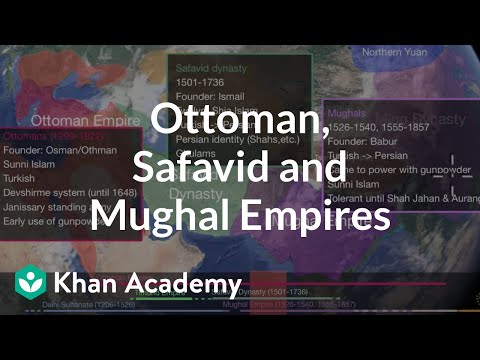
Ottoman, Safavid and Mughal Empires | World History | Khan Academy
Evolution of Empires in Asia
In this video, we will focus on the evolution of empires in North India, Persia, the Middle East, and the Anatolian peninsula (modern-day Turkey). We will explore the fragmented state of Asia in 1300 and how various empires emerged and expanded over time.
Fragmentation of Empires (1300)
- The Mongol Empire under Genghis Khan had taken over much of Asia by the 13th century.
- By 1300, the Mongol Empire had fragmented into different khanates: Yuan Dynasty in China, Chagatai Khanate in Central Asia, Golden Horde in Northwest Asia, and Ilkhanate in Persia and the Middle East.
- The Sultanate of Rum collapsed, leading to the formation of several fragmented kingdoms including the nascent Ottoman Empire founded by Osman.
- The Delhi Sultanate emerged as a significant Muslim empire in North India.
Changes by 1500
- The Ming Dynasty replaced the Yuan Dynasty in China.
- Timur took over much of Central Asia and parts of Persia from the Ilkhanate. He sacked Delhi and weakened the Delhi Sultanate.
- The Ottoman Empire continued to expand its territories.
- Gunpowder started being used for guns and artillery during this period.
Empires by 1600
- The Ming Dynasty still controlled much of China while Northern Yuan remained in Mongolia.
- The Ottoman Empire expanded significantly, encompassing most of the Middle East.
- Timurid Empire fell, leading to Safavid Dynasty taking over Persia.
- Babur established the Mughal Empire after defeating the Delhi Sultanate.
Characteristics of Each Empire
Ottoman Empire
- Founded by Osman with a Sunni Islamic ruling class led by a caliph.
- Used Devshirme system to recruit Janissaries, who were Christian boys indoctrinated into the Ottoman military.
- Known for successfully using gunpowder in battle.
Safavid Dynasty
- Founded by Shah Ismail and based on Twelver Shia Islam.
- Brought back Persian culture and native Persian rule.
- Had Ghulams, similar to Janissaries, as slave soldiers.
Commonalities and Differences
- The Ottoman Empire, Safavid Dynasty, and Mughal Empire are often grouped together due to some shared characteristics.
- Each empire had its unique religious and cultural influences.
- The Ottomans were Sunni Muslims with Turkish ruling class, while the Safavids were Twelver Shia Muslims with a Persian cultural revival.
- The Mughals had Mongol and Timurid ancestry and ruled over a diverse population in India.
Comparing Empires: Ottomans, Safavids, Mughals
In this section, we will compare the Ottoman Empire, Safavid Dynasty, and Mughal Empire in terms of their origins, ruling classes, military systems, and cultural influences.
Ottoman Empire
- Founded by Osman in the Anatolian peninsula.
- Sunni Islamic empire with a Turkish ruling class led by a caliph.
- Used the Devshirme system to recruit Janissaries from Christian boys who became influential figures within the empire.
- Known for successful use of gunpowder in battle.
Safavid Dynasty
- Founded by Shah Ismail based on Twelver Shia Islam.
- Revived Persian culture after centuries of foreign rule.
- Introduced Ghulams as slave soldiers who gained wealth and power over time.
Mughal Empire
- Established by Babur after defeating the Delhi Sultanate.
- Descendant of Timur on his father's side and Genghis Khan on his mother's side.
- Ruled over a diverse population in India.
Commonalities and Differences
- Each empire had its unique religious, cultural, and ruling class characteristics.
- The Ottomans were Sunni Muslims with Turkish ruling class, while the Safavids were Twelver Shia Muslims with Persian cultural revival.
- The Mughals had Mongol and Timurid ancestry and ruled over a diverse population in India.
Cultural Influences of the Safavid Dynasty
In this section, we will explore the cultural influences of the Safavid Dynasty, including their revival of Persian culture and the use of Ghulams as slave soldiers.
- The Safavid Dynasty revived Persian culture after centuries of foreign rule.
- Shah Ismail brought back many aspects of Ancient Persia's culture.
- The dynasty used the term "Shah" to signify their rulership, similar to Cyrus the Great as "Shahanshah."
- Introduced Ghulams as slave soldiers who became an elite military unit with significant wealth and power.
Janissaries in the Ottoman Empire
In this section, we will focus on the Janissaries in the Ottoman Empire, their origins through the Devshirme system, and their role within the empire.
- The Sultan or Emperor of the Ottoman Empire maintained a personal army called Janissaries.
- Janissaries were Christian boys taken at a young age through the Devshirme system.
- Although forced into becoming Janissaries and separated from their families, they were given privileges and opportunities for advancement within society.
- Many Janissaries rose to prominent positions within the Ottoman Empire, including becoming Grand Viziers who effectively ruled over the empire.
The Importance of Indoctrinating Young Boys as Ghulams and Janissaries
This section discusses the strategy of indoctrinating young boys as Ghulams or Janissaries to ensure loyalty and stability in establishing dynasties.
Establishing Loyalty through Indoctrination
- By indoctrinating young boys as Ghulams or Janissaries, rulers could potentially prevent them from wanting to establish their own dynasties.
- This strategy aimed to create a sense of loyalty towards the ruler, reducing the risk of betrayal and instability.
- The practice provided an unusual amount of stability for empires like the Mughal Empire.
Babur and the Foundation of the Mughal Empire
This section focuses on Babur, who founded the Mughal Empire, and his Turco-Mongolian background.
Babur's Background and Defeat of Delhi Sultanate
- Babur was Timur's great-grandson's grandson and belonged to a Turco-Mongolian tradition.
- He famously defeated the significantly weakened Delhi Sultanate with the aid of gunpowder.
- Despite practicing Sunni Islam, the Mughals ruled over a large Hindu majority.
Tolerance and Intolerance among Mughal Rulers
This section explores the varying levels of tolerance among different Mughal rulers.
Akbar's Religious Syncretism
- Akbar, also known as Akbar the Great, attempted to merge Islam with Hinduism, Jainism, and Christianity.
- He was considered one of the most tolerant Mughal rulers.
Shah Jahan's Intolerance and Construction of Taj Mahal
- Shah Jahan built the Taj Mahal for his wife but was known for being intolerant and persecuting Hindus and Sikhs.
- He constructed the grand mausoleum during a time of famine in India.
Aurangzeb's Continuation of Intolerance
- Shah Jahan's son, Aurangzeb, continued the policy of intolerance towards non-Muslims.
- Historians often refer to these three empires (Babur, Shah Jahan, and Aurangzeb) as the Gunpowder Empires.
The Gunpowder Empires
This section explains why the Ottoman Empire, Mughal Empire, and Safavid Empire are referred to as the Gunpowder Empires.
Formation of Centralized Empires with Gunpowder
- The term "Gunpowder Empires" refers to the Ottoman Empire, Mughal Empire, and Safavid Empire.
- These empires were able to form major centralized powers due to their effective use of gunpowder.
- The Ottomans were famous for their early use of artillery. Babur also utilized gunpowder in his conquests.