Redes Neuronales Recurrentes: EXPLICACIÓN DETALLADA
Introduction to Recurrent Neural Networks
In this section, Miguel Sotaquirá introduces the concept of recurrent neural networks (RNNs) and highlights their importance in deep learning. He explains how RNNs are used to analyze sequences of data that change over time.
Structure of Recurrent Neural Networks
- RNNs have a similar structure to conventional neural networks but include an important element called the activation or hidden state.
- The activation or hidden state serves as the memory of the recurrent network, allowing it to analyze sequences and preserve information between states.
Limitations of Conventional Neural Networks
- Conventional neural networks, such as feedforward and convolutional neural networks, can only process data in one direction and do not consider past or future inputs.
- This limitation is problematic when dealing with sequential data like text, conversations, or videos where analyzing previous and future instances is crucial.
Memory in Recurrent Neural Networks
- Recurrent neural networks overcome the limitations of conventional networks by considering information from previous time steps.
- The activations in RNNs serve as memory, preserving and sharing information between different time steps.
- This memory allows RNNs to effectively analyze sequences and make predictions based on past inputs.
Internal Structure of Recurrent Neural Networks
In this section, Miguel explains how recurrent neural networks are internally structured. He uses the example of generating dinosaur names to illustrate why conventional neural networks are not suitable for sequence generation tasks.
Limitations of Conventional Neural Networks for Sequence Generation
- Conventional neural networks can only process data in one direction without considering past inputs.
- This limitation makes them unsuitable for tasks like generating sequences character by character.
Notation for Time Steps in Sequences
- Each element within a sequence is associated with a time step, represented by an integer.
- For example, in the word "diplosaurio," the first character "d" corresponds to time step 1, the second character "i" corresponds to time step 2, and so on.
Activation and Prediction in Recurrent Neural Networks
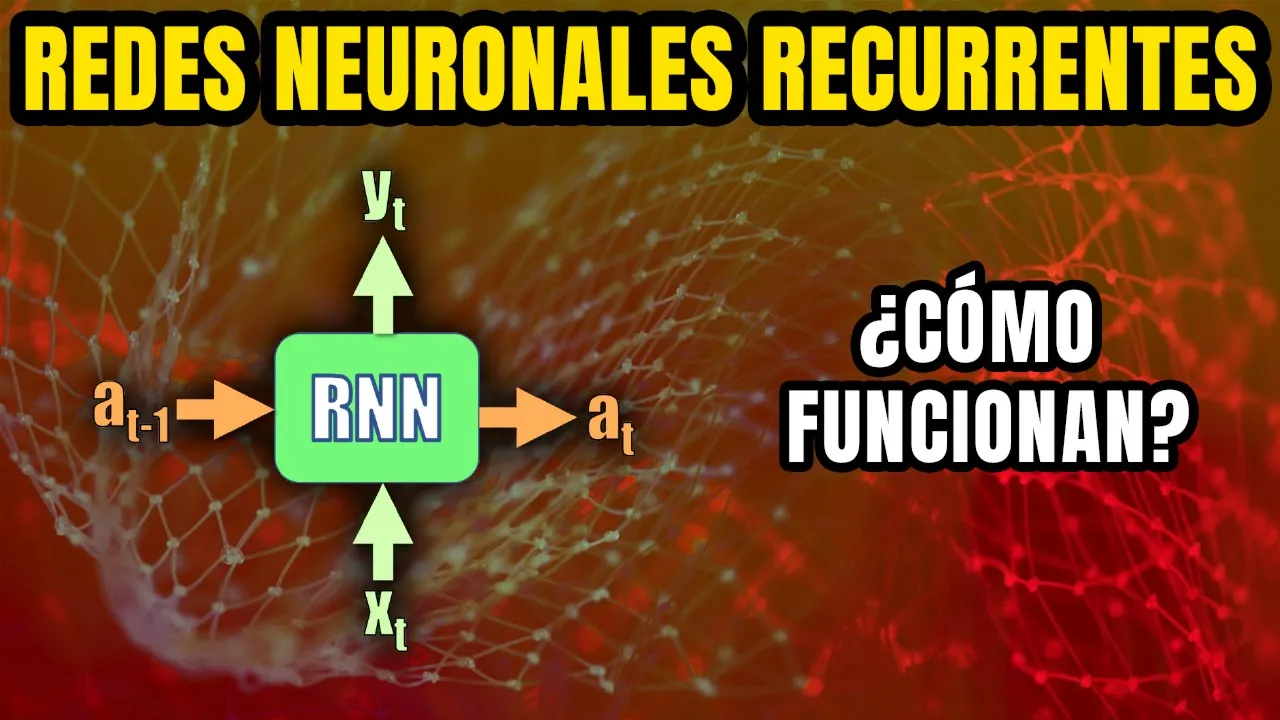
- Recurrent neural networks have two inputs and two outputs at each time step.
- The inputs are the current data point (x_t) and the previous activation (a_t-1).
- The outputs are the current prediction (y_t) and the current activation (a_t).
- The activations serve as memory, allowing information to be preserved and shared between different time steps.
Calculation of Outputs in Recurrent Neural Networks
In this section, Miguel explains how the outputs of recurrent neural networks are calculated based on their inputs. He discusses the role of transformations and non-linear activation functions in generating predictions and activations.
Calculation of Activations and Predictions
- The calculation of activations and predictions in recurrent neural networks follows a similar logic to conventional artificial neurons.
- The activation is obtained by transforming the input data (current activation + current input) using a non-linear activation function.
- The coefficients for these transformations are determined through training.
Memory in Recurrent Neural Networks
- The output at each time step depends not only on the current input but also on the previous activation value.
- This dependency allows recurrent neural networks to preserve information from past time steps, effectively utilizing memory for sequence analysis.
Memory in Recurrent Neural Networks
In this section, Miguel further explores how memory is incorporated into recurrent neural networks. He emphasizes that both activations and predictions depend on previous values, highlighting their role in preserving information across different time steps.
Dependency on Previous Activation and Input
- The current activation (a_t) in a recurrent neural network depends not only on the current input (x_t) but also on the previous activation (a_t-1).
- This dependency allows the network to retain information from past time steps, serving as its memory.
Memory and Information Preservation
- The concept of memory in recurrent neural networks is realized through the dependence of activations and predictions on previous values.
- By considering past inputs and activations, RNNs can effectively preserve and share information across different time steps, enabling them to analyze sequences comprehensively.
Recurrent Neural Networks (RNNs)
In this section, we learn about recurrent neural networks (RNNs) and how they differ from other types of neural networks.
RNNs for Sequence Analysis
- RNNs are designed to analyze sequences of data.
- Unlike other neural networks, RNNs use the same set of parameters to calculate coefficients during training at each time step.
- This allows the trained RNN to generate predictions using the same set of parameters at every time step.
Representation of RNNs
- To represent the dependencies between current and previous time steps in a compact way, a common representation is used.
- The representation includes an arrow indicating the dependency between the current activation and the one generated at a previous time step.
Solving Sequence Analysis with RNNs
- While traditional neural networks and convolutional neural networks cannot effectively analyze sequences, RNNs can solve this problem.
- RNNs use two inputs: the current data point and the previous hidden state or activation.
- By combining these inputs, an RNN can generate predictions while preserving information from previous time steps, effectively creating memory within the network.
Next Steps: Implementing an RNN with Keras
- In the next video, we will combine all these concepts and ideas into a practical example.
- We will implement an RNN step by step using the Keras library.