Aula: Origem dos Tetrapoda e Conquista do Ambiente Terrestre - Parte 3
Conquest of Terrestrial Environment by Vertebrates
In this segment, the discussion revolves around the conquest of the terrestrial environment by vertebrates and the origin of tetrapods. Anatomical modifications related to body support and respiration in aerial environments compared to aquatic ones are explored through fossil comparisons.
Anatomical Modifications for Terrestrial Life
- Comparison between lobed-finned fish fossils from the Devonian period and osteolepiform fossils, showcasing tetrapodomorphs as intermediate forms.
- Specific features observed in early tetrapod fossils like Acanthostega and Ichthyostega, highlighting digit evolution preceding full terrestrial adaptation.
- Discussion on limb support inadequacy in early tetrapods due to lack of wrist and ankle bones, leading to probable locomotion challenges on land.
Evolutionary Adaptations for Terrestrial Locomotion
- Progression towards more developed hand and foot joints in later fossil records for enhanced terrestrial mobility efficiency.
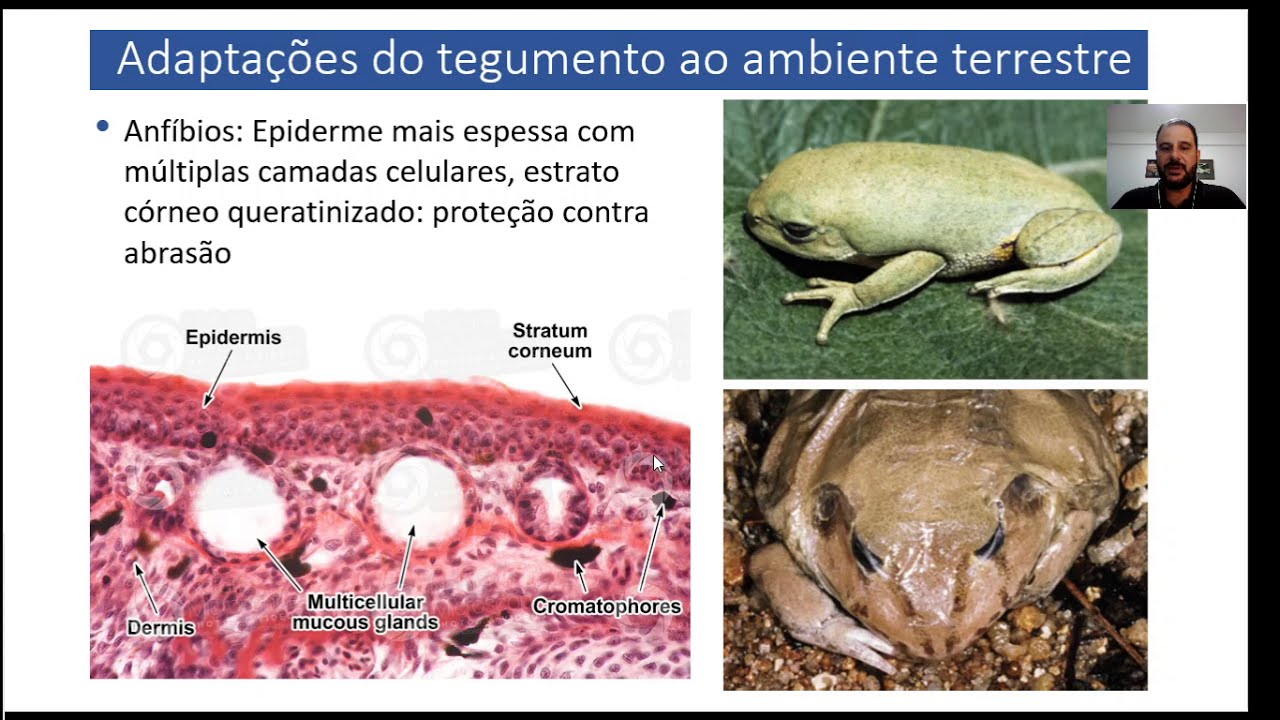
- Necessity for adaptations such as water loss prevention and thermoregulation for survival on land, with amphibians exhibiting thick epidermis layers rich in keratin.
Adaptations for Land Living Vertebrates
This part delves into various adaptations seen in modern tetrapods (amphibians, reptiles including birds, mammals) that aid in protection, temperature regulation, osmoregulation, and excretion.
Epidermal Adaptations
- Amphibians' multi-layered keratin-rich epidermis providing abrasion protection; secretion of lipids and mucous aiding thermal regulation during dry periods.
- Description of lipid and mucus secretion capabilities even in permeable amphibian skin for protection against heat stress or prolonged drought.
Tegumentary Modifications
- Mention of lungfish secreting mucus to form protective cocoons during dry seasons; diverse integumentary changes like scales (reptiles), feathers (birds), fur (mammals).
Osmoregulation Strategies in Aquatic vs. Terrestrial Vertebrates
Focus shifts to osmoregulatory mechanisms distinguishing aquatic vertebrates from their terrestrial counterparts concerning ammonia excretion pathways.
Ammonia Excretion Variations
- Aquatic species predominantly excrete ammonia due to its low energy synthesis but require rapid expulsion; contrastingly, terrestrial animals opt for uric acid or urea excretion strategies.
Fertilization Strategies in Terrestrial Animals
The discussion focuses on the challenges of fertilization in terrestrial environments compared to aquatic settings, exploring various strategies employed by terrestrial animals for successful reproduction.
Fertilization Challenges in Terrestrial Environments
- In terrestrial environments, the absence of water poses a challenge for fertilization as seen in aquatic organisms where external fertilization is common.
- Some terrestrial animals, like amphibians, still utilize external fertilization but with adaptations such as amplexus and egg deposition by males to facilitate sperm-egg meeting.
- Other animals opt for internal fertilization where males have intromittent organs to transfer sperm directly into the female's body, as observed in certain amphibian species like Cecilia and some anurans.
Adaptations for Successful Fertilization
- Salamanders employ spermatophores - packets containing sperm that females collect using specialized structures for storage before fertilization.
- Terrestrial embryos face desiccation risks due to the lack of protective egg shells found in aquatic species; thus, some amphibians deposit eggs in moist environments to prevent dehydration.
Egg Deposition and Embryonic Protection
This section delves into the mechanisms terrestrial animals use to protect embryos during development and highlights differences from aquatic species.
Embryonic Protection Strategies
- Amphibian eggs are shielded by mucous layers instead of hard shells, allowing gas exchange but making them susceptible to desiccation; hence, they are often laid in water or humid environments.
- Some species develop fibrous and calcified eggshells providing protection but requiring pre-fertilization due to shell formation hindering sperm access.
Fertilization Process and Egg Development
- Internal fertilizers like reptiles have evolved copulatory organs (e.g., penis-like structures) facilitating sperm delivery before eggshell calcification.
- The oviduct plays a crucial role post-fertilization: infundibulum for fertilization, medial part for albumen deposition, and terminal part (uterus) for shell formation.
Amniotic Egg Structure and Function
Exploring the unique features of amniotic eggs that provide protection and support embryonic development in terrestrial animals.
Amniotic Egg Characteristics
- Amniotic eggs possess embryonic membranes (amnion, allantois, chorion), offering physical protection against shocks, gas exchange facilitation, and waste storage essential for embryo survival.
The Evolution of Vertebrates: Transition to Terrestrial Life
In this section, the discussion revolves around the anatomical adaptations of vertebrates as they transitioned from aquatic to terrestrial environments.
Adaptations for Terrestrial Life
- The presence of a nasal cavity with olfactory epithelium and mucous glands helps in maintaining moisture and capturing odor particles.
- Some animals, like snakes and lizards, possess the Jacobson's organ for olfaction, located in the nasal cavity or roof of the mouth.
- Snakes and lizards use their tongues to capture odor particles, which are then detected by the sensory epithelium in the Jacobson's organ.
- In amphibians like caecilians, olfaction is facilitated by specialized tentacles that capture odor particles.
Evolution of Hearing Mechanisms in Vertebrates
This section delves into the development of hearing mechanisms in vertebrates, particularly focusing on the evolution of middle ear structures.
Evolution of Hearing
- The emergence of a middle ear in tetrapods during the Devonian period marked a significant advancement related to terrestrial auditory adaptations.
- Middle ear structures aid in transmitting sound waves efficiently from air to fluid-filled inner ears, compensating for impedance differences between air and liquid mediums.
- Sound waves are captured by ciliated epithelial cells within the inner ear responsible for auditory reception.
- Amphibians and reptiles have a single ossicle (columella) in their middle ear; however, mammals possess three ossicles (stapes being homologous to columella).
Key Adaptations Facilitating Terrestrial Life
This segment highlights crucial adaptations that enabled vertebrates to thrive in terrestrial habitats.
Adaptations for Terrestrial Success
- The conquest of land by tetrapods led to various adaptations such as pulmonary respiration, limb modifications for locomotion, and changes in skeletal elements.
- Many terrestrial adaptations were derived from features already beneficial in aquatic environments, including respiratory systems and limb structures.