Clasificación bacteriana│Gram positivas │Gram negativas │Microbiologia
Classification of Bacteria
Types of Bacterial Classification
- Bacteria can be classified based on their respiration needs:
- Aerobic: Require oxygen for biological processes.
- Anaerobic: Do not require oxygen.
- Facultative Aerobes can survive with or without oxygen, while Microaerophiles need low levels of oxygen to function.
Inter-Species Relationships
- Bacteria are also classified by their interspecific relationships:
- Parasites harm the host (e.g., humans) by consuming nutrients without providing benefits.
- Commensals may benefit both themselves and the host; includes normal flora which exists naturally in the body.
- Normal flora consists of:
- Resident Flora: Always present in the body.
- Transient Flora: Present temporarily and often eliminated by immune processes.
Morphological Classification
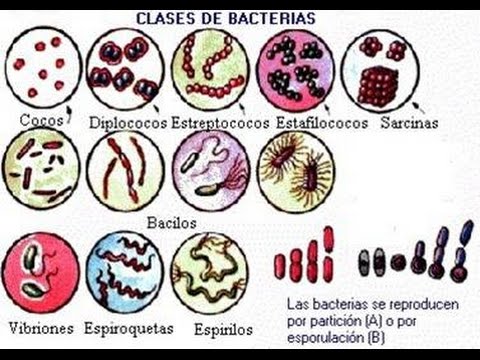
- Morphologically, bacteria can be categorized into shapes:
- Cocci (spherical),
- Bacilli (rod-shaped),
- Vibrio (comma-shaped),
- Spirilla (spiral).
- Groupings include:
- Diplococci: Pairs of cocci,
- Tetrads: Groups of four cocci,
- Sarcinae: Cubical arrangements,
- Staphylococci: Clusters resembling grapes,
- Streptobacilli: Bacilli arranged in chains.
Staining Techniques for Identification
- Bacteria can also be classified through staining methods, such as Gram staining:
- Divided into two categories:
- Gram-positive: Stain violet/purple.
- Gram-negative: Stain pink/red.
- Example identification includes:
- Staphylococcus aureus as a Gram-positive bacterium,
- Escherichia coli as a Gram-negative bacillus.