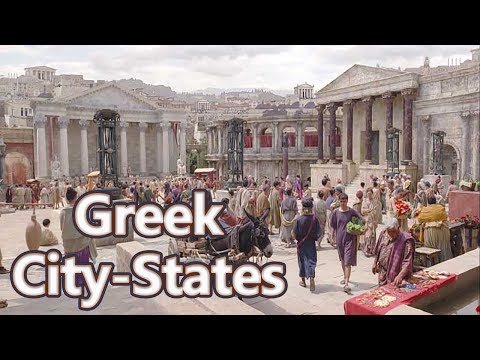
The Greek City-States - Ancient History #02 - See U in History
Overview of Ancient Greek City-States
The Structure of Ancient Greece
- Ancient Greece was not a unified kingdom or empire but rather a collection of independent city-states, each functioning like its own country.
- Each city-state had total sovereignty and autonomy over its territory, leading to diverse forms of governance.
Forms of Government in City-States
- Governance varied among city-states:
- Democracy in Athens, where citizens held power.
- Aristocracy in Thebes and Corinth, ruled by noblemen.
- Oligarchy in Sparta, governed by a small group of elites.
Identity and Culture Among the Greeks
- Greeks identified as Hellenic rather than simply Greek, tracing their lineage back to mythological figures like Helenus.
- Religion played a crucial role in unifying the various city-states under a common identity.
Prominent City-States and Their Characteristics
Notable City-States
- Athens: Known as the birthplace of democracy and western culture; named after the goddess Athena.
- Sparta: Renowned for its military prowess; descended from Doric invaders linked to Hercules.
- Thebes: Associated with mythological kings Oedipus and Cadmus; located in Boeotia.
- Corinth: Strategically positioned between Peloponnesus and mainland Greece; frequently involved in conflicts.
- Olympia: Famous for hosting the Olympic Games, which fostered cultural connections among city-states.
Expansion and Colonization
Challenges Faced by City-States
- Despite cultural and economic prosperity, overpopulation became an issue for Greek city-states.
The Second Greek Diaspora
- To address overpopulation, Greeks began colonizing new lands during what is known as the second Greek diaspora.
- This followed an earlier diaspora after the Doric invasion.
Geographic Spread of Colonies
- Colonies were established across various regions including France, Spain, Africa, Italy, and along Turkey’s coastline (e.g., Samos and Miletus).
Economic Growth Through Trade
- These colonies thrived economically due to trade interactions with other cultures that introduced new knowledge.
Conflict with Persia
Tensions with Larger Empires
- The wealth generated by these prosperous cities made them targets for powerful empires such as Persia. A conflict between Greek city-states and Persia seemed inevitable.