Pragmática
Introduction to Pragmatics
Overview of Linguistic Analysis
- The class begins with a discussion on pragmatics, building upon previous units that covered various divisions of linguistics.
- Key linguistic levels include phonological, morphological, syntactic, and semantic analysis, each contributing to understanding language structure.
Understanding Pragmatics
- Pragmatics is defined as the study of language in context, focusing on how linguistic systems interact with external factors.
- It emphasizes the importance of context over mere structural analysis, highlighting the relationship between language and its usage environment.
Pragmatic Knowledge and Interpretation
Examples of Pragmatic Knowledge
- An example illustrates how pragmatic knowledge helps interpret indirect responses in conversation (e.g., declining an offer for coffee).
- Another example shows how speakers convey information without explicitly stating it (e.g., not knowing Maria's exact address).
Implications of Contextual Understanding
- The speaker discusses how understanding context allows for appropriate responses in conversations (e.g., responding to a request for time).
- Pragmatics involves cognitive and social factors that influence effective communication beyond just linguistic meaning.
Defining Meaning vs. Interpretation
Distinction Between Meaning and Interpretation
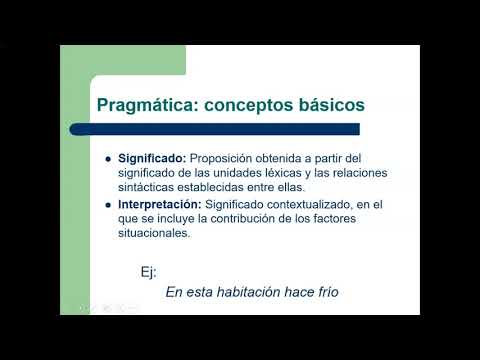
- A distinction is made between 'meaning' (linguistic significance derived from lexical units and syntax) and 'interpretation' (contextual understanding).
- Meaning is described as systematic and constant, while interpretation incorporates situational elements such as speaker intent.
Practical Application of Interpretation
- An example demonstrates how a statement about temperature can imply requests or actions based on contextual cues.
- The role of pragmatics is emphasized in bridging the gap between what is said and what is meant in communication.
Key Concepts in Pragmatics
Importance of Utterances
- In pragmatics, the concept of 'utterance' replaces traditional syntactic focus on sentences; it refers to specific communicative acts by speakers.
Understanding the Role of Context in Communication
The Concept of Enunciation
- Discusses how enunciation refers to a speaker's concrete intervention in a communicative situation, contrasting it with the abstract grammatical unit of a sentence.
- Introduces "dípticos," linguistic elements tied to the moment of speech and interlocutors, which help indicate context such as participants, time, and place.
Linguistic Elements Indicating Context
- Highlights personal pronouns (e.g., "yo," "vos," "usted") and verbal forms that allow speakers to reference their social distance from others during communication.
- Explains temporal adverbs and verb tenses that relate current speech to past or future events, emphasizing their role in anchoring discourse.
Pragmatics: Cognitive vs. Social Perspectives
- Differentiates between cognitive pragmatics, focusing on mental processes underlying language use, and social pragmatics, which examines cultural rules governing verbal behavior.
- Cognitive pragmatics explores how humans infer unspoken information and integrate it with prior knowledge for effective communication.
Mechanisms of Language Processing
- Describes cognitive sciences' role in understanding how we process information through various channels (language, vision, hearing).
- Emphasizes common cognitive mechanisms shared among humans that facilitate successful linguistic exchanges.
Cultural Influences on Communication
- Social pragmatics is concerned with specific cultural norms dictating appropriate verbal conduct within different contexts (e.g., humor appropriateness).
- Discusses how authority or social hierarchy influences communication styles and behaviors across various settings like classrooms or medical consultations.
Conversational Maxims and Cooperative Principle
- Introduces Grice's conversational maxims that govern cooperative dialogue contributions based on context.
- Mentions violations of these maxims can lead to implicatures—unspoken meanings inferred by listeners during conversations.
Understanding Pragmatics and Speech Acts
Contextual Relevance in Communication
- The speaker emphasizes the importance of context in extracting relevant information from a statement, aiming for maximum insight with minimal cognitive effort.
- Discussion on conversational maxims and their apparent violations, which help infer unspoken meanings in communication.
Theory of Speech Acts
- Introduction to the theory of speech acts, originally developed by philosophers in England and furthered in the U.S., focusing on how language performs actions.
- Examples illustrate that certain linguistic declarations (e.g., marriage or sentencing) require specific authority to be valid, highlighting the performative nature of language.
Conditions for Valid Speech Acts
- The speaker discusses various linguistic emissions that count as actions (e.g., promises, bets), emphasizing their role as performative statements.
- Authors classify different types of speech acts and establish conditions under which these utterances are recognized as valid actions.
Interactional Pragmatics
- Exploration of typical linguistic situations within cultural contexts, including roles of speakers and appropriate verbal conduct.
- Mention of politeness theories that explain verbal strategies used to avoid conflicts and maintain good relationships during communication.
Recommended Readings