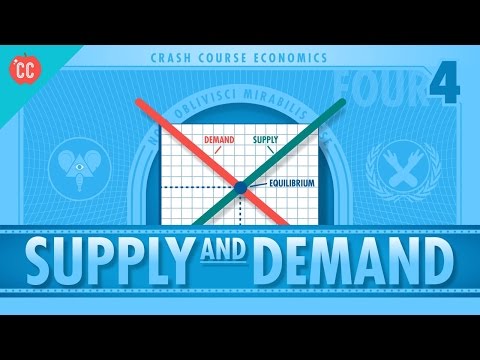
Supply and Demand: Crash Course Economics #4
Introduction
Mr. Clifford and Adriene Hill introduce the topic of markets and their importance in our daily lives.
Understanding the Importance of Markets
- Markets are often taken for granted, but they play a crucial role in our lives.
- Markets are where buyers and sellers meet to exchange goods and services.
- Voluntary exchange is the key concept in markets, where both parties willingly decide to make a transaction.
The Efficiency of Markets
Mr. Clifford explains how markets efficiently allocate resources through voluntary exchange.
Efficient Allocation of Resources
- Competitive markets allocate scarce resources towards their most efficient use.
- If there is an oversupply of strawberries, prices will fall, leading farmers to produce other crops with higher demand.
- Conversely, if there is a shortage of strawberries, prices will rise, incentivizing farmers to increase production.
- Price signals generated by markets guide the distribution of resources.
Incentives and Quality Control in Markets
Mr. Clifford discusses how markets incentivize high-quality products and discourage deceptive practices.
Incentives for Quality Products
- Markets incentivize producers to create high-quality products that meet consumer demands.
- If products are subpar or defective, consumers will choose alternatives, leading businesses to improve their offerings.
- While greed and deception can occur in real life, transparent markets with consumer choice limit such practices.
Consumer Choice and Market Signals
Adriene emphasizes the power of consumer choice in shaping market outcomes.
Consumer Choice as Market Signals
- Every dollar spent by consumers sends signals to producers about what should be produced and how it should be produced.
- Consumers have the power to influence market outcomes by supporting or boycotting specific companies.
- In a free market, prices and profits determine resource allocation.
Supply and Demand
Mr. Clifford introduces the fundamental concept of supply and demand in determining prices.
Understanding Supply and Demand
- Prices are determined by the interaction of supply and demand.
- The law of demand states that as prices increase, quantity demanded decreases, and vice versa.
- The law of supply states that as prices increase, quantity supplied increases, and vice versa.
Graphical Representation of Supply and Demand
Mr. Clifford explains how supply and demand curves visually represent market dynamics.
Visualizing Supply and Demand
- On a graph, the Y-axis represents price, while the X-axis represents quantity.
- The downward sloping demand curve shows that as prices increase, quantity demanded decreases.
- The upward sloping supply curve shows that as prices increase, quantity supplied increases.
This summary covers the main points discussed in the transcript. For a more detailed understanding, please refer to the full transcript or watch the video.
New Section
This section explains the concept of supply and demand, equilibrium price, and quantity.
Understanding Supply and Demand
- Supply and demand determine the equilibrium price and quantity in a market.
- The equilibrium price is where the quantity buyers want to buy equals the quantity sellers want to sell.
- External forces can shift both the supply and demand curves, affecting the equilibrium price and quantity.
New Section
This section discusses how external factors can impact supply and demand, using strawberries as an example.
Impact of External Factors on Supply and Demand
- Changes in weather can affect the supply of strawberries.
- Colder temperatures make it harder to grow strawberries, resulting in a leftward shift of the entire supply curve.
- In a market, there are four possible outcomes: decrease or increase in supply, decrease or increase in demand.
New Section
This section explores different perspectives on fair pricing and voluntary exchange.
Fair Pricing and Voluntary Exchange
- The perception of fair pricing varies between buyers and sellers.
- Economists generally avoid pushing opinions about prices as voluntary exchange suggests that prices exist for a reason.
- If the demand for strawberries falls inexplicably, economists argue against government intervention or subsidies.
New Section
This section highlights that the supply and demand model applies to various markets beyond strawberries.
Applicability of Supply and Demand Model
- The supply and demand model is not limited to analyzing strawberries but applies to various commodities like gasoline.
- Fluctuating gas prices are determined by changes in both demand (weakened economies) and supply (new fracking technology).
New Section
This section discusses situations where the market approach may not be suitable, such as firefighting and organ markets.
Limitations of Market Approach
- The market approach is not appropriate for services like firefighting.
- The question arises whether there should be a competitive market for human organs.
- Unregulated organ markets raise ethical concerns and can lead to exploitation and human trafficking.
New Section
This section presents a regulated market approach to address the shortage of donated kidneys.
Regulated Market Approach for Organ Donation
- Economists support creating kidney exchanges where willing donors are matched with patients in need.
- Family and friends who are willing to donate but not a match can participate in kidney exchanges.
- Regulating the market for organ donation can increase the supply of donated kidneys.
New Section
This section discusses the concept of supply and demand in economics, emphasizing that it is not an absolute law like gravity but rather influenced by human choices.
Supply and Demand as Laws
- Supply and demand are not absolute laws like the law of gravity.
- Economics is about human choices and their consequences.
- While supply and demand behave predictably, they are reliant on humans acting as buyers and sellers.
New Section
This section highlights how human actions influence supply and demand in economics, unlike gravity which remains unaffected by our actions.
Influence of Human Actions
- Our actions have a direct impact on supply and demand.
- Unlike gravity, economic laws are influenced by human choices.
- It's important to keep in mind that economic laws are not as fixed as physical laws.
New Section
In this final section, the importance of supporting Crash Course Economics through Patreon is emphasized to ensure the continued availability of educational content for everyone.
Supporting Crash Course Economics
- Thanks for watching Crash Course Economics.
- The series was made possible with the help of supporters on Patreon.
- Viewers are encouraged to contribute voluntarily on Patreon to keep Crash Course free for everyone.
Turn any video into a summary like this
YouTube links, meetings, lectures. With transcripts, search, and chat.