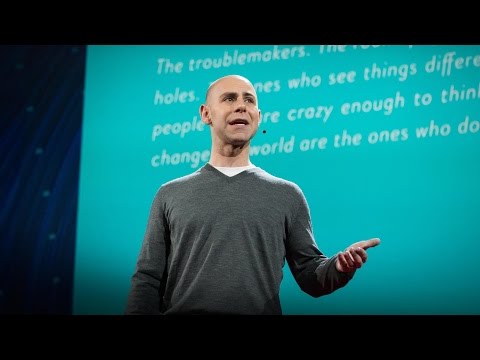
The surprising habits of original thinkers | Adam Grant | TED
Originals: How Non-Conformists Move the World
In this section, the speaker shares a personal anecdote about missing an investment opportunity with Warby Parker and introduces the concept of "originals" as nonconformists who drive creativity and change in the world.
Recognizing Originals
- Originals are individuals who not only generate new ideas but also take action to support them.
- The speaker passed on investing in Warby Parker due to their slow start, highlighting his tendency as a precrastinator.
- The speaker reflects on his early habits of finishing tasks ahead of time and contrasts this with a student's creativity emerging from procrastination.
The Link Between Procrastination and Creativity
This part delves into research findings on procrastination and creativity, exploring how moderate procrastinators tend to be more creative than extreme procrastinators.
Procrastination Study Results
- Chronic procrastinators lack new ideas due to excessive goofing off, while those rushing in are too anxious for original thoughts.
- Experiments reveal that moderate procrastinators show 16% more creativity compared to immediate task doers or extreme procrastinators.
- Procrastination allows for divergent thinking, nonlinear approaches, and unexpected leaps in creativity.
Embracing Procrastination for Creativity
Here, the speaker discusses embracing procrastination as a tool for enhancing creativity by allowing ideas to incubate over time.
Embracing Procrastination
- The speaker intentionally delays completing a chapter on procrastination while writing about it, leading to fresh insights upon returning to the task.
What Makes Originals Different
The speaker discusses the misconception of needing to be the first mover in a market and emphasizes the importance of being different and better rather than first. He also touches on the significance of doubt in the creative process and how it can be both paralyzing and energizing.
Importance of Being Different and Better
- First movers have a failure rate of 47%, while improvers only have an 8% failure rate.
- Being original doesn't require being first; it's about offering something different and better than existing options.
Dealing with Doubts in Creativity
- Distinguishes between self-doubt, which is paralyzing, and idea doubt, which is energizing.
- Emphasizes that managing doubt is crucial for creativity, as seen in examples like MLK testing ideas.
Courage to Be Original
The speaker explores the concept of courage in being original, highlighting how doubts can impact one's ability to innovate. He contrasts surface confidence with internal fears among creative individuals.
Courage vs. Doubts
- Expresses doubts about Warby Parker's backup plans impacting their originality.
- Original individuals may appear confident externally but often grapple with fear and doubt internally.
Overcoming Fear and Taking Initiative
The speaker delves into how originals handle fear differently by emphasizing action over inaction. He stresses the importance of trying despite potential failures.
Handling Fear and Taking Action
- Originals are more afraid of failing to try than failing itself.
- Elon Musk's example illustrates the significance of attempting important ideas even when success is uncertain.
Embracing Failure for Innovation
The speaker discusses how embracing failure is integral to innovation, showcasing that great originals fail frequently but persist in trying new ideas. He highlights that bad ideas are part of the journey towards success.
Embracing Failure for Success
- Celebrates those who fail frequently as they are often the ones who try new things most.
How to Be Original
The speaker discusses the process of generating original ideas and how even renowned figures like Bach, Beethoven, and Mozart had to create numerous compositions to produce a few masterpieces.
Generating Original Ideas
- Originality requires generating more ideas.
- Example of Warby Parker founders testing over 2,000 names before choosing "Warby Parker."
- Emphasizes the need for persistence in idea generation for uniqueness.
Embracing Fear and Doubt
The speaker highlights that individuals considered original are not fundamentally different from others. They experience fear, doubt, procrastination, and have bad ideas; however, success can stem from these qualities rather than despite them.
Qualities of Original Individuals
- Original individuals share common traits with others.
- Success can be influenced by fear, doubt, and bad ideas.
Turn any video into a summary like this
YouTube links, meetings, lectures. With transcripts, search, and chat.