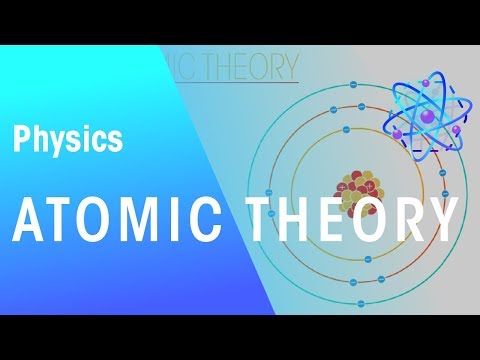
Atomic theory | Matter | Physics | FuseSchool

Atomic theory | Matter | Physics | FuseSchool

The Evolution of Atomic Theory

Ancient Greek Concepts of Atoms

  • The ancient Greeks theorized that matter could be divided into smaller units until reaching indivisible particles, which they termed "atomos," meaning indivisible.

John Dalton's Atomic Theory

  • In the 1800s, John Dalton proposed five key principles about atoms:
  • All matter is composed of atoms.
  • Atoms cannot be subdivided into smaller particles.
  • Atoms of the same element are identical; those of different elements differ.
  • Chemical reactions rearrange atoms in compounds formed by bonding different elements.

Discovery of Electrons by J.J. Thomson

  • J.J. Thomson expanded on Dalton's theory in the late 19th century by discovering electrons through experiments with cathode rays, revealing that atoms consist of smaller particles.
  • He introduced the plum pudding model, depicting the atom as a positively charged sphere with electrons embedded within it.

Rutherford's Gold Foil Experiment

  • Ernest Rutherford challenged Thomson’s model through his gold foil experiment using alpha particles, expecting them to pass through thin gold foil based on the plum pudding model.
  • Unexpectedly, some alpha particles were deflected or repelled, leading to the conclusion that atoms have a small, dense nucleus containing positively charged subatomic particles.

Bohr's Model and Current Understanding

  • Niels Bohr further developed Rutherford’s nuclear model by proposing that electrons occupy specific orbits around the nucleus, akin to planets orbiting the sun.
  • This modern understanding describes an atom with a central positive nucleus orbited by negatively charged electrons at defined distances and energy levels.

Turn any video into a summary like this

YouTube links, meetings, lectures. With transcripts, search, and chat.

Video description

Atomic theory | Matter | Physics | FuseSchool We didn’t always know exactly what the atom looked like. Even today we’re not entirely sure – but we have a far better idea than ever before! In this video, we’re going to look at the evolution of atomic theory. Before we start, you should have a general idea of the structure of an atom, so you may want to watch this video first. https://www.youtube.com/watch?v=pNroKeV2fgk CREDITS Animation & Design: Bing Rijper Narration: Dale Bennett Script: Eleanor Trezise SUBSCRIBE to the FuseSchool YouTube channel for many more educational videos. Our teachers and animators come together to make fun & easy-to-understand videos in Chemistry, Biology, Physics, Maths & ICT. VISIT us at www.fuseschool.org, where all of our videos are carefully organised into topics and specific orders, and to see what else we have on offer. Comment, like and share with other learners. You can both ask and answer questions, and teachers will get back to you. These videos can be used in a flipped classroom model or as a revision aid. Find all of our Chemistry videos here: https://www.youtube.com/playlist?list=PLW0gavSzhMlReKGMVfUt6YuNQsO0bqSMV Find all of our Biology videos here: https://www.youtube.com/playlist?list=PLW0gavSzhMlQYSpKryVcEr3ERup5SxHl0 Find all of our Physics videos here: https://www.youtube.com/playlist?list=PLW0gavSzhMlTWm6Sr5uN2Uv5TXHiZUq8b Find all of our Maths videos here: https://www.youtube.com/playlist?list=PLW0gavSzhMlTKBNbHH5u1SNnsrOaacKLu Instagram: https://www.instagram.com/fuseschool/ Facebook: https://www.facebook.com/fuseschool/ Twitter: https://twitter.com/fuseSchool Access a deeper Learning Experience in the FuseSchool platform and app: www.fuseschool.org Follow us: http://www.youtube.com/fuseschool Befriend us: http://www.facebook.com/fuseschool This is an Open Educational Resource. If you would like to use the video, please contact us: info@fuseschool.org