CCNP RS - Route - 3.55 - OSPF Giriş
Introduction to OSPF Training
Overview of the Course
- This is the first video in a series of 15 training videos on OSPF (Open Shortest Path First) routing protocol.
- The instructor emphasizes the importance of using reliable resources for learning, particularly recommending John Moy's book on OSPF as an excellent starting point.
Recommended Resources
- The instructor mentions that John Moy's book is well-written and not overly technical, making it accessible for learners.
- Another resource mentioned includes works by an unnamed author, which are also beneficial for understanding OSPF concepts.
- RFC documents will be referenced throughout the course, highlighting their significance in networking education.
Recap of Previous Knowledge
CCNA Foundations
- The course will begin with a review of CCNA (Cisco Certified Network Associate) knowledge, which is essential for understanding advanced topics in this series.
- Key protocols previously covered include RIP (Routing Information Protocol) and IGRP (Interior Gateway Routing Protocol), both classified as distance vector protocols.
Understanding Hybrid Protocols
- OSPF is identified as a hybrid protocol that utilizes both distance vector and link state methodologies in its operation.
- The distinction between how link state operates within areas versus distance vector across areas is clarified, emphasizing the complexity of OSPF's functionality.
Link State Concept Explained
Definition and Functionality
- Link state refers to routers sharing information about their connections with other routers, providing insights into network topology.
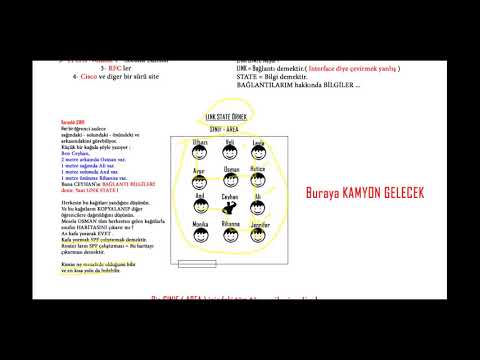
- A practical analogy involving students in a dark classroom illustrates how each router gathers connection data from its neighbors to build a comprehensive map of the network environment.
Practical Application Scenario
- In this analogy, each student writes down their neighboring connections on paper; when shared among all students (routers), they can collectively deduce the layout of the classroom (network). This process mirrors how SPF (Shortest Path First) algorithms operate within OSPF to determine optimal paths based on gathered link state information.
Understanding Link State and Distance Vector Routing Protocols
The Concept of Link State Routing
- Link state routing operates by determining the shortest path to a destination, akin to how one might navigate using a map. Each router has knowledge of its connections and distances, allowing it to calculate optimal routes.
- This process is referred to as link state; routers maintain information about their links on small papers (or data structures) that are shared with all other routers in the network.
- Upon receiving this information, routers can understand the network topology and determine the most efficient paths based on collective knowledge.
Classrooms as an Analogy for Network Areas
- In this analogy, each classroom represents an area within a network. All students (routers) in a classroom know the layout of their own room but not necessarily those of others.
- An OSPF domain encompasses an entire school (network), while areas represent different classrooms. This structure helps manage large networks more efficiently.
Challenges in Large Networks
- If there were only one classroom for 1000 students, it would be chaotic and inefficient for them to create a comprehensive map due to overwhelming complexity.
- The concept of areas allows for manageable segments where each student can focus on creating maps without being overwhelmed by too much information at once.
Router Capacity and Efficiency
- The number of routers that can effectively operate within an area depends on their capabilities—such as processing power and memory—not just arbitrary numbers suggested in textbooks.
- A well-designed area will have routers that are capable enough to handle routing tasks efficiently without causing delays or confusion among them.
Understanding Communication Between Routers
- Within an OSPF domain, various areas exist, but communication between these areas is limited; routers know their immediate surroundings but lack complete visibility into other areas' layouts.
- For example, if two students from different classrooms want to communicate, they only know the distance between themselves through direct measurements rather than having full access to each other's maps.
Distance Vector vs. Link State Routing
- In contrast with link state routing, distance vector protocols only provide basic distance metrics without detailed knowledge about intermediate nodes or paths beyond immediate neighbors.
- This limitation means that while distance vector protocols can inform you how far away something is (e.g., 100 kilometers), they do not reveal what lies along that route or how many hops are involved until reaching the destination.
By understanding these concepts clearly through analogies like classrooms and focusing on both link state and distance vector methodologies, we gain insights into effective networking strategies essential for managing complex systems like OSPF domains.
OSPF and Distance Vector Protocols
Understanding OSPF as a Hybrid Protocol
- OSPF operates as a hybrid protocol, combining features of distance vector protocols. The speaker emphasizes the importance of understanding this dual nature.
Looping in Routing Protocols
- The speaker discusses whether loops can occur within areas in routing protocols, asserting that loops cannot exist within a single area due to complete map knowledge.
- However, inter-area loops are possible when using distance vector protocols, highlighting the potential for looping between different areas.
Preventing Loops in Distance Vector Protocols
- The discussion includes how distance vector protocols like RIP and IACP implement measures to prevent loops, referencing theoretical concepts from CCNA literature.
Practical Applications and Limitations
- Despite theoretical discussions on loop prevention, practical applications are limited. Some resources have attempted to address these issues but lack comprehensive implementation examples.
Packet Types in OSPF
- The speaker introduces various packet types used in OSPF such as Hello packets and LSR (Link State Request), indicating that these will be explored further throughout the course.
Key Concepts of OSPF Routers Communication
- Unlike distance vector protocols where routers exchange network information directly, OSPF relies on smaller packets for communication. This method enhances efficiency by minimizing direct data exchanges.
Course Overview and Structure
- This introductory video is part of a series consisting of 15 videos focused on OSPF. The subsequent videos will delve deeper into specific topics related to routing protocols and their functionalities.