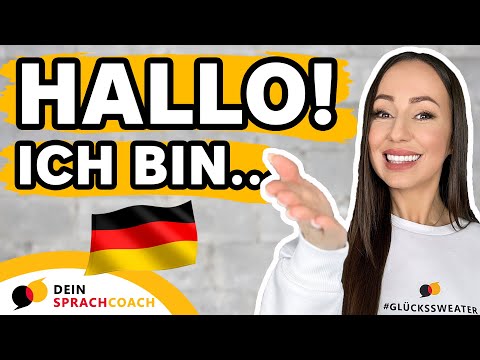
SICH VORSTELLEN AUF DEUTSCH🇩🇪(Tipps | Tricks | Redemittel | Deutsch im Beruf)
Introduction to Self-Introduction in German
Overview of the Video
- Maria introduces herself as a German teacher and emphasizes the importance of knowing how to introduce oneself correctly in various situations.
- She acknowledges that self-introductions can be nerve-wracking, even for those who have lived in Germany for a long time, and shares her intention to provide helpful tips.
Resources Offered
- A free PDF with examples from the video is available through a link provided below the video. Users need to enter their name and email address to access it.
- The PDF includes extensive materials on different topics related to learning German, allowing users to improve their speaking and writing skills at no cost.
Key Components of Self-Introduction
Starting with Greetings
- The video begins by discussing various ways to greet someone beyond just saying "Hallo," highlighting both formal and informal options.
Introducing Yourself
- Maria explains three common phrases for stating one's name: "Ich heiße," "Ich bin," or "Mein Name ist." Examples include “Ich heiße Maria” or “Mein Name ist Maria.”
Discussing Place of Origin
- When talking about where one comes from, useful phrases include "Ich komme aus" or "Ich komme ursprünglich aus." An example given is “Ich komme aus Russland.”
Describing Birthplace and Background
Birthplace Expressions
- To express being born in a specific location, one can say “Ich bin geboren und aufgewachsen,” e.g., “Ich bin in Kanada geboren und aufgewachsen.” This helps clarify if someone was born in one place but raised elsewhere.
Clarifying Living Situations
- Maria discusses the difference between using "leben" (to live) and "wohnen" (to reside), noting that while they can often be used interchangeably, there are contexts where only one is appropriate. For instance, living implies deeper integration into a place than merely residing there.
Sharing Personal Information
Birth Date Details
- When sharing birth dates, it's noted that stating just the year does not require a preposition; e.g., “Ich bin 1985 geboren” is acceptable shorthand for more formal expressions like “Ich bin im Jahr 1985 geboren.”
Age Expression Variations
- Different ways to express age are discussed; for example, saying “ich bin 37 Jahre alt” can be shortened informally to just stating the age or using terms like “Anfang,” “Mitte,” or “Ende” when referring to decades of life experience.
Understanding Age and Education in Conversations
Discussing Age
- When avoiding precise age details, one can say "I'm almost 40" or "I just turned 40," which is a common practice, especially for women around the age of 30.
- The age of 30 is often viewed as a significant milestone for women; however, aging should not be feared as it brings beauty and improvement.
Educational Background
- It's important to discuss one's educational journey, including where one studies. For example, stating "I study medicine in Munich" is common.
- You can specify your academic progress by mentioning your semester: "I'm in my fourth semester" or indicate if you are nearing completion of your studies.
Vocational Training
- If you have undergone vocational training instead of traditional education, you might say, "I am doing an apprenticeship at [Company Name]."
- Mentioning the type of apprenticeship (e.g., baker's training) can also provide clarity about your professional background.
Discussing Profession and Work Experience
Job Title and Responsibilities
- Clearly state your profession without articles: "I am a teacher." Alternatively, describe what you do: "I teach German online."
- You may combine job title with workplace: "I work as an engineer at BMW," providing both role and company information.
Work Environment
- Discussing the nature of your work environment is essential; for instance, saying “I work with children” gives insight into your job context.
- If self-employed, phrases like “I run my own business” or “I'm self-employed” clarify your employment status.
Experience and Qualifications
Professional Experience
- Sharing years of experience enhances credibility; for example, “I have five years of experience in marketing.”
- Combining job title with experience creates impactful statements like “I am a German teacher with over 14 years of experience.”
Academic Qualifications
- Highlighting qualifications such as degrees (e.g., Bachelor’s in Business Administration or Master’s in International Business) showcases educational achievements.
- Continuing education is vital; mentioning participation in courses (like computer or English classes), reflects ongoing professional development.
Introduction to German Language Skills
Formation of Adjectives
- The speaker discusses the formation of new adjectives in German, using examples like "dreitägig" (three-day), "fünfwöchig" (five-week), and "viermonatig" (four-month).
Discussing Language Proficiency
- Emphasizes how to express language skills, suggesting phrases such as "Ich spreche Deutsch, Englisch und Russisch" (I speak German, English, and Russian) or describing proficiency levels from A1 to C2.
Personal Information Sharing
- Highlights the importance of sharing personal details during introductions, including family size and relationships. Examples include having siblings or being an only child.
Family Dynamics and Status
Family Structure
- Discusses various family structures: having a mother and father, siblings, or being an only child. Also mentions pets as part of the family.
Marital Status
- Covers different marital statuses such as single ("ledig"), married ("verheiratet"), divorced ("geschieden"), or widowed ("verwitwet").
Children and Hobbies
Children
- Provides examples for discussing children: stating if one has children, specifying their genders, or mentioning names.
Hobbies Expression
- Explains how to talk about hobbies using nominalized verbs like "Mein Hobby ist Kochen" (My hobby is cooking). Encourages expressing preferences with phrases like "Ich mag schwimmen" (I like swimming).
Engaging Introductions
Fun Facts in Introductions
- Suggests including interesting facts during introductions to make them engaging. This could be a unique hobby or experience that stands out.
Personal Introduction Example
Speaker's Background
- The speaker introduces herself as Maria, a German teacher with over 14 years of experience living in Germany. She shares her family details including her son and pets.
Conclusion and Call to Action
Encouragement for Interaction
- Invites viewers to introduce themselves in the comments section and engage with others by responding to comments.
Additional Resources
- Mentions a free PDF resource available for download that summarizes useful phrases from the video for further study.