Video2 Tema2
Introduction to Cell Membrane
Overview of the Class
- Dr. Mónica Martínez Pacheco welcomes students to the second class on cellular biology, focusing on the cell membrane's structure and function.
- The discussion will cover the components of the cell membrane, their roles in cellular communication, and implications for dental health.
Definition and Functions of Cell Membrane
- The cell membrane is described as a selective barrier that separates cytoplasm from the external environment, maintaining cellular integrity.
- It provides rigidity and flexibility, allowing compartmentalization within cells while facilitating transport and communication with external environments.
Communication and Structural Role
Interaction Between Cells
- The membrane connects internal cellular processes with external signals, enabling communication between cells within tissues.
- It anchors to the cytoskeleton and extracellular matrix, contributing to overall cell stability.
Chemical Composition of Cell Membrane
Lipids in Membrane Structure
- Key components include lipids such as phospholipids forming a lipid bilayer; these are crucial for membrane structure.
- Phospholipids have polar heads and non-polar tails, creating a bilayer that facilitates selective permeability.
Asymmetry in Lipid Layers
- The outer layer contains phosphatidylcholine and sphingomyelin; the inner layer has phosphatidylethanolamine, phosphatidylserine, and phosphatidylinositol.
- This asymmetry is vital for signaling capabilities and allows flexibility compared to rigid cell walls.
Cholesterol's Role in Membrane Fluidity
Functionality of Cholesterol
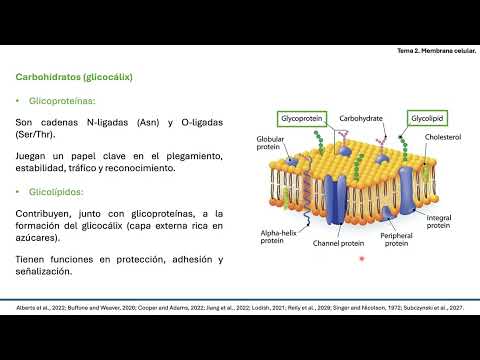
- Cholesterol molecules intercalate among phospholipids, reducing permeability by controlling what enters or exits the cell.
Glycolipids in Cellular Recognition
Importance of Glycolipids
- Glycolipids are primarily found on the outer layer of membranes; they play key roles in cellular recognition against antigens.
Proteins: Integral Components of Membranes
Types of Membrane Proteins
- Integral proteins span across the lipid bilayer (transmembranous), facilitating transport through protein channels.
Peripheral Proteins' Functions
- Peripheral proteins modulate signaling pathways without being covalently attached to membranes but assist in structural support.
Carbohydrates: Glicocalyx Formation
Role of Carbohydrates
- Carbohydrates form part of glycoproteins or glycolipids contributing to stability, protection, adhesion, and signaling functions.
Fluid Mosaic Model Explanation
Understanding Fluid Mosaic Model
- Proposed by Singer and Nicholson in 1972; describes membranes as dynamic structures with fluid movement allowing protein mobility within lipid layers.
Factors Influencing Membrane Fluidity
Temperature Effects
- Higher temperatures increase fluidity due to increased kinetic energy among lipids; lower temperatures lead to more rigid states.
Other Influencing Factors
- Shorter fatty acid chains enhance fluidity due to reduced hydrophobic interactions.
- Unsaturated fatty acids create bends that prevent tight packing leading to increased fluidity.
Cholesterol's Dual Role
- Cholesterol acts as a buffer for fluidity at varying temperatures preventing crystallization at low temps while limiting excessive movement at high temps.
Protein Influence on Fluidity
- Transmembrane proteins can restrict lipid movement thus affecting overall membrane fluidity based on their abundance.
Lipid Rafts Impact
- Lipid rafts are cholesterol-rich domains that reduce overall membrane fluidity impacting molecular traffic across membranes.
Cytoskeletal Interactions
- Proteins anchored to cytoskeleton limit mobility further decreasing membrane flexibility when bound tightly.
Protective Barriers Created by Junction Proteins
- Tight junction proteins create barriers restricting molecular flow enhancing tissue stability through limited permeability.
General Functions of Cell Membranes
- Compartmentalization isolates metabolic processes within organelles ensuring specific conditions for biochemical reactions occur efficiently.
Signaling Mechanisms
- Transmembrane proteins act as receptors triggering intracellular responses upon ligand binding facilitating intercellular communication.
Adhesion Properties
- Adhesion proteins like cadherins anchor cells together providing structural integrity essential for tissue formation.
Recognition Processes
- Surface proteins identify self versus non-self entities aiding immune response mechanisms during pathogen encounters.
Transport Mechanisms Across Membranes
Passive Transport: Simple Diffusion
- Simple diffusion allows molecules like oxygen or carbon dioxide to move freely across membranes down concentration gradients without energy expenditure.
Facilitated Diffusion
Facilitated diffusion requires transmembrane protein channels utilizing ATP indirectly while transporting substances along concentration gradients effectively managing entry/exit rates based on needs .
Osmosis Process
Osmosis involves water moving through semipermeable membranes balancing solute concentrations without energy use maintaining homeostasis vital for cellular function .
Active Transport Mechanisms
Primary Active Transport
Primary active transport utilizes ATP directly moving ions against concentration gradients exemplified by sodium-potassium pumps regulating ion balance crucially influencing electrical activity across excitable cells .
Secondary Active Transport
Secondary active transport relies on electrochemical gradients established via primary active transport enabling co-transports (symporters/antiporters).
Active and Passive Transport Mechanisms in Cellular Physiology
Overview of Active Transport
- Adenosine triphosphate (ATP) converts to adenosine monophosphate (AMP) and a free phosphate, providing energy for molecules to migrate against concentration gradients during primary active transport.
- Sodium-potassium pumps consume significant ATP, up to 70% in neurons, which are highly differentiated cells requiring constant homeostasis.
Importance of Transport in Oral Tissues
- Active and passive transport facilitates ionic exchange between internal and external cellular environments, crucial for mucosal epithelial cells regulating secretion.
- Proper ion exchange maintains pH levels in oral mucosa, preventing pathogen invasion that could disrupt homeostasis.
Role of Ion Channels and Pumps
- Chloride channels and sodium-potassium ATPase pumps regulate osmotic balance within oral mucosal cells, essential for tissue health and regeneration after injury.
- Osmosis and co-transporters maintain cell volume and tonicity, vital for oral tissues' integrity.
Consequences of Disrupted Transport Mechanisms
- Failure to regulate pH or solute concentrations can lead to inflammation in gingival tissue, increasing the risk of periodontal disease or neoplasia.
- Calcium and phosphate transport is critical during the development of oral organs; odontoblasts form dentin while ameloblasts create enamel.
The Significance of Calcium Transport
Mineralization Processes
- Effective calcium and phosphate transport is essential for synthesizing dentin and enamel correctly; improper mineralization leads to mechanical weakness in teeth.
- Dysfunctional ion pumps result in demineralization processes that can lead to dental caries.
Endocytosis: Internalizing Substances
Types of Endocytosis
- Endocytosis allows cells to internalize substances through membrane invaginations; it requires energy from ATP.
- Phagocytosis enables the uptake of large particles like bacteria by immune cells such as macrophages; these particles are enclosed within phagosomes that fuse with lysosomes for degradation.
Pinocytosis Process
- Pinocytosis involves the non-selective intake of fluids into the cell via small vesicles formed by invagination, crucial for cellular component renewal.
Receptor-Mediated Endocytosis
Selective Uptake Mechanism
- Receptor-mediated endocytosis is a selective process where specific ligands bind receptors on the membrane before being internalized through invagination.
Exocytosis: Secretion Processes
Overview of Exocytosis Functions
- Exocytosis involves expelling substances from the cell using vesicles that fuse with the plasma membrane; it also requires ATP.
Types of Exocytosis
- Constitutive exocytosis occurs continuously across most cell types without needing specific signals; it helps renew plasma membranes.
- Regulated exocytosis happens in specialized cells like neurons or endocrine glands, releasing hormones or neurotransmitters when needed.
Clinical Relevance in Dentistry
Impact on Oral Health
- Proper functioning of endo/exocytic processes is vital for immune responses against pathogens within oral tissues; failure can lead to periodontal diseases or caries.
Turn any video into a summary like this
YouTube links, meetings, lectures. With transcripts, search, and chat.