ED Lineales de 1° orden
Introduction to First Order Differential Equations
Overview of Linear Differential Equations
- The presentation introduces a new method for solving first-order differential equations, specifically linear ones, expressed in the form y' = p(x)y + q(x) , where p(x) and q(x) are continuous functions or constants.
Types of Linear Differential Equations
- There are two types of first-order linear differential equations:
- Homogeneous (Incomplete): Occurs when q(x) = 0 , simplifying to y' = p(x)y .
- Non-Homogeneous (Complete): When q(x) neq 0, represented as y' = p(x)y + q(x) .
Solving Homogeneous Linear Differential Equations
Methodology for Incomplete Equations
- For homogeneous equations, the solution involves separating variables and integrating, leading to a general solution that includes an essential constant.
General Solution Formulation
- By applying logarithmic properties, the absolute value can be eliminated from the equation, allowing it to be expressed as:
- y = Ce^-int p(t),dt , where C is a constant representing all solutions satisfying the equation.
Example of Solving an Incomplete Equation
Finding Particular Solutions
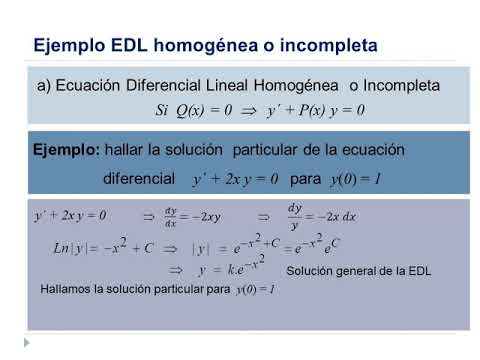
- An example is provided with the equation y' + 2x = 0 . The integration leads to a general solution involving an essential constant.
Applying Initial Conditions
- To find a particular solution given initial conditions (e.g., when x = 0, then y = 1), substitute these values into the general solution to solve for C.
Transitioning to Complete Linear Differential Equations
New Approach for Non-Homogeneous Cases
- A substitution method is proposed where the unknown function is expressed as a product of two functions. This aims at deriving a family of functions that satisfy the complete differential equation.
Deriving Expressions from Substitutions
Steps in Derivation Process
- After substituting and differentiating, we arrive at an expression that can be simplified by factoring out common terms.
Setting Up New Equations
- The derived expression allows us to set up another incomplete linear differential equation which can be solved using known methods.
Example of Solving Complete Linear Differential Equation
Identifying Functions in Complete Form
- An example with initial condition shows how to rearrange into standard form and identify functions necessary for solving.
Integration and Final Solution Expression
- Integrating yields specific forms for both parts of our substituted function. The final expression represents the general solution including essential constants.
Conclusion on Finding Particular Solutions
Finalizing Particular Solutions with Initial Conditions
- By substituting back into our derived expressions with specific initial conditions (e.g., when x=pi/2), we determine constants leading us to conclude with particular solutions fitting those conditions.
Turn any video into a summary like this
YouTube links, meetings, lectures. With transcripts, search, and chat.