W6_L5_Multiplexers
Multiplexer Explained
Introduction to Multiplexers
- The multiplexer, abbreviated as MX or DMX, is introduced as a significant circuit in digital electronics.
- A decoder translates encoded addresses into physical locations; similarly, a multiplexer selects one of several inputs to connect to an output.
Functionality of a Multiplexer
- The multiplexer operates like a switch that chooses which input (from multiple sources) will be directed to the output.
- An analogy is drawn comparing the multiplexer to train tracks where levers determine the direction of the train, illustrating how inputs are routed.
Practical Example and Logic Circuit
- A practical example involves selecting water from different taps (sources), emphasizing that only one source can be active at any time.
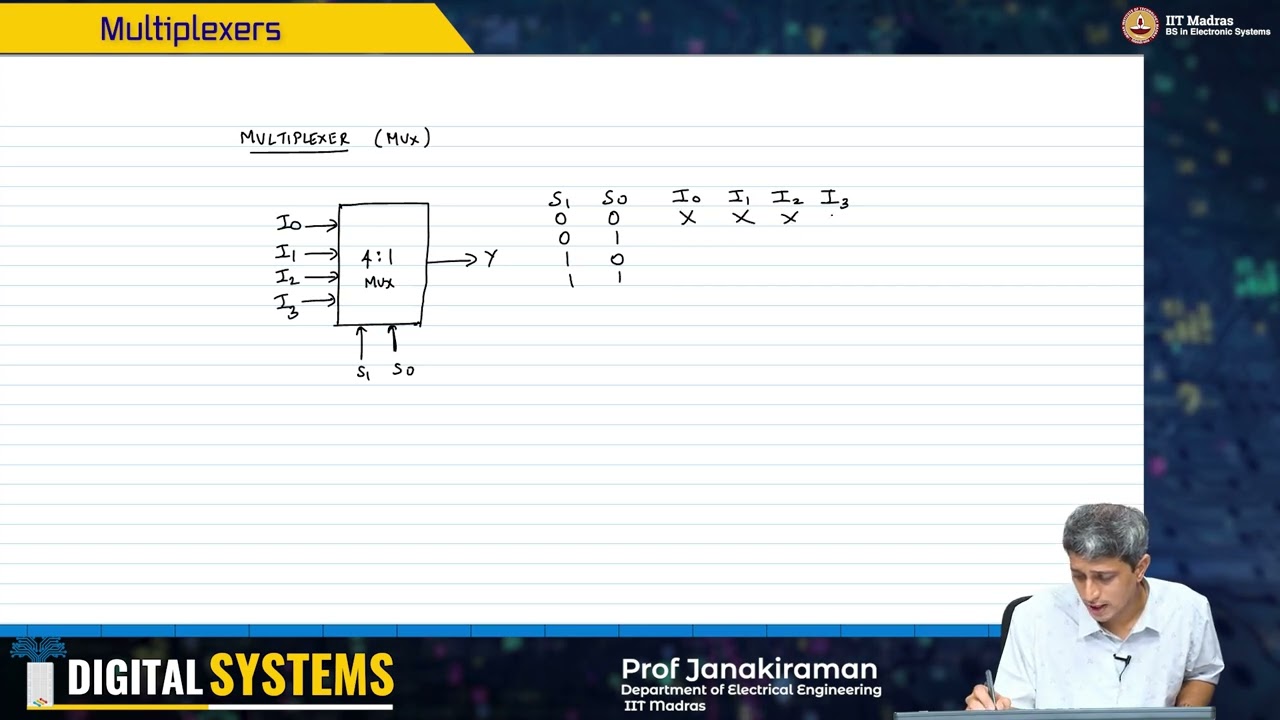
- For a 4-to-1 multiplexer, two select lines (S1 and S0) are required to choose between four inputs.
Truth Table and Implementation
- The number of inputs for multiplexers follows powers of two: 4-to-1, 8-to-1, etc., necessitating two select signals for four inputs.
- Instead of writing all combinations for the truth table (which would be complex), it’s simplified by focusing on key outputs based on select line states.
Generating Min Terms
- The output y is expressed in terms of min terms derived from each input based on select line conditions.
- Various logic gates can be used to implement these min terms effectively within the circuit design.
Output Behavior Over Time
- It’s crucial to visualize how outputs change over time with varying select signals.
Digital and Analog Multiplexers Overview
Understanding Multiplexers
- The discussion highlights the ability to plot time functions based on various inputs for multiplexers, emphasizing their practical applications.
- A distinction is made between digital and analog multiplexers; while digital multiplexers operate on binary signals, analog multiplexers follow the analog signal directly.
- Despite differences in operation, the fundamental logic behind both types of multiplexers remains similar, indicating a shared underlying technology.