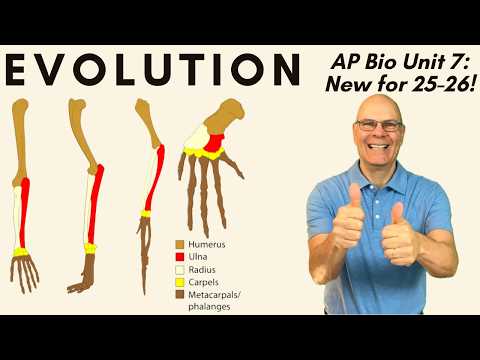
AP Bio Evolution (Unit 7) Mega-Review (25–26): From Natural Selection to Speciation to Phylogeny
Introduction to Evolution in AP Biology
Overview of Topics
- The unit covers the extensive timeline of biological evolution, focusing on key concepts such as natural selection, artificial selection, and sexual selection.
- Additional topics include population genetics, Hardy-Weinberg equilibrium, evidence for evolution, speciation, variation in populations, and the origin of life.
Understanding Selection Mechanisms
Natural vs. Artificial Selection
- Natural selection is a fundamental concept introduced by Charles Darwin; it builds upon artificial selection (selective breeding).
- Artificial selection involves breeders selecting organisms with desired traits over generations to create specific gene pools.
Examples of Artificial Selection
- Brassica oleracea species (cauliflower, broccoli, Brussels sprouts) illustrate how selective breeding can produce diverse plant varieties from a single ancestor.
- Dog breeds demonstrate artificial selection where various traits have been enhanced for human purposes like companionship or work.
Mechanisms of Natural Selection
Process of Natural Selection
- Variation within populations is crucial; inherited genetic variations arise through recombination and mutation.
- The phrase "Many are born, but few survive" summarizes the survival advantage conferred by beneficial traits leading to adaptation over generations.
Types of Adaptations
- Adaptations can be structural (e.g., bat wings), behavioral (e.g., sonar in bats), or molecular (e.g., enzyme-substrate interactions).
Sexual Selection Dynamics
Intersexual vs. Intrasexual Selection
- Intersexual selection occurs when one sex (usually females) chooses mates based on attractive traits displayed by the other sex (males).
- Intrasexual selection involves competition among males for access to females or territories; this often results in larger size and aggressive behavior.
Phenotypic Distribution Changes
Types of Selection Impacting Populations
- Directional selection favors one extreme phenotype over others; stabilizing selection favors average phenotypes while disruptive selection favors two extremes.
Example: Birth Weight in Babies
- Stabilizing selection example shows that babies with average birth weights have higher survival rates compared to those who are too small or too large.
Adaptive Melanism Case Study
Darkening Body Coloration
- Adaptive melanism refers to changes in body coloration due to environmental factors like predation pressures affecting allele frequencies over time.
Rock Pocket Mouse Example
- Populations living on dark substrates evolved mutations resulting in increased melanin production for better camouflage against predators.
Defining Evolutionary Fitness
Concept of Fitness
- Evolutionary fitness measures reproductive success rather than physical strength; it encompasses offspring survival across all life stages.
Pepper Moth Case Study
The peppered moth illustrates directional selection and adaptive melanism as its color shifted from light to dark during industrialization due to environmental changes.
Population Genetics Fundamentals
Key Concepts
- Population genetics studies gene distribution and changes over time within populations focusing on allele frequency as a measure.
Hardy-Weinberg Principle
- The principle states that allele frequencies remain constant unless certain conditions are violated including random mating and no immigration/emigration.
Factors Influencing Evolution
Genetic Drift & Bottlenecks
- Genetic drift leads to random changes in allele frequencies especially significant in small populations; bottlenecks reduce genetic diversity after substantial population loss.
Founder Effect
- Occurs when a small group establishes a new population with potentially different allele frequencies than the original population they left behind.
Gene Flow Impacts
Definition & Effects
- Gene flow describes the movement of alleles between populations which can alter allele frequencies and reduce differences between them.
Mutation's Role
- Mutations introduce genetic variation essential for evolution; directional mutations can shift allele frequencies significantly within populations.
Sickle Cell Disease Example
Heterozygote Advantage
- Sickle cell disease exemplifies how recessive alleles can persist at high frequencies due to heterozygote advantages against malaria despite their detrimental effects when homozygous recessive.
Evidence of Common Ancestry in Biology
Homologies and Shared Features
- All living organisms share common features indicating a relationship, such as DNA as genetic material, ATP for energy coupling, and ribosomes for protein synthesis.
- Eukaryotes exhibit shared characteristics like the presence of a nucleus and mitochondria, suggesting they are all cousins with a common ancestor dating back 1.8 billion years.
- Embryological development shows that early vertebrate embryos resemble each other, supporting the idea of common ancestry among fish, reptiles, birds, and humans.
Evolutionary Development
- Descent with modification leads to diverse body forms while embryonic similarities indicate shared lineage from a common vertebrate ancestor.
- Vestigial features in embryos (e.g., human tails and gill slits) provide evidence of descent from ancestors with different traits.
Genetic Evidence Supporting Evolution
Shared Genes Across Species
- The eyeless gene serves as a master switch for eye development across species; its transplantation can lead to successful eye formation in different organisms.
- Homeotic genes dictate body structure organization across various animal groups, reinforcing the concept of shared ancestry.
Biogeography: Geographic Distribution as Evidence
Patterns of Distribution
- Biogeography studies how species are distributed geographically; populations evolve in one area before spreading to adjacent regions.
- Marsupials dominate Australia due to geographic isolation preventing placental mammals from migrating there.
Parallel Evolution Examples
- Convergent evolution occurs when marsupials fill ecological niches similar to placental mammals found elsewhere (e.g., moles and predators).
Fossils: A Record of Evolution Over Time
Understanding Fossils
- Fossils represent petrified remains showing evolutionary changes over time through transitional forms leading back to ancestral species.
Dating Fossils
- Relative dating uses sedimentary layers' positions to determine fossil ages based on superposition principles.
- Absolute dating relies on radioactive isotopes' decay rates (half-lives), providing precise age estimates for fossils.
Observing Modern Evolution: Resistance Development
Case Study: Mosquito Resistance
- The evolution of DDT resistance in mosquitoes illustrates rapid genetic change due to selective pressure from pesticide use against malaria-spreading mosquitoes.
Broader Implications
- Similar resistance patterns have been observed in bacteria against antibiotics and cancer cells against chemotherapy drugs.
Defining Species: Biological Species Concept
Key Characteristics
- The biological species concept defines species by their ability to interbreed naturally and produce viable offspring while being reproductively isolated from others.
Limitations
- This concept struggles with hybridization cases among closely related species or applies poorly to extinct or asexual organisms.
Reproductive Isolation Mechanisms
Prezygotic vs. Postzygotic Barriers
- Prezygotic mechanisms prevent mating or fertilization (e.g., behavioral differences).
- Postzygotic barriers occur after zygote formation but prevent viable offspring production (e.g., hybrid sterility).
Speciation Processes
Alopatric vs. Sympatric Speciation
- Alopatric speciation involves geographic barriers leading to reproductive isolation over time.
- Sympatric speciation occurs without geographical separation through mechanisms like polyploidy or microhabitat adaptation.
Adaptive Radiation
Concept Overview
- Adaptive radiation describes how one ancestral species diversifies into multiple descendant species adapted to different ecological niches (e.g., Galapagos finches).
Importance of Phenotypic Variation
Role in Natural Selection
- Phenotypic variation is crucial for natural selection; it provides the raw material upon which selection acts, influencing survival and reproduction rates.
Understanding Phylogenetic Trees and Evolutionary Relationships
Key Concepts in Phylogenetics
- The vertebral column is a shared derived feature that distinguishes mammals, including salmon and gorillas, from other organisms like hagfish. This feature helps define clades within evolutionary biology.
- A node in a phylogenetic tree represents the point where two branches diverge, indicating a common ancestor for those lineages. Nodes are crucial for understanding evolutionary relationships among species.
- Sister groups are defined as descendants that split from the same node, such as the common cactus finch and large ground finch, which can also be referred to as sister species at their taxonomic level.
- An outgroup is a more distantly related group used to compare with the ingroup (the main focus of study), helping to clarify evolutionary relationships within the tree. For example, an outgroup may provide context for understanding traits in the ingroup.
Common Misconceptions in Phylogenetic Analysis
- A prevalent misconception is that vertical proximity on a horizontal tree indicates closeness in evolution; however, only recency of common ancestry matters. For instance, frogs and lizards appear close but share a distant common ancestor compared to alligators and robins.
- The concept of node rotation illustrates that phylogenetic trees can be represented differently while conveying the same information about evolutionary relationships; thus, visual representation does not affect underlying data accuracy.
Defining Ancestral Features
- An ancestral feature is a trait shared by members of a clade but also found in larger inclusive clades; it does not uniquely define any single clade. For example, claws or nails are ancestral features for mammals like rats and gorillas because they are present across broader categories including reptiles.
Evidence Used in Constructing Phylogenetic Trees
- Prior to 1960, morphological similarities were primarily used to construct phylogenetic trees; however, post-Watson and Crick's discovery of DNA structure led to nucleotide sequences becoming the gold standard for determining evolutionary relationships among species through genetic analysis.
Molecular Clocks Explained
- Molecular clocks utilize mutation rates in proteins or nucleic acids over time to estimate when species diverged based on fossil records; this method allows researchers to infer timelines for speciation events effectively using accumulated mutations as indicators of time elapsed since divergence occurred.
Exploring the Origin of Life: Key Steps and Experiments
Emergence of Life on Earth
- The origin of life involves understanding how life emerged naturally without pre-existing cells; this includes addressing both cellular emergence and chemical processes leading up to biological complexity amidst Earth's ancient conditions approximately 3.8 billion years ago.
Key Steps Required for Life Emergence
- Earth needed stabilization after being bombarded by asteroids before life could begin.
- Abiotic synthesis must produce monomers (like amino acids) necessary for forming polymers essential for cellular structures.
- Formation of vesicles encapsulating these monomers/polymers leads towards proto-cells.
- Development into self-replicating systems marks significant progress toward living cells capable of evolution through natural selection processes leading up to LUCA (Last Universal Common Ancestor).
Miller-Urey Experiment Insights
- The Miller-Urey experiment demonstrated abiotic synthesis capabilities by simulating early Earth conditions resulting in amino acid formation without life presence—this foundational experiment paved ways for further research into life's building blocks despite some inaccuracies regarding early atmospheric composition today recognized by scientists as needing revision based on current geological understandings.(4082).
Components & Process
- Sterile apparatus created various chambers representing early oceans/atmosphere devoid of oxygen.
- Electrodes simulated lightning effects facilitating chemical reactions among gases believed present during Earth's formative years.
- Resulting samples revealed amino acids' presence confirming potential pathways toward life's molecular foundations even if full life creation wasn't established directly through this setup.(4156).
RNA World Hypothesis
- It’s theorized that RNA was likely the first hereditary molecule due its dual role storing genetic information while also possessing catalytic properties unlike DNA—leading towards complex self-replicating systems evolving eventually into modern cellular forms through natural selection mechanisms observed today.(4252).