Major Aircraft Components
Aircraft Components Overview
Major Components of an Aircraft
- The video introduces the major components common to nearly all aircraft, including the fuselage, wings, empennage, landing gear, and power plant.
Fuselage Structure
- The fuselage serves as the central body of the airplane, housing crew and cargo while providing structural support for wings and tail assembly.
- Older designs often used open truss structures made from wood or metal; modern aircraft typically utilize monocoque (single shell) or semi-monocoque designs.
Wing Design and Functionality
- Wings are essential airfoils attached to the fuselage that generate lift during flight; various designs cater to specific performance needs.
- Wing attachment can vary: high-wing, mid-wing, or low-wing configurations affect aerodynamics and stability.
- Monoplanes have a single set of wings while biplanes feature two sets; high-wing planes may use external braces called wing struts for added support.
Wing Structure Details
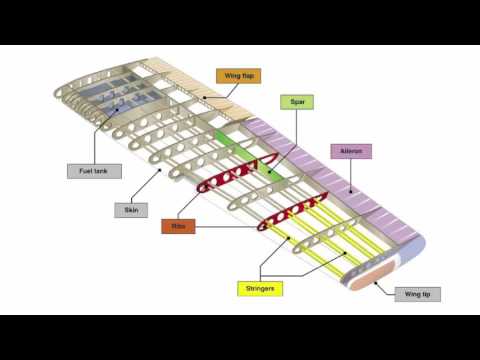
- Key structural elements of wings include spars, ribs, stringers, and skin; these components work together to maintain shape and integrity under load.
- Control surfaces like ailerons (for rolling motion) and flaps (to increase lift during takeoff/landing) are crucial for maneuverability.
Empennage Functions
- The empennage comprises the tail section with vertical stabilizer (rudder), horizontal stabilizer (elevator), and trim tabs for control adjustments.
- The rudder controls left/right movement while the elevator manages up/down motion; trim tabs help reduce pilot workload by adjusting control pressures.
Advanced Tail Designs
- Some aircraft use a stabilator instead of an elevator; this design pivots from a central hinge allowing more responsive control movements.
Landing Gear Types
- Landing gear supports the aircraft on ground operations; typical configurations include conventional (tail wheel) or tricycle gear setups with steerable wheels for ground control.
Power Plant Overview
- The power plant includes both engine and propeller systems; engines provide thrust as well as electrical power and heating for passengers.
Engine Cooling Mechanisms
- Cowling around engines streamlines airflow for cooling purposes while propellers convert engine rotation into thrust necessary for flight.
Understanding Pusher Type Aircraft
Propeller Mechanics
- A pusher type aircraft features a propeller located at the rear of the engine, which plays a crucial role in generating thrust.
- The propeller acts as a rotating airfoil, producing thrust through aerodynamic actions similar to how lift is generated by traditional lifting surfaces.
- As the propeller rotates, it creates a low-pressure area behind it and a high-pressure area at its face, facilitating forward motion.
- This mechanism highlights the fundamental principles of aerodynamics that govern both lift and thrust in aviation.