Major Aircraft Components

Major Aircraft Components

Aircraft Components Overview

Major Components of an Aircraft

  • The video introduces the major components common to nearly all aircraft, including the fuselage, wings, empennage, landing gear, and power plant.

Fuselage Structure

  • The fuselage serves as the central body of the airplane, housing crew and cargo while providing structural support for wings and tail assembly.
  • Older designs often used open truss structures made from wood or metal; modern aircraft typically utilize monocoque (single shell) or semi-monocoque designs.

Wing Design and Functionality

  • Wings are essential airfoils attached to the fuselage that generate lift during flight; various designs cater to specific performance needs.
  • Wing attachment can vary: high-wing, mid-wing, or low-wing configurations affect aerodynamics and stability.
  • Monoplanes have a single set of wings while biplanes feature two sets; high-wing planes may use external braces called wing struts for added support.

Wing Structure Details

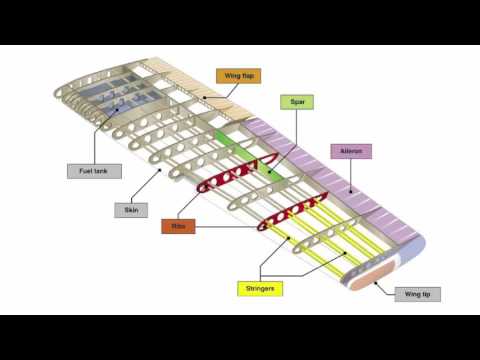
  • Key structural elements of wings include spars, ribs, stringers, and skin; these components work together to maintain shape and integrity under load.
  • Control surfaces like ailerons (for rolling motion) and flaps (to increase lift during takeoff/landing) are crucial for maneuverability.

Empennage Functions

  • The empennage comprises the tail section with vertical stabilizer (rudder), horizontal stabilizer (elevator), and trim tabs for control adjustments.
  • The rudder controls left/right movement while the elevator manages up/down motion; trim tabs help reduce pilot workload by adjusting control pressures.

Advanced Tail Designs

  • Some aircraft use a stabilator instead of an elevator; this design pivots from a central hinge allowing more responsive control movements.

Landing Gear Types

  • Landing gear supports the aircraft on ground operations; typical configurations include conventional (tail wheel) or tricycle gear setups with steerable wheels for ground control.

Power Plant Overview

  • The power plant includes both engine and propeller systems; engines provide thrust as well as electrical power and heating for passengers.

Engine Cooling Mechanisms

  • Cowling around engines streamlines airflow for cooling purposes while propellers convert engine rotation into thrust necessary for flight.

Understanding Pusher Type Aircraft

Propeller Mechanics

  • A pusher type aircraft features a propeller located at the rear of the engine, which plays a crucial role in generating thrust.
  • The propeller acts as a rotating airfoil, producing thrust through aerodynamic actions similar to how lift is generated by traditional lifting surfaces.
  • As the propeller rotates, it creates a low-pressure area behind it and a high-pressure area at its face, facilitating forward motion.
  • This mechanism highlights the fundamental principles of aerodynamics that govern both lift and thrust in aviation.
Video description

Common airplane structural components include the fuselage, wings, an empennage, landing gear, and a powerplant. The fuselage is the central body of an airplane and is designed to accommodate the crew, passengers, and cargo. It also provides the structural connection for the wings and tail assembly.. Wings are airfoils normally attached to each side of the fuselage and are the main lifting surfaces that support the airplane in flight. There are numerous wing designs, sizes, and shapes used by aircraft manufacturers. Each design fulfills a certain need with respect to the expected performance for the airplane. We will discuss how the wing produces flight in a later video all about aerodynamics. Wings may be attached at the top, middle, or lower portion of the fuselage. These designs are referred to as high-, mid-, and low-wing. The number of wings can also vary. Airplanes with a single set of wings are referred to as monoplanes, while those with two sets are called biplanes. Many high-wing airplanes have external braces, or wing struts, which help to spread the wing loading to the fuselage for additional support. Since the wing struts are usually attached approximately halfway out on the wing, this type of wing structure is called semi-cantilever. A few high-wing and most low-wing airplanes have a full cantilever wing designed to carry the loads without external struts. The principal structural parts of the wing are spars, ribs, and stringers. These are reinforced by trusses, I-beams, tubing, or other devices, including the skin. In most modern airplanes, the fuel tanks are either an integral part of the wing’s structure, or consist of flexible containers mounted inside of the wing. Attached to the rear or trailing edges of the wings are two types of control surfaces referred to as ailerons and flaps. Ailerons extend from about the midpoint of each wing outward toward the tip, and move in opposite directions to create aerodynamic forces that cause the airplane to roll. Flaps extend outward from the fuselage to near the midpoint of each wing. The flaps are normally flush with the wing’s surface during cruising flight. When extended, the flaps move simultaneously downward to increase the lifting force of the wing for takeoffs and landings. The empennage includes the entire tail group and consists of the vertical stabilizer and the horizontal stabilizer, rudder, elevator, and one or more trim tabs. The rudder is attached to the back of the vertical stabilizer. During flight, it is used to move the airplane’s nose left and right. The elevator, which is attached to the back of the horizontal stabilizer, is used to move the nose of the airplane up and down during flight. Trim tabs are small, movable portions of the trailing edge of the control surface. These movable trim tabs are controlled by the pilot to reduce control pressures during flight. Trim tabs may be installed on the ailerons, the rudder, and/or the elevator. The landing gear is the principal support of the airplane when operating on the ground, taking off, or landing. The most common type of landing gear consists of wheels, but airplanes can also be equipped with floats for water operations, or skis for landing on snow. The landing gear consists of three wheels—two main wheels and a third wheel positioned either at the front or rear of the airplane. A landing gear configuration with a rear mounted wheel is called conventional landing gear. When the third wheel is located on the nose, it is called a nosewheel, and the design is referred to as a tricycle gear. A steerable nosewheel or tailwheel permits the airplane to be controlled while on the ground. Most aircraft are steered by moving the rudder pedals, whether nosewheel or tailwheel. Additionally, some aircraft are steered by differential braking. The primary function of the engine is to provide the power to turn the propeller. It also generates electrical power, provides a vacuum source for some flight instruments, and in most single-engine airplanes, provides a source of heat for the pilot and passengers. The purpose of the cowling or nacelle is to streamline the flow of air around the engine and to help cool the engine by ducting air around the cylinders. The propeller, mounted on the front of the engine, translates the rotating force of the engine into thrust. As you will recall from the previous video, thrust is a forward acting aerodynamic force that helps move the airplane through the air. A propeller is a rotating airfoil that produces thrust through aerodynamic action. Propellers are usually matched to a specific aircraft/powerplant combination to achieve the best efficiency at a particular power setting. -Lesson derived from Pilot's Handbook of Aeronautical Knowledge-