TCP # 5 - 3-Way Handshake
Introduction
In this section, the video introduces the topic of establishing a connection in networking protocols, specifically focusing on the TCP series.
Server and Client Connection Setup
- The server initiates the passive open process by creating unspecified tests and listening for client requests on a port.
- The client engages in active open operation by creating its Transmission Control Block (TCB) and sending the initial segment message required for connection establishment.
Initial Message Exchange
- The first message sent during connection establishment is known as a SYN (Synchronization) message, containing no application data.
- The TCP header encapsulates this SYN segment with essential information like the SYN flag set to 1, indicating a request for connection establishment.
Message Exchange Process
This part delves into how devices interpret incoming TCP segments during the connection setup phase.
Understanding Segment Values
- A TCP segment with the SYN flag set to 1 signifies a request for connection establishment.
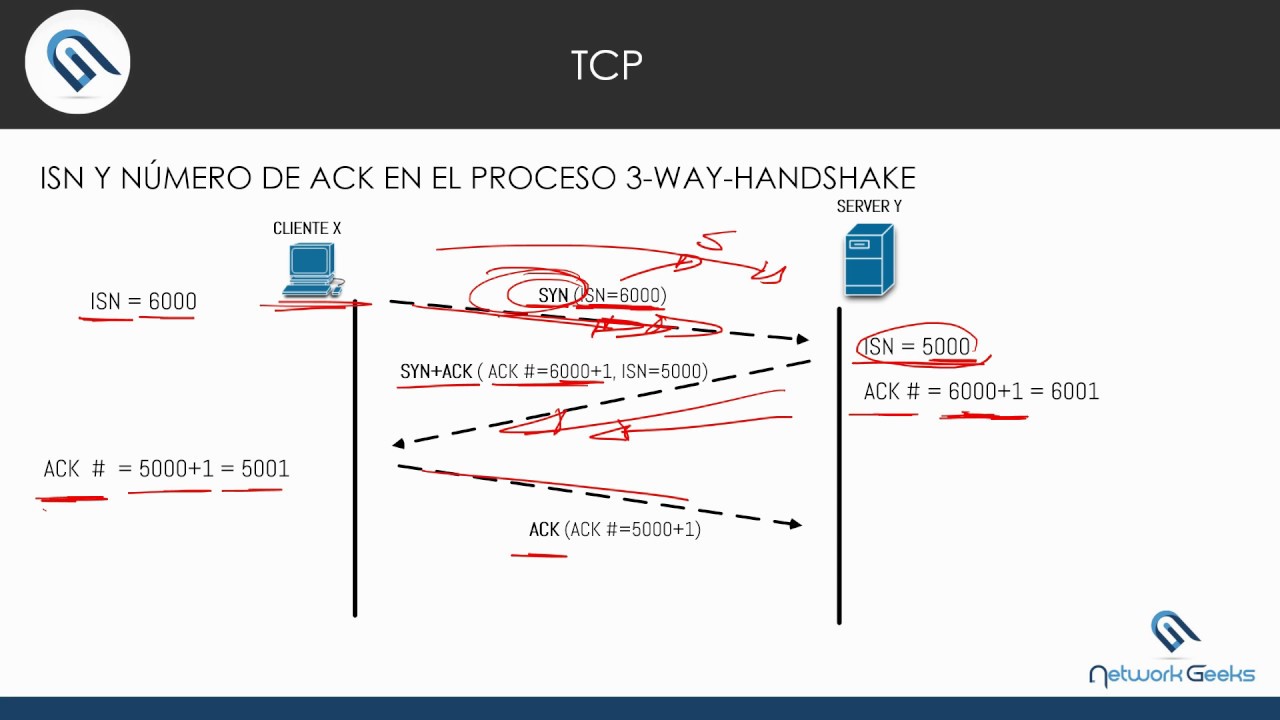
- Devices also pay attention to the Initial Sequence Number (ISN), denoted as 'x,' which aids in tracking communication sequences.
Acknowledgment and Response
- Upon receiving a SYN segment, the server responds with a SYN ACK segment to acknowledge receipt and signal further communication.
- The acknowledgment number (ACK) in TCP headers indicates successful reception of messages; it equals the received initial sequence number plus one.
Connection Establishment Completion
This section explores how connections are finalized after successful acknowledgment between devices.
Finalizing Connection Details
- After exchanging necessary information, such as sequence numbers and acknowledgments, both parties confirm readiness to communicate effectively.
- Once connections are established, data transfer can commence seamlessly between clients and servers for various applications like web page requests.
Understanding TCP Connection Establishment and Sequence Numbers
In this section, the speaker delves into the process of establishing a TCP connection and the significance of sequence numbers in data transmission.
General Purpose of Sequence Numbers
- Sequence numbers represent bytes sent between devices, not individual messages.
- The sequence number corresponds to the first byte of application data in a TCP segment.
Role of Sequence Numbers in Data Transmission
- Each byte in a segment is identified by a sequence number, starting sequentially from an initial value.
- The sequence number field in the TCP header must match the first byte's sequence number for accurate data transmission.
Acknowledgment and Confirmation Process
- Devices confirm receipt of segments using acknowledgment numbers.
- Acknowledgment numbers indicate the next expected sequence number or the last received byte's sequence number plus one.
TCP Segment Structure and Data Transmission
This section explores how TCP segments are structured and transmitted, emphasizing the role of sequence numbers in ensuring data integrity during communication.
Server Response and Segment Formation
- Servers structure segments based on application data bytes, assigning sequential sequence numbers.
- Clients respond with segments containing acknowledgment values matching expected next sequences for successful communication.
Sequential Data Transmission
- Subsequent segments contain increasing sequence numbers for each byte transmitted.
Establishment of Connection Process in Networking
In this section, the process of establishing a connection in networking is discussed, focusing on the initialization of sequence numbers and the transmission of bytes during connection setup.
Initialization of Sequence Numbers
- The bytes sent are stored in a buffer before being transmitted until they are acknowledged.
- During the three-way handshake process, it is crucial to determine from which sequence number the byte counting will commence.
- The initial sequence number is established during the connection setup through a random value.
Transmission and Acknowledgment
- The sender initiates the connection request by sending a message with an initial sequence number (e.g., 6000) to the server.
- Challenges arise when segments exchanged during connection establishment do not contain application data, leading to conceptual issues regarding byte representation by sequence numbers.
- Acknowledgment involves recognizing the reception of segments and responding with appropriate sequence numbers for continued connection establishment.
Conclusion of Connection Establishment
- Once acknowledgment occurs between client and server, both parties establish sequential numbering for data transmission.
- The first real application data sent from client to server carries a specific sequence number (e.g., 6), while data from server to client has its assigned sequence number (e.g., 5001).