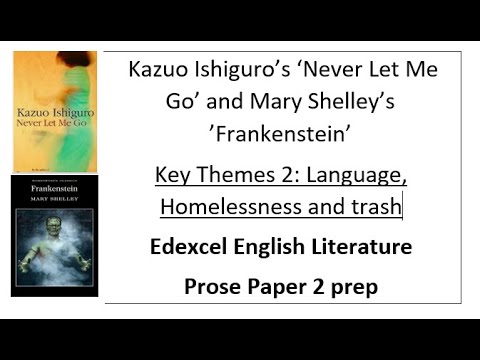
Part 2: Themes of 'Never Let Me Go': Language, homelessness and trash compared with 'Frankenstein'
Language and Humanity in Frankenstein
The creature's language acquisition and understanding of humanity are explored through his observations of the De Lacey family, as well as his interactions with humans.
The Importance of Delacy Family's Language (Chapters 1 & 2)
- The creature learns language by observing the De Lacey family.
- Safie's arrival and education is a surprising example of womanhood in the narrative.
- The students at the cottages also learn language by watching TV and copying behavior.
The Creature's Understanding of Nature and Beauty (Chapter 11)
- The creature has a noble understanding of nature and beauty that suggests he is not a savage.
- His phrasing is much more complex than Frankenstein's, indicating his nobility.
Treatment of the Creature vs. Treatment of Students in Never Let Me Go
- The creature is treated as "other" by humans he encounters, who react with horror to him.
- In Never Let Me Go, students are similarly treated as "other" by society.
- Both narratives explore themes of dignity and humanity.
The Desire to be Normal
This section discusses the desire of characters in various novels to be considered normal and ordinary.
Characters Wanting to be Ordinary
- Characters in novels such as "Never Let Me Go" and "Frankenstein" want to be seen as normal and ordinary.
- They dream of being able to go to work, work in an office, and buy things like humans do.
- They believe that someone might treat them as special if they are seen as ordinary.
- They also desire to be consumers like humans.
Struggling with Human Interaction
This section discusses how characters in various novels struggle with forming human interaction.
Struggles with Human Interaction
- Characters in novels such as "Never Let Me Go" struggle with forming human interaction, resulting in odd conversations.
- They create their own mythologies, such as the terrifying nature of the wood deferrals and the importance of art.
- Similarly, the creature in "Frankenstein" wants a wife because he desires love and normality.
Isolation
This section discusses isolation experienced by characters in various novels.
Types of Isolation
- Characters experience different types of isolation: alienation from themselves and others, isolation within society or outside society, and isolation despite looking the same.
- In "Never Let Me Go," physical isolation is also present when characters move from Hill Shum to freezing cold cottages.
Homelessness
This section discusses homelessness as a literal and metaphorical idea in various novels.
Homelessness
- Characters in novels such as "Never Let Me Go" and "Frankenstein" are homeless, seeking out places to sleep or avoiding going home.
- Cathy in "Wuthering Heights" feels most at home with rubbish, while the creature seeks out a hut or hobble.
The Idea of Tommy and Normalcy
In this section, the speaker talks about the idea of normalcy and how it is defined in the novel. They also discuss the character's desire to bring back something lost.
The Fantasy of Tommy
- The speaker describes a fantasy where they stand in front of a field waiting for a tiny figure to appear on the horizon.
- The figure turns out to be Tommy, who would wave at them.
- This fantasy never goes beyond that point.
Defining Normalcy
- The speaker discusses how "normal" is used multiple times in the novel.
- They question who defines normal and what we are supposed to be doing as humans.
- They reference page 65 where Norfolk is discussed in geography, which leads to a discussion on trying to bring back something lost.
Value and Trash
In this section, the speaker talks about how characters in the novel view themselves as being made from trash. They also discuss various references throughout the book that relate to value and self-worth.
Aligning with Trash
- The speaker notes that characters align themselves with trash because they are made from it.
- They reference chapter four of Frankenstein where bits of dead bodies are sewn together from various sources such as graveyards and convict furnaces.
- This aligns with their view that if you want to look for possibilities, you should look in the gutter or rubbish bins.
Lack of Value
- The speaker notes several references throughout the book where characters don't value themselves or talk themselves down.
- These include pages 105, 129, 221, and 282.
- Tommy even says his art is rubbish.
Overall, the speaker discusses the themes of normalcy, value, and trash in the novel. They reference specific pages and chapters to support their points.
Turn any video into a summary like this
YouTube links, meetings, lectures. With transcripts, search, and chat.