Megaconstrucciones El Tunel Del Canal De La Mancha
The Channel Tunnel: A Modern Marvel
Overview of the Channel Tunnel Construction
- The Channel Tunnel is an extraordinary engineering feat, described as one of the seven wonders of the modern world, taking seven years to construct and requiring a million tons of concrete.
- It connects Great Britain and France, spanning 34 kilometers across the English Channel, which is twice as wide as the Grand Canyon.
- Historical tensions between Britain and France created controversy over building a tunnel to unite former enemies; however, economic incentives for increased trade were compelling.
Agreement and Excavation Initiation
- In 1986, British Prime Minister Margaret Thatcher and French President François Mitterrand agreed to build the tunnel with a budget of €4.5 billion funded through private financing.
- Excavation began in December 1987 with two teams—one British and one French—each consisting of 4,000 workers competing to reach the midpoint under the channel first.
Team Dynamics and Challenges
- The British team was composed of elite tunnelers known as "the Tigers of the Tunnel," emphasizing teamwork led by chief engineer Gordon Crayton.
- The French team consisted mainly of unskilled local laborers who were trained for this monumental project, expressing pride in their involvement.
Technical Specifications and Safety Measures
- The project involved excavating two main railway tunnels plus a central service tunnel equivalent to a four-lane highway width, totaling approximately 153 kilometers.
- Essential safety features included 245 emergency cross-passages and ventilation systems designed to manage pressure from high-speed trains.
Advanced Technology Utilized
- Workers faced significant challenges including digging beneath 100 meters of water and rocky seabed while managing noise and dust levels during excavation.
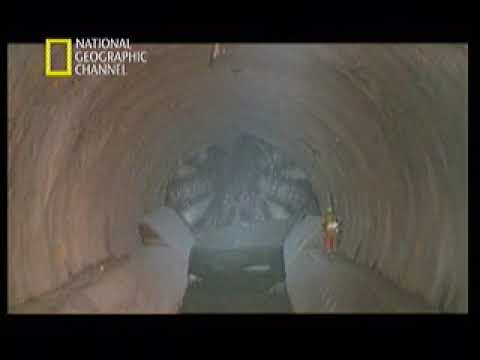
- Advanced tunneling machines (TBMs), measuring 200 meters long and weighing 11,000 tons each, played a crucial role in creating tunnels efficiently.
Tunneling Process Explained
- TBMs operate by rotating through soil while simultaneously constructing support structures around them; they are self-sufficient with energy sources for repairs on-site.
- Twelve TBMs worked continuously around-the-clock; each machine could excavate up to ten tons of rock per rotation at costs reaching €15 million per unit.
Competitive Edge Between Teams
Tunnel Construction Challenges
The Role of British Tunnel Boring Machines
- British tunnel boring machines (TBMs) gained a speed advantage, leading to the daily dispatch of hundreds of concrete slabs for tunnel reinforcement.
- These slabs were not ordinary; they used a special granite mix, making them three times heavier than family cars and more durable than those used in nuclear reactors.
Engineering Constraints and Financial Pressures
- Chief engineer Crayton faced strict deadlines with nearly €20 billion funded by private sources, leaving no room for government subsidies on delays.
- The excavation cost was €1.5 million per day, translating to €60,000 for every hour of delay.
Alignment and Safety Concerns
- Maintaining alignment between the two tunnels was crucial; any deviation could endanger lives.
- Engineers feared that if the tunnels did not meet correctly at the midpoint under the English Channel, it would necessitate last-minute trajectory corrections.
Precision in Tunnel Trajectory
- A straight path was essential for high-speed trains operating safely within the tunnel.
- The allowable margin of error was only 2.5 meters; straying from this could lead to catastrophic flooding or tunnel collapse.
Geological Studies and Surveying Techniques
Initial Surveying Challenges
- In August 1986, surveyor Eric Tracklive began plotting the tunnel route, aware of its complexity over a distance of 34 km.
- Traditional surveying methods became impractical underground where visibility is limited to rock walls.
Complications in Underground Navigation
- Unlike surface roads that allow movement in two dimensions, tunnels require navigation through a three-dimensional space with multiple potential failure points.
Geological Analysis as a Solution
- To maintain trajectory accuracy, surveyors relied on geological data from various soil and rock strata along the proposed route.
Finding Suitable Rock Strata
Identifying Ideal Conditions for Tunneling
- Geologists sought impermeable rock types that could withstand flooding while remaining stable during excavation.
Successful Discovery of Blue Chalk
- They identified blue chalk as an ideal drilling material due to its water-resistant properties and structural integrity.
Complex Drilling Operations
Tunnel Construction Challenges
Geological Considerations and Risks
- Geologists determined that blue chalk would mark a feasible route through the channel, but mistakes could lead to disasters if machines penetrated wet zones.
- By spring 1988, tunnel boring machines (TBMs) were advancing deeper under the sea, equipped with laser guidance systems to mitigate flooding risks.
- Unlike surface projects where lasers guide forward, TBMs used lasers to scan backward for continuous position comparison against planned coordinates.
- The laser system is crucial for monitoring TBM positions; it informs operators of necessary adjustments in real-time as they progress further from land.
Working Conditions and Safety Measures
- As the tunnel extended underwater, working conditions worsened; workers faced long commutes and hazardous environments requiring respirators due to toxic gases.
- A massive ventilation system was essential for maintaining breathable air at great depths while managing increasing heat levels.
Unexpected Water Ingress
- By March 1988, unexpected water ingress occurred in the British side's service tunnel, halting construction and causing panic among engineers.
- Urgent investigations revealed that seawater was flooding the tunnel at alarming rates, leading to fears of catastrophic structural failure.
Structural Integrity Concerns
- Engineers discovered that seawater entering the tunnel posed severe risks due to immense pressure from above; this situation required immediate action to prevent disaster.
- Water began leaking forcefully through cracks in the ceiling, threatening structural integrity as rocks fell into the tunnel.
Mitigation Strategies and Ongoing Challenges
- Chief engineer Creighton had to find ways to seal leaks or face potential catastrophe; previous geological studies failed to predict fractures in rock layers.
- Despite identifying an impermeable layer of blue chalk, unforeseen faults complicated tunneling efforts significantly.
Crisis Management and Adaptation
- Creighton successfully mitigated disaster by sealing cracks and replacing concrete supports with stronger wrought iron alternatives.
- Tensions remained high as new leaks continued appearing during excavation; electrical short circuits caused further delays amid rising costs exceeding millions of euros.
Comparative Experiences: French Team's Preparedness
- The French team also encountered water issues but had prior warnings about fractures on their side of the project.
Tunnel Construction: The Race Between France and Britain
Initial Challenges in Tunnel Construction
- Workers faced difficult conditions with water leaks and rock falls while hoping for better circumstances ahead. They protected the tunnel boring machines with a type of armor and continued their work.
- After nine months, the British team reached drier ground, increasing pressure to catch up with their rivals. The soil conditions improved, allowing for faster progress.
- Despite advancements of up to 400 meters per week, the British faced a supply issue; if they ran out of concrete slabs, excavation would halt, costing millions daily.
Intensifying Competition
- Both French and British teams had been drilling for two years. As they moved further from their coasts, competition intensified to meet at the midpoint of the Channel Tunnel.
- The British were recovering from earlier setbacks but needed more than speed; a parallel operation was crucial to supply necessary materials like concrete.
- A total of 750,000 concrete slabs were required for tunnel lining. Each slab weighed as much as a small truck.
Supply Chain Issues
- Special trains continuously transported concrete slabs from Britain to the coast but faced storage challenges due to steep cliffs limiting space on the English side.
- As excavation progressed rapidly, storage space dwindled. Without adequate storage for concrete slabs, operations would be halted.
Innovative Solutions
- To address storage issues caused by rapid tunneling without sufficient concrete lining, an innovative idea emerged: using waste material generated by tunneling.
- Approximately 36,000 tons of earth and rock waste produced daily could be used to extend England's coastline and create new storage areas.
Historic Milestone in Tunneling
- This plan resulted in reclaiming about 36 hectares (68 football fields), solving the storage problem effectively.
- As both sides approached each other underground after three years of work on a 37-kilometer tunnel, engineers were anxious about meeting precisely at the center point.
The Moment of Connection
- Upon reaching what they believed was the meeting point first, British engineers discovered air flowing through a small hole—indicating proximity to their French counterparts.
- A historic moment occurred when Graham Farrer became the first person to step into France through this newly created passageway after thousands of years.
Celebrating Success Amidst Competition
- Farrer humbly noted that his achievement was part of a larger team effort despite being recognized as a significant milestone in connecting Britain with mainland Europe after 13 millennia.
- Surveyors celebrated as both tunnels aligned almost perfectly—only deviating by 35 centimeters over an extensive distance—a remarkable feat in engineering history.
Conclusion: The Outcome of Rivalry
- Although Britain won this race in tunneling construction against France, logistical challenges awaited them post-completion regarding machinery disposal once operations ceased.
- If roles had reversed at completion time with France arriving first at the junction point, they would have had to wait for Britain's arrival due to equipment limitations on both sides.
The Emotional Journey of the Channel Tunnel Construction
The Beginning of a Historic Project
- The construction of the Channel Tunnel was an emotional experience for workers, particularly when parting with their machines. Seeing the French tunneling machine buried was a rare sight.
- Workers excavated hundreds of connecting passages and drilled air pressure ducts, completing caverns to cross tunnels. By May 1991, the tunnel was finally excavated.
Significance and Challenges
- The completion marked a historic moment; Napoleon had previously attempted to build a tunnel but failed. This project symbolized a united Europe.
- Despite success in excavation, delays escalated costs from €1.9 billion to €3 billion as construction on transport networks began after tunnellers left.
Infrastructure Development
- The project required extensive infrastructure: 195 km of railway tracks and a massive cooling system equivalent to 250,000 domestic refrigerators were needed for high-speed trains.
- Investors faced disappointment as costs soared due to delays; by May 6, 1994, Queen Elizabeth II and President Mitterrand inaugurated the tunnel one year late.
Financial Struggles
- Total costs reached €15 billion—enough to launch 33 space rockets—making it the largest privately funded project ever. However, initial operations struggled financially.
- Initially limited to transporting trucks, passenger services took six months to commence despite faster travel times compared to ferries.
Crisis Point: The Fire Incident
- High-interest rates and competition led to increased debt for the tunnel company. In November 1996, economic results turned negative just after opening.
- A severe incident occurred when train number 7539 approached the tunnel carrying an incendiary load—a burning truck that posed significant danger.
Emergency Response and Aftermath
- Passengers aboard experienced panic as smoke filled their compartment while firefighters prepared for an unprecedented fire scenario within the confined space of the tunnel.
- Rescuers faced immense challenges; escaping through emergency exits became nearly impossible due to thick smoke obscuring visibility.
Tunnel Fire Incident and Rescue Operations
Identification of the Fire
- Controllers identify a hot zone within the tunnel using fire sensors, suspecting it to be related to an incendiary train incident.
Emergency Response Initiatives
- Remote operation opens the nearest crossing door; controllers communicate with French firefighters directing them through the central emergency tunnel towards door 4 101, believed to be closest to the passenger carriage.
Escalation of Danger
- Explosions occur in the tunnel as truck tires burst; temperatures soar up to 1000 degrees Celsius, melting steel wheels and compromising concrete tunnel linings.
Miscommunication in Rescue Efforts
- Firefighters arrive at door 4 101 only to find no train present, realizing they are at the wrong location. The chances of rescuing passengers alive diminish as flames spread rapidly.
Passenger Struggles for Survival
- Trapped 19 km inside the tunnel, 31 passengers await rescue amidst smoke. Flames approach dangerously close while firefighters search in vain at an incorrect section.
Desperate Escape from Flames
The Decision to Evacuate
- Passengers discover a bubble of clean air amid smoke and decide it's their only chance for survival. They leave their carriage into a hellish environment filled with flames.
Harrowing Journey Through Smoke
- For seven minutes, passengers navigate blindly through thick smoke, struggling with red eyes and burning lungs until they finally reach an open passageway.
Rescue and Aftermath
Successful Rescue Operation
- At 10:24 PM, after enduring intense conditions for over 40 minutes since the fire started, passengers reunite with firefighters. Miraculously, there are no fatalities reported despite severe circumstances.
Reflection on Safety Measures
- The incident serves as a stark reminder of underground emergency dangers; urgent safety reviews lead to improved fire sensors and emergency lighting systems post-event.
Impact on Channel Tunnel Operations
Recovery and Future Prospects
- By 1999, over five million vehicles crossed through the Channel Tunnel; nearly seven million people traveled between London and Paris via high-speed trains that significantly reduced travel time.
Legacy of Construction Challenges
- Despite challenges like debt and disasters during construction (11 lives lost), engineers view the tunnel as a lasting tribute to those who built it—an engineering marvel connecting nations historically divided.
Personal Reflections from Engineers